

On this page
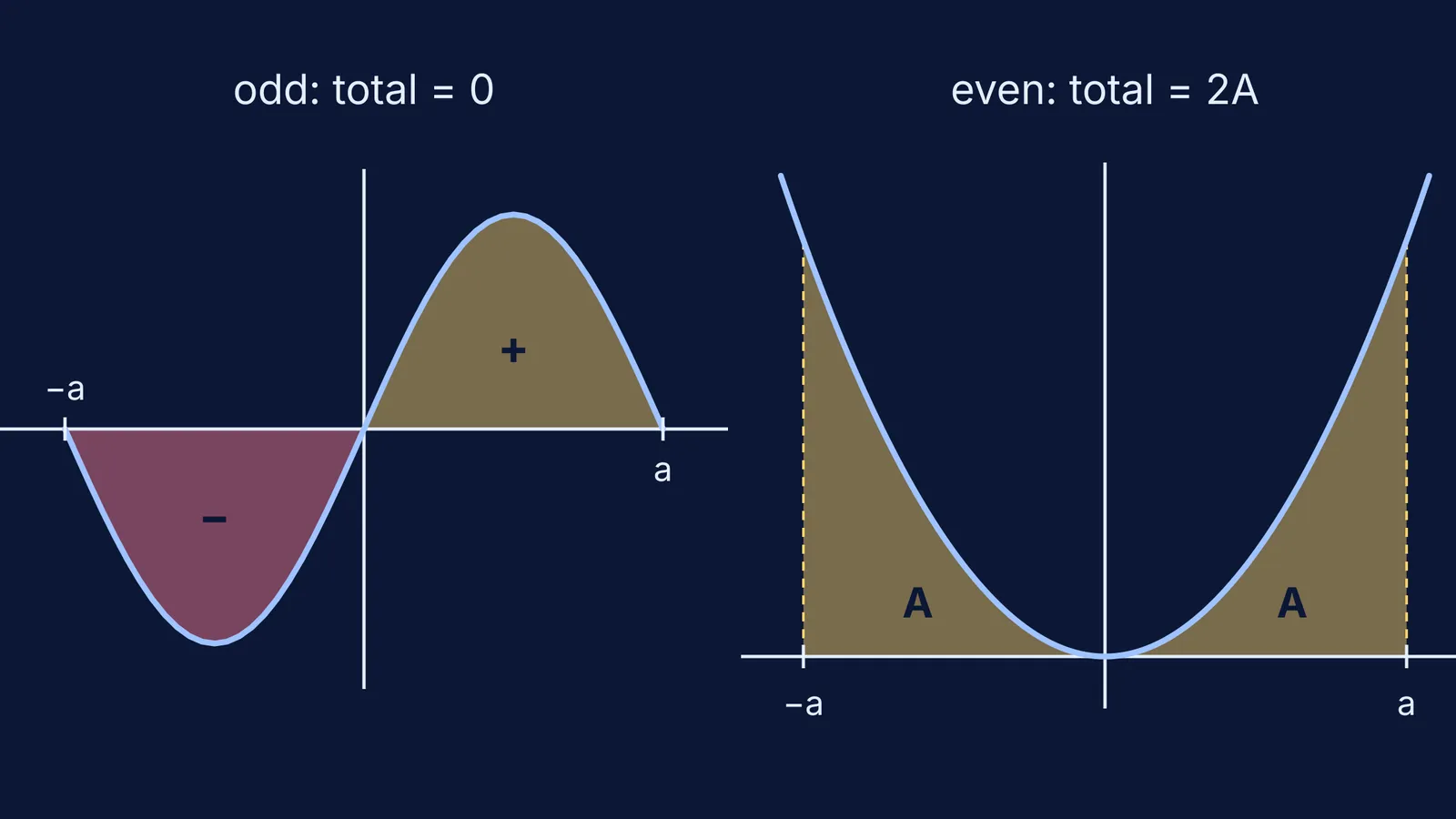
Picture sin x between −π and π. To the right of zero the curve rises above the axis in one hump. To the left you get the same hump, flipped upside down. Add the signed areas and they cancel. That picture is the whole shortcut.
Why is the integral of an odd function from −a to a zero?
A function is odd when f(−x) = −f(x) for every x in its domain, so its graph is symmetric about the origin, as OpenStax Calculus Volume 1 defines it.
A definite integral adds up signed area: above the x-axis counts as positive, below as negative. For an odd function, a thin strip at x = t above the axis has a twin at x = −t that is just as tall but below it. From −a to a, the twins pair off and the total is zero. OpenStax says such integrals are zero "because the areas above and below the x-axis are equal".
The NCERT Class 12 Mathematics Part II textbook proves it as property P7: split at 0, put t = −x in the left half, and it becomes −∫₀ᵃ f(x) dx, cancelling the right half.
What happens with an even function?
An even function satisfies f(−x) = f(x), so its graph is symmetric about the y-axis (OpenStax). Now the twin strips share height and sign, so the halves are equal: ∫ from −a to a of f(x) dx = 2∫₀ᵃ f(x) dx. NCERT's Example 29 uses this: because sin²x is even, it rewrites the integral from −π/4 to π/4 as twice the integral from 0 to π/4.
Try it: sketch y = x³ and y = x², shade both from −1 to 1, and colour the parts below the axis differently. The Fermi Simulation Lab has interactive simulations for the ideas that are easier to see than to read.
How can you predict the answer before calculating?
Run this check every time you see limits from −a to a:
Check the limits are symmetric about 0.
Replace x with −x in the integrand. If the whole expression changes sign, it is odd and the answer is 0.
If the expression stays exactly the same, it is even, so double the integral from 0 to a.
If it is neither, split it: f(x) = [f(x) + f(−x)]/2 + [f(x) − f(−x)]/2. The second part is odd and integrates to zero.
Parity multiplies like signs: odd × odd and even × even are even, while odd × even is odd. So x, x³, sin x and tan x are odd, and x², cos x, |x| and constants are even. For practice, see our guide to periodic, even and odd functions.
How does this trick work on JEE-style questions?
Example 1. ∫ from −1 to 1 of sin⁵x cos⁴x dx. Replace x with −x: sin⁵x flips sign and cos⁴x does not, so the integrand is odd and the answer is 0. This is NCERT's Example 31.
Example 2. ∫ from −1 to 1 of (x³ + 3x² + x cos x) dx. Here x³ is odd, x cos x is odd × even and so odd, and 3x² is even. Only 3x² survives: 2∫₀¹ 3x² dx = 2[x³]₀¹ = 2.
Example 3, the disguised one. I = ∫ from −π/2 to π/2 of sin²x/(1 + eˣ) dx. The integrand is neither even nor odd. Replace x with −x and it becomes ∫ sin²x · eˣ/(eˣ + 1) dx over the same limits. Add the two versions and the fractions combine to 1: 2I = ∫ from −π/2 to π/2 of sin²x dx = 2∫₀^(π/2) sin²x dx = π/2. So I = π/4. In general, for any even f, the integral of f(x)/(1 + eˣ) from −a to a equals ∫₀ᵃ f(x) dx.
If a symmetry question goes wrong and you can't see why, the Fermi Problem Library has worked problems with a step-by-step solver that explains the reasoning rather than printing an answer.
When does the shortcut fail?
Limits that are not symmetric: ∫ from −1 to 2 of x³ dx = (16 − 1)/4 = 15/4, not 0. Only the piece from −1 to 1 cancels.
A function that breaks inside the interval: 1/x is odd, but ∫ from −1 to 1 of dx/x is not 0. It has no value at all, because the integral is improper and does not converge. NCERT notes that f must be well defined and continuous on the interval (NCERT Class 12, Chapter 7).
A question asking for area, not the integral. Where the curve crosses the axis, you split the interval and take the modulus, as in definite integrals with modulus and floor.
For a related shortcut that repeats one period instead of cancelling two halves, see integrating over n periods. Next time you see limits from −a to a, try the x → −x test first.


