

On this page
In Class 11 trigonometry, cos(A + B) is the formula most others come from: exact values, double angles, sum-to-product and the sine formula. Here is how each works, with examples you can check.
What is the cos(A + B) formula?
The formula is cos(A + B) = cos A cos B − sin A sin B, listed as identity 3 in section 3.4 of the NCERT Class 11 Mathematics chapter on trigonometric functions. NCERT proves it on the unit circle by showing two chords are equal and writing both lengths with the distance formula.
Replacing B by −B gives cos(A − B) = cos A cos B + sin A sin B, because cos(−B) = cos B and sin(−B) = −sin B. Both signs appear in one line as equation 4.21.3 of NIST's Digital Library of Mathematical Functions.
How do you find cos 75° and cos 15° exactly?
Write each angle as a sum or difference of 30°, 45° and 60°, then substitute values you already know.
cos 75° = cos(45° + 30°) = cos 45° cos 30° − sin 45° sin 30°
= (1/√2)(√3/2) − (1/√2)(1/2) = (√3 − 1)/(2√2)
Multiply top and bottom by √2: cos 75° = (√6 − √2)/4 ≈ 0.2588
cos 15° = cos(45° − 30°) = (1/√2)(√3/2) + (1/√2)(1/2) = (√3 + 1)/(2√2) = (√6 + √2)/4 ≈ 0.9659
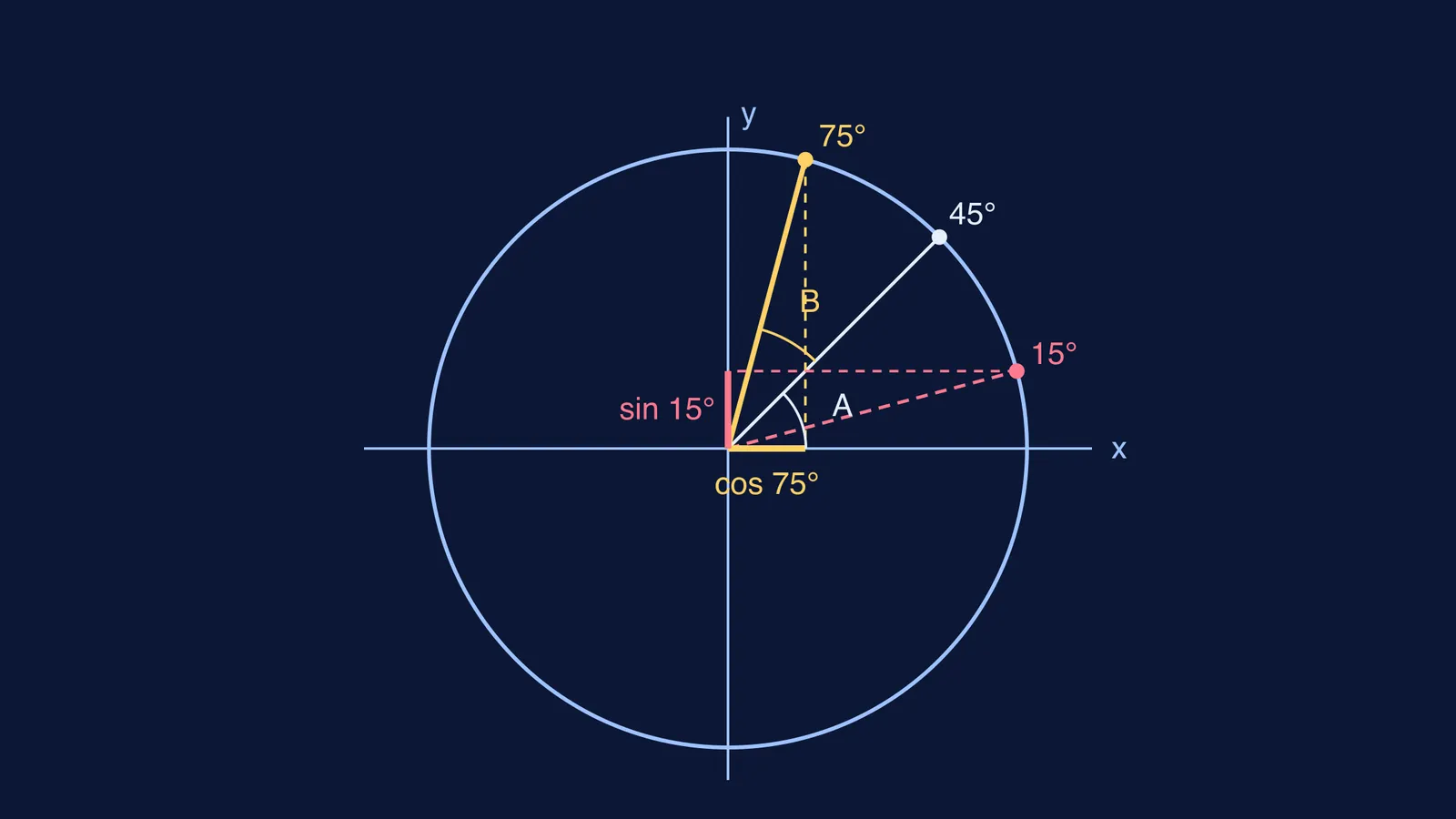
Cross-check with a second route: cos 75° = sin 15°, since 75° and 15° are complementary. The NCERT chapter works out sin 15° in its Example 11 and gets (√3 − 1)/(2√2), which matches line 2 above. The diagram at the top shows the same fact: the yellow length on the x-axis and the pink length on the y-axis are equal.
How do you get the sin(A + B) formula from cos(A + B)?
NCERT's derivation in section 3.4 runs in three moves:
Put A = π/2 into cos(A − B) to get cos(π/2 − x) = sin x.
Write sin(x + y) = cos((π/2 − x) − y).
Expand with cos(A − B): cos(π/2 − x) cos y + sin(π/2 − x) sin y = sin x cos y + cos x sin y.
So sin(A + B) = sin A cos B + cos A sin B, and replacing B by −B gives sin(A − B) = sin A cos B − cos A sin B. The sine formula keeps its sign and mixes the functions. The cosine formula flips the sign and pairs like with like. Once you have both, tan(A + B) follows by dividing one by the other. We use it in finding tan(A + B) when tan A and tan B are roots of a quadratic.
How is cos(A + B) used to prove identities?
Put B = A and you get cos 2A = cos² A − sin² A, which is identity 14 in the NCERT chapter. Add the expansions of cos(A + B) and cos(A − B) and you get 2 cos A cos B, the starting point for the sum-to-product formulas.
Here is a worked proof of a standard identity: show that cos(A + B) cos(A − B) = cos² A − sin² B.
Expand both brackets: (cos A cos B − sin A sin B)(cos A cos B + sin A sin B).
That is a difference of squares: cos² A cos² B − sin² A sin² B.
Write cos² B = 1 − sin² B and sin² A = 1 − cos² A.
You get cos² A − cos² A sin² B − sin² B + cos² A sin² B.
The middle terms cancel, leaving cos² A − sin² B.
Test it with A = 60° and B = 30°: the left side is cos 90° cos 30° = 0, and the right side is 1/4 − 1/4 = 0. After any identity proof, plug in one pair of angles like this. If the two sides disagree, a sign slipped somewhere.
A five-step checklist for any cos(A + B) question
Split the angle into standard angles: 75° = 45° + 30°, 105° = 60° + 45°, 15° = 45° − 30° or 60° − 45°.
Write the formula with the sign flip before you substitute anything.
Substitute the exact values and simplify. Rationalise only at the end.
Check against a calculator decimal.
Cross-check through a complement, such as cos 75° = sin 15°.
If you get stuck on step 3 or 5, the Fermi Problem Library has worked problems with a step-by-step solver that explains the reasoning rather than printing an answer. If the gap is earlier, for example you don't remember why cos(−B) = cos B, the Fermi Concept Library has a lesson for each concept in mathematics. Write your own proof first, then learn to check an AI's proof of a trigonometric identity line by line.


