

On this page
You have sin 7x + sin 5x in front of you and no obvious next step. Sum to product formulas turn that sum into 2 sin 6x cos x, and a product is something you can cancel, factor or set equal to zero. Here are the four formulas, three signals for using them, and two problems that fall apart once you do.
What are the sum to product formulas?
The NIST Digital Library of Mathematical Functions lists the four identities as equations 4.21.6 to 4.21.9 (DLMF §4.21):
sin A + sin B = 2 sin((A+B)/2) cos((A−B)/2)
sin A − sin B = 2 cos((A+B)/2) sin((A−B)/2)
cos A + cos B = 2 cos((A+B)/2) cos((A−B)/2)
cos A − cos B = −2 sin((A+B)/2) sin((A−B)/2)
The NCERT Class 11 mathematics textbook derives the same four in Section 3.4 of its Trigonometric Functions chapter, by adding and subtracting the formulas for cos(x ± y) and sin(x ± y) and then putting x + y = θ and x − y = φ (NCERT Class 11 Mathematics, Chapter 3). Do that derivation once yourself, so you never have to trust a half-remembered sign in an exam. Every formula has the same shape: half the sum, half the difference.
When should you use sum to product formulas?
Reach for them when you see two sines or two cosines added or subtracted and you need a product. Watch for three signals:
A fraction of sums. Products cancel; sums do not. NCERT's Example 16 proves (cos 7x + cos 5x)/(sin 7x − sin 5x) = cot x this way: the top becomes 2 cos 6x cos x, the bottom becomes 2 cos 6x sin x, and cos 6x cancels (NCERT, Chapter 3).
An equation equal to zero. A product equal to zero splits into two easy equations. A sum does not.
Three or more terms with evenly spaced angles. Pair the outer two so that their half-sum matches the middle angle, then take out the common factor.
Skip them when the expression is already a product (go the other way, with the product to sum formulas for 2 sin A cos B), or when you have sin x + cos x, which the form R sin(x + α) handles more cleanly.
How do you solve sin x + sin 5x = sin 3x?
Pair the outer terms, because (x + 5x)/2 = 3x matches the right side: sin 5x + sin x = 2 sin 3x cos 2x.
Rewrite the equation: 2 sin 3x cos 2x − sin 3x = 0.
Factor: sin 3x (2 cos 2x − 1) = 0.
First factor: sin 3x = 0 gives 3x = nπ, so x = nπ/3.
Second factor: cos 2x = 1/2 gives 2x = 2nπ ± π/3, so x = nπ ± π/6, where n is any integer.
The mistake to avoid is dividing both sides by sin 3x. That throws away the whole family x = nπ/3. Factor, never divide.
If you keep losing solutions this way, the Fermi Problem Library has worked problems with a step-by-step solver that explains the reasoning rather than printing an answer, so you can find the step where your method went wrong.
How do sum to product formulas collapse a series?
Here the formulas work in both directions. Take S = sin x + sin 2x + … + sin nx.
Multiply every term by 2 sin(x/2). The product to sum rule 2 sin A sin B = cos(A − B) − cos(A + B), equation 4.21.15 in the DLMF, turns term k into cos((k − ½)x) − cos((k + ½)x).
Add the terms. Each negative piece cancels the positive piece of the next term, so only cos(x/2) − cos((n + ½)x) survives.
Turn that difference back into a product with the cos A − cos B formula: 2 sin((n + 1)x/2) sin(nx/2).
So S = sin(nx/2) sin((n + 1)x/2) / sin(x/2), whenever sin(x/2) ≠ 0. Check n = 1: you get sin x.
Given sin x + sin y and cos x + cos y, the same formulas give the half-angle: see finding the half-angle from given sums of sines and cosines.
Where do sum to product formulas show up in physics?
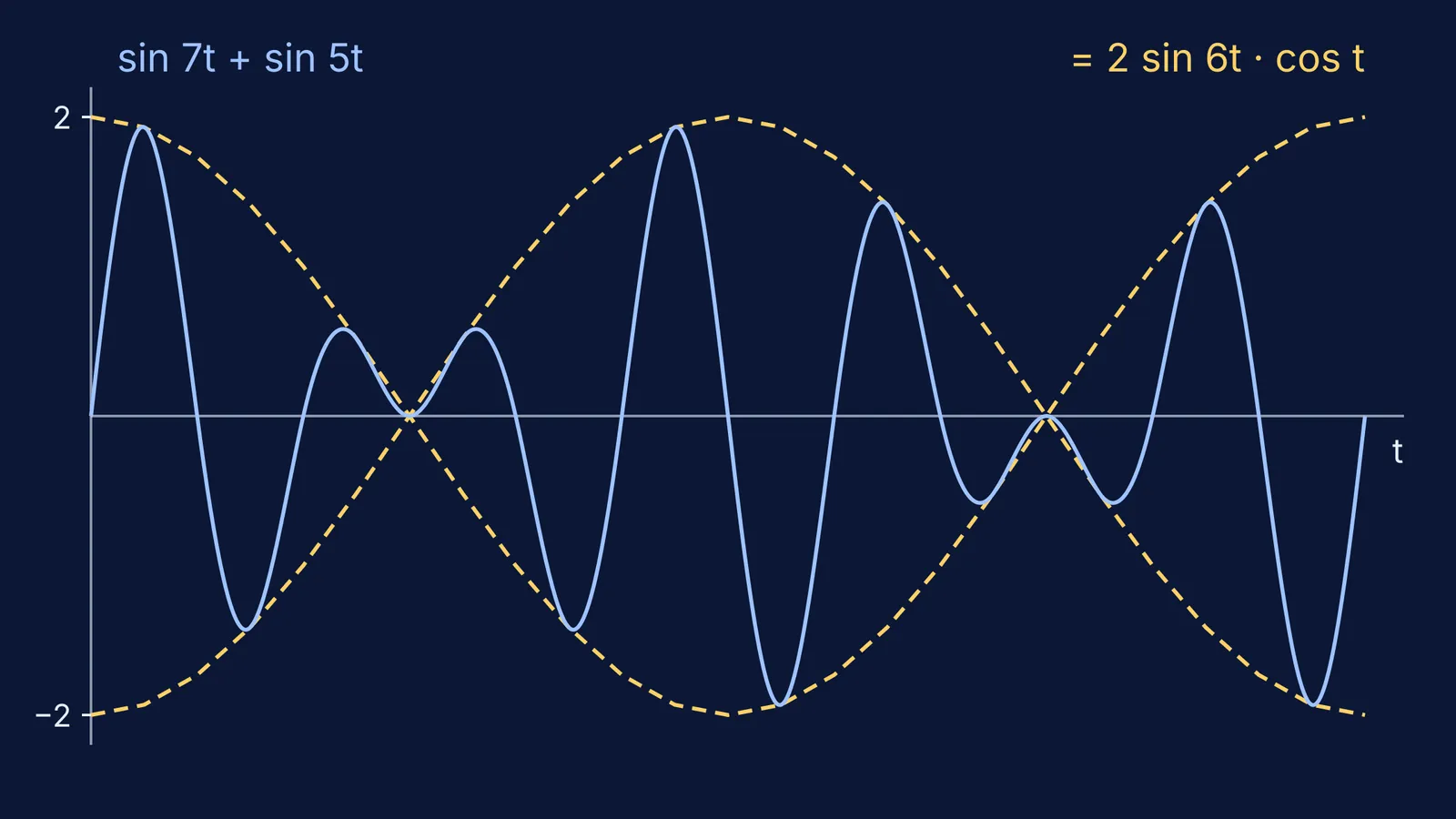
Write sin 7t + sin 5t as 2 sin 6t cos t and you see a fast wave inside a slow envelope. That is what you hear as beats when two notes are close in pitch: the beat frequency equals the difference between the two frequencies (HyperPhysics, Beats). The loudness peaks twice in every cycle of the slow cosine, which is why the beat frequency is the full difference and not half of it. You can try this in the beats simulation with two close frequencies.
Before your next test, write the four formulas from memory, derive one from cos(x + y), and solve one equation by factoring. If a step still feels shaky, the Fermi Concept Library gives each mathematics concept its own lesson and shows its place in the map.


