

On this page
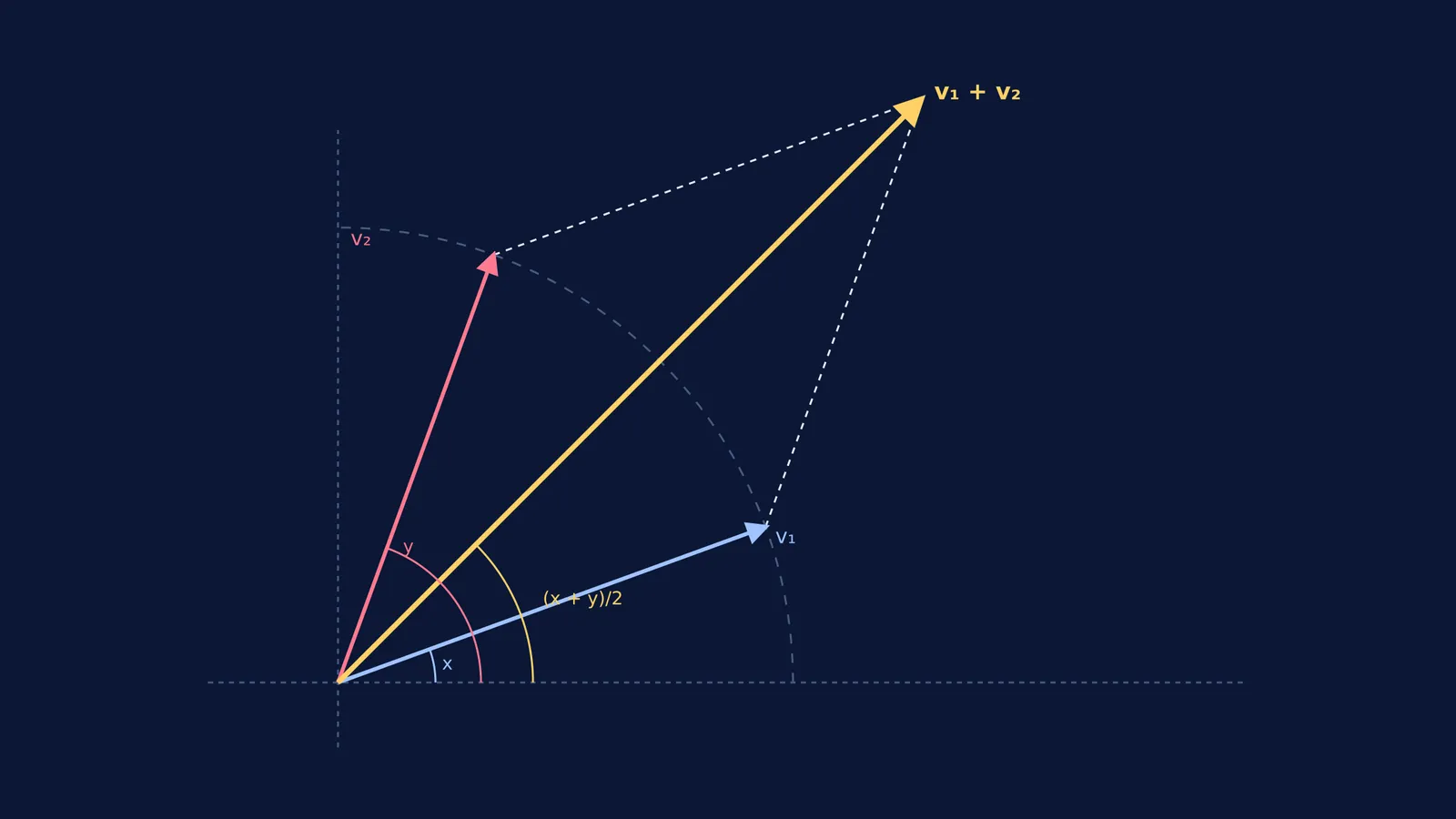
In short: When given sin x + sin y = a and cos x + cos y = b, you can divide their sum-to-product forms to find tan((x + y)/2) = a/b. This classic trick bypasses finding the individual angles and is a staple in the JEE Main, which over 1.41 million students took in 2024.
It is one of the most common setups in trigonometry problems: you are handed the sums of sines and cosines of two unknown angles and asked to find the sine or cosine of their sum.
If you try to solve for x and y individually, you will hit a wall. The trick is to treat the two equations as a system, convert the sums into products, and extract the half-angle. This method is a favourite of examiners testing if a student can manipulate identities under pressure. In 2024, 1,415,110 unique candidates appeared for the JEE Main, and problems like this frequently decide who clears the mathematics cut-off.
Why does this trigonometry problem come up so often?
You start with the given system of equations: sin x + sin y = a cos x + cos y = b
The immediate next step is to apply the sum-to-product identities to the left side of both equations. These identities convert the sum of two trigonometric functions into a product involving their half-sum and half-difference: sin x + sin y = 2 sin((x + y)/2) cos((x - y)/2) cos x + cos y = 2 cos((x + y)/2) cos((x - y)/2)
Substitute these back into the original system:
2 sin((x + y)/2) cos((x - y)/2) = a
2 cos((x + y)/2) cos((x - y)/2) = b
How do you find the half-angle?
Notice that both equations now share a common factor: 2 cos((x - y)/2). If you divide the first equation by the second, this entire term cancels out, leaving only the sine and cosine of the half-angle.
Dividing equation 1 by equation 2 gives: [ 2 sin((x + y)/2) cos((x - y)/2) ] / [ 2 cos((x + y)/2) cos((x - y)/2) ] = a / b
This simplifies beautifully to: tan((x + y)/2) = a / b
How do you find cos(x + y) and sin(x + y)?
Once you have the tangent of the half-angle, you can find any trigonometric ratio of the full angle (x + y) using the standard double-angle formulas expressed in terms of tangent.
To find cos(x + y), use the identity: cos(x + y) = (1 - tan²((x + y)/2)) / (1 + tan²((x + y)/2))
Substitute tan((x + y)/2) = a/b: cos(x + y) = (1 - (a/b)²) / (1 + (a/b)²) cos(x + y) = (b² - a²) / (b² + a²)
Similarly, to find sin(x + y), use: sin(x + y) = 2 tan((x + y)/2) / (1 + tan²((x + y)/2)) sin(x + y) = 2(a/b) / (1 + (a/b)²) sin(x + y) = 2ab / (b² + a²)
A worked example
Suppose you are given: sin x + sin y = 1 cos x + cos y = √3
Using our derived formula, we first find the tangent of the half-angle. Here, a = 1 and b = √3. tan((x + y)/2) = 1 / √3
This tells us that the half-angle (x + y)/2 is 30° (or π/6 radians). Therefore, the sum of the angles x + y is 60° (or π/3 radians).
If the problem asks for cos(x + y), you can calculate it directly: cos(60°) = 1/2
Alternatively, using the formula (b² - a²) / (b² + a²): cos(x + y) = ( (√3)² - 1² ) / ( (√3)² + 1² ) cos(x + y) = (3 - 1) / (3 + 1) cos(x + y) = 2 / 4 = 1/2
Both methods yield the same correct result.
If you are staring at a trigonometric identity and cannot spot the next step, Fermi's AI tutor can work out what you already know and build a plan for the session. Sometimes, walking through the algebra line by line is what it takes to make the pattern click. For practice on similar manipulations, the Fermi Problem Library has worked problems with a step-by-step solver that explains the reasoning rather than printing an answer.
For more practice with trigonometric transformations, read how to simplify cos A cos 2A cos 4A products using the sine doubling trick, or how to set up conditional identities when A + B + C = π.


