

On this page
The question gives a quadratic whose roots are tan A and tan B and asks for tan(A + B). You never need to solve it. The sum and product of the roots plus the tangent addition formula do the work. The follow-up asking for sin(A + B) or cos(A + B) is where sign slips happen.
What do Vieta's relations give when tan A and tan B are roots?
For ax² + bx + c = 0 with roots r₁ and r₂, Vieta's formulas say that r₁ + r₂ = −b/a and r₁r₂ = c/a. They are named after the French mathematician François Viète (1540–1603).
The tangent addition formula, as stated in NCERT's Class 11 chapter on trigonometric functions, is tan(x + y) = (tan x + tan y)/(1 − tan x tan y).
Put the two roots in:
tan(A + B) = (−b/a)/(1 − c/a) = −b/(a − c) = b/(c − a).
This needs a ≠ c. If a = c, then tan A tan B = 1, A + B is an odd multiple of 90°, tan(A + B) is undefined and cos(A + B) = 0.
To run the same relations in reverse, see writing a quadratic from the sum and product of its zeros.
Worked example: tan A and tan B are roots of 2x² − 7x + 3 = 0
Here a = 2, b = −7 and c = 3.
Sum: tan A + tan B = 7/2.
Product: tan A tan B = 3/2.
tan(A + B) = (7/2)/(1 − 3/2) = (7/2)/(−1/2) = −7.
Shortcut check: b/(c − a) = −7/(3 − 2) = −7.
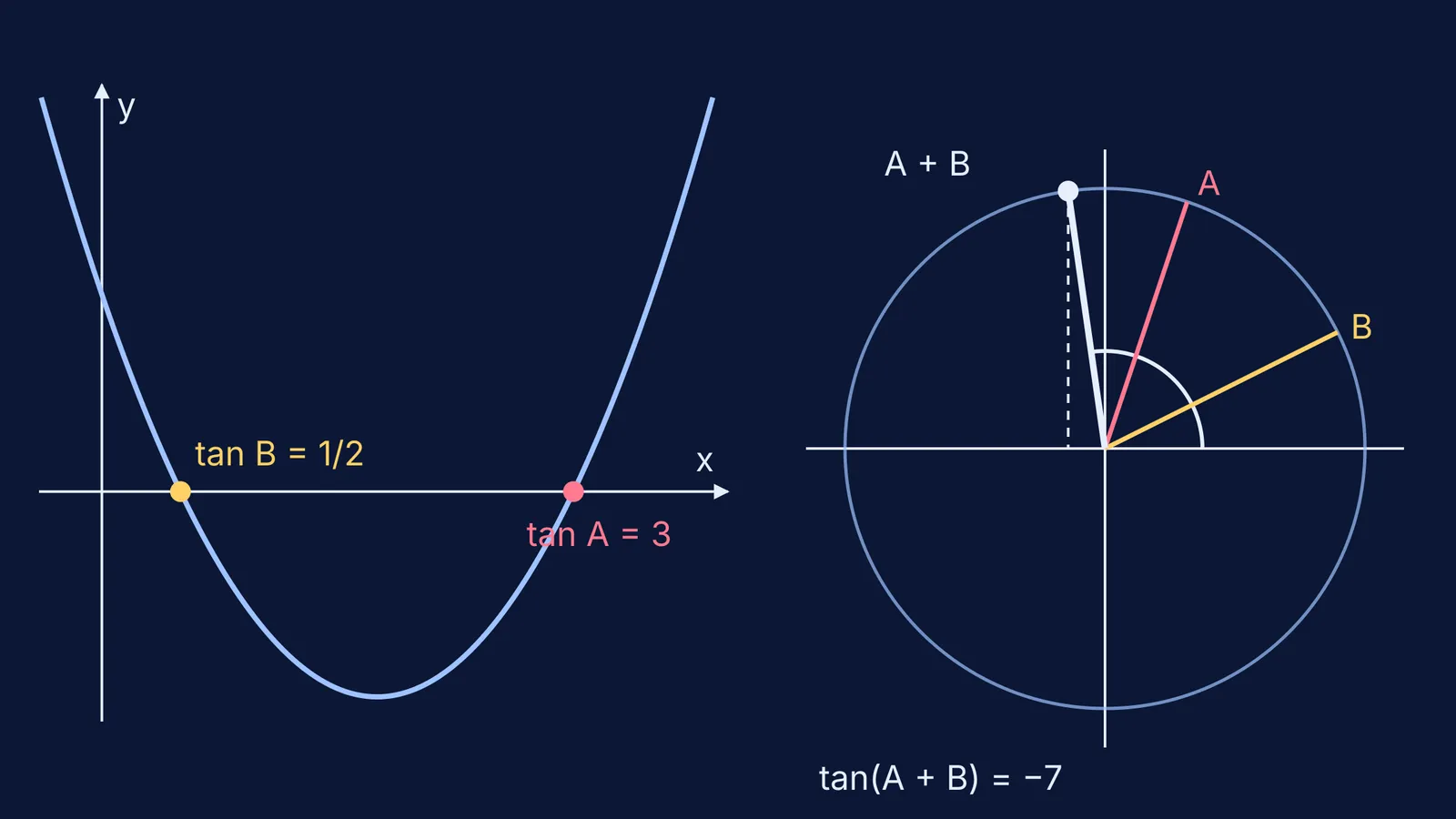
Factorising, (2x − 1)(x − 3) = 0, confirms the roots are 1/2 and 3, as the diagram at the top shows.
How do you find sin(A + B) and cos(A + B) from tan(A + B)?
Let t = tan(A + B). The identity 1 + tan² x = sec² x, from the same NCERT trigonometry chapter, gives cos²(A + B) = 1/(1 + t²) and sin²(A + B) = t²/(1 + t²).
With t = −7, cos²(A + B) = 1/50 and sin²(A + B) = 49/50.
The squares are safe; the signs are not. Tangent repeats every 180°, so tan(A + B) = −7 fits the second quadrant or the fourth. If the question says A and B are acute, then 0° < A + B < 180°, and a negative tangent puts A + B in the second quadrant: sin(A + B) = 7/√50 and cos(A + B) = −1/√50. With no stated range, give both sign choices.
Double angles avoid the problem. NCERT's identities sin 2x = 2 tan x/(1 + tan² x) and cos 2x = (1 − tan² x)/(1 + tan² x) give sin 2(A + B) = −7/25 and cos 2(A + B) = −24/25 with no quadrant decision.
Why does a sin²(A + B) + b sin(A + B) cos(A + B) + c cos²(A + B) equal c?
Call this expression E and take out cos²(A + B):
E = cos²(A + B) × (at² + bt + c), where t = b/(c − a).
The bracket simplifies to c[b² + (c − a)²]/(c − a)², and cos²(A + B) = 1/(1 + t²) = (c − a)²/[(c − a)² + b²]. Multiply, and everything cancels except c.
Check on the example: sin² = 49/50, sin × cos = t cos² = −7/50 and cos² = 1/50, so E = (98 + 49 + 3)/50 = 3, which is c. The product sin × cos depends only on t, so no quadrant is needed. When a = c, E = a sin²(A + B) = a = c, so the result still holds.
For the sister problem, see the condition when sin θ and cos θ solve a quadratic. If the addition formula feels like pure memorisation, the single rectangle that proves the sin(A + B) formula shows where it comes from.
What should you check before writing the final answer?
Write sum = −b/a and product = c/a before anything else.
Check whether a = c. If it does, A + B is an odd multiple of 90°.
Compute tan(A + B) = b/(c − a), and verify it once with the long formula.
For sin or cos, find the squares first, then pick the sign from the stated range of A and B.
For a mixed expression in sin², sin cos and cos², factor out cos² and turn it into a polynomial in tan.
If your number is right but the sign is wrong, the slip is in step 4. The Fermi Problem Library has worked problems with a step-by-step solver that explains the reasoning rather than printing an answer, so you can see where a quadrant was chosen. To revise the identities behind each step, the Fermi Concept Library gives every mathematics concept its own lesson.


