

On this page
If you are preparing for exams like JEE Main or NEET-UG, the list of trigonometric identities can seem endless. It is easy to forget whether sin(A + B) has a plus or a minus sign in the middle, or whether it mixes sine and cosine. Instead of relying on rote memorisation, you can derive the addition formulas yourself using a single rectangle.
What is the proof of the sin(A + B) formula?
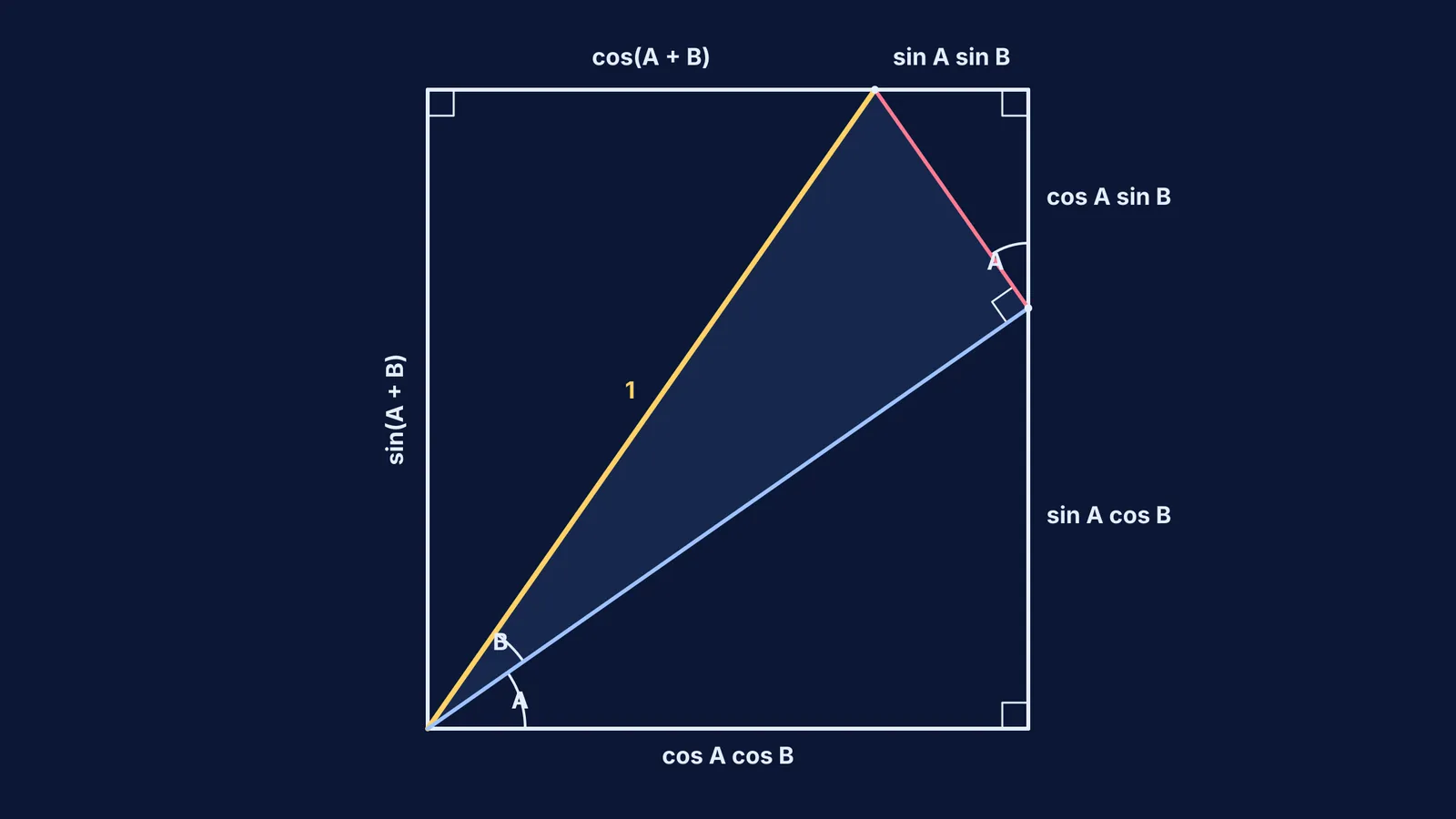
The geometric proof relies on building a rectangle around a set of right-angled triangles. If you draw a right-angled triangle with a hypotenuse of 1 and an angle A + B, the side opposite to the angle is exactly sin(A + B).
By breaking that angle into two smaller angles, A and B, and enclosing the figure in a rectangle, the length of that opposite side forms the left side of the rectangle. The right side is split into two distinct segments. As shown in the diagram above, the geometry reveals exactly what those segments are:
The top part has a length of cos A sin B.
The bottom part has a length of sin A cos B.
Since the total length of the left side of the rectangle is sin(A + B), and the right side is formed by these two smaller segments stacked on top of each other, their lengths must be equal.
This gives the standard addition formula directly: sin(A + B) = sin A cos B + cos A sin B
How do you find the side lengths of the smaller triangles?
If you are wondering where expressions like cos A sin B come from, it helps to break the diagram down into its three component right-angled triangles.
First, look at the main central triangle. Its hypotenuse is defined as 1, and its angle is B. Using basic SOH CAH TOA definitions, the side opposite to angle B must have a length of 1 × sin B = sin B. The side adjacent to angle B must have a length of 1 × cos B = cos B. These two sides now become the hypotenuses for the two other triangles in the diagram.
Next, examine the bottom-right triangle. Its hypotenuse is the adjacent side of the central triangle, which we just found to be cos B. The angle at the origin for this bottom triangle is A. Therefore, its vertical side (opposite to A) is the hypotenuse multiplied by sin A, giving sin A cos B. Its horizontal side (adjacent to A) is the hypotenuse multiplied by cos A, giving cos A cos B.
Finally, look at the top-right triangle. A quick geometric check involving parallel lines reveals that the angle between its vertical side and its hypotenuse is A. The hypotenuse of this triangle is the opposite side of the central triangle, which is sin B. Therefore, the vertical side (adjacent to angle A) is cos A sin B, and the horizontal side (opposite to angle A) is sin A sin B.
By methodically working through each triangle, every segment of the rectangle's boundary is accounted for. This structured approach builds your confidence in geometric problem-solving.
How do you find cos(A + B) from the same diagram?
The beauty of the rectangle proof is that it gives you the cosine addition formula for free. You do not need a new diagram; you just look at the horizontal sides of the same rectangle.
The total width of the rectangle at the bottom is cos A cos B. The top of the rectangle is split into two parts by the tip of the triangle:
The first segment, equal in length to the adjacent side of the main angle, is cos(A + B).
The extra segment jutting out to complete the rectangle has a length of sin A sin B.
Because the top and bottom sides of a rectangle are equal in length, you can set them equal to each other: cos(A + B) + sin A sin B = cos A cos B
Rearranging this equation gives you the cosine rule: cos(A + B) = cos A cos B - sin A sin B
From this one sketch, you can recover the foundational formulas for trigonometry. If you need sin(A - B), you simply substitute -B into the equation and remember that cosine is an even function while sine is an odd function.
Why does drawing diagrams beat rote memorisation?
When you sit in an exam hall, stress can make you doubt a formula you have read a hundred times. However, if you know the geometric argument, you can rebuild the equation from scratch in seconds.
This approach is an example of active learning. A landmark 2014 meta-analysis published in the Proceedings of the National Academy of Sciences looked at STEM education and found that undergraduate students in traditional lecture courses were 55% more likely to fail than those in active learning environments. Deriving the math yourself engages your brain far more deeply than reading a textbook chapter.
When you are stuck on a physics or maths problem because you cannot remember the formula, the Fermi Concept Library can help you step back. Fermi's AI tutor works through derivations alongside you, drawing the figures and checking your understanding as it goes, so you build the intuition instead of just memorising the final line.
Explore more mathematical derivations:


