

On this page
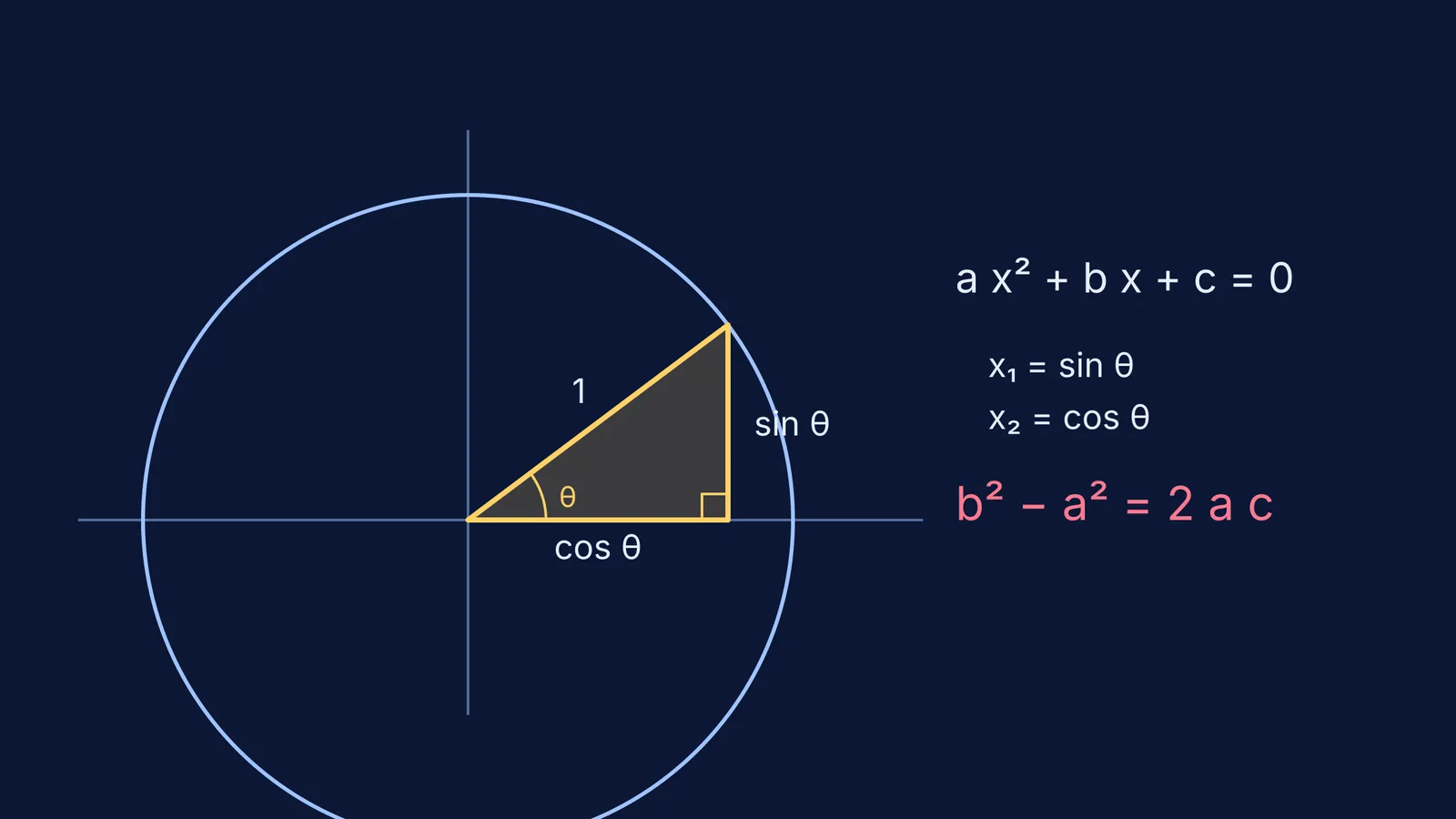
Often in JEE Main mathematics, problems connect trigonometry to algebra to test your fluency across different topics. A classic trap asks you to find a relation between the coefficients a, b, and c of a quadratic equation ax² + bx + c = 0 if its two roots are sin θ and cos θ.
If you try to solve for the roots directly using the quadratic formula, you end up with a messy expression involving square roots and the coefficients. Setting this equal to sin θ and cos θ rarely leads to a clear path forward. Instead of finding the roots directly, the standard approach relies on evaluating the sum and product of the roots.
How do Vieta's formulas connect the roots?
According to Vieta's formulas (Wolfram MathWorld), the roots of any polynomial are directly related to its coefficients. For a standard quadratic equation ax² + bx + c = 0, the sum of the roots is equal to −b/a, and the product of the roots is equal to c/a.
Since we know our roots are exactly sin θ and cos θ, we can write out the two relations:
Sum of roots: sin θ + cos θ = −b/a
Product of roots: (sin θ)(cos θ) = c/a
These symmetric equations give us two solid pieces of algebraic information without needing to evaluate the individual roots. This is exactly the same strategy you would use when you are asked to evaluate symmetric functions of roots such as α² + β² or α³ + β³. By keeping the roots grouped together as a sum and a product, you avoid the messy square roots of the discriminant entirely.
How do we derive the condition?
Our goal is to eliminate the angle θ entirely to find a clean mathematical condition purely in terms of the coefficients a, b, and c. The key to making the trigonometric terms disappear is to lean on the fundamental Pythagorean identity: sin² θ + cos² θ = 1.
We can force this identity to appear by squaring the sum of the roots. Start with the sum equation: sin θ + cos θ = −b/a
Now, square both sides of the equation: (sin θ + cos θ)² = (−b/a)²
Expand the left side using the standard algebraic expansion (x + y)² = x² + y² + 2xy: sin² θ + cos² θ + 2 sin θ cos θ = b²/a²
At this stage, you can substitute the known identity sin² θ + cos² θ = 1, and you can also replace the product term (sin θ)(cos θ) with c/a: 1 + 2(c/a) = b²/a²
To clear the fractions and write the equation in a linear format, multiply every term by a²: a² + 2ac = b²
Rearranging this gives the final standard condition: b² − a² = 2ac
How does this help solve exam problems?
In competitive exams, you might be given an equation with an unknown variable, like 2x² + kx + 1 = 0, and told that its roots are sin θ and cos θ. Instead of working backwards through the quadratic formula, you can immediately apply the condition.
Here, the coefficients are a = 2, b = k, and c = 1. Substitute these values straight into b² − a² = 2ac: k² − 2² = 2(2)(1) k² − 4 = 4 k² = 8 k = ±√8
This provides the possible values for k in just four lines of working. Just as you might apply the discriminant test for positive quadratics or test whether two quadratics share a root, knowing this specific condition saves you from following time-consuming dead ends.
Are there hidden constraints on the roots?
Finding the value of b² − a² = 2ac is the main step, but you must also remember the natural limits of sine and cosine. Both sin θ and cos θ must lie in the closed interval [−1, 1].
Because of this, their product must also obey strict limits. We know that 2 sin θ cos θ is equal to sin 2θ, which means the product 2(c/a) must also lie between −1 and 1. Therefore, the ratio c/a must fall between −1/2 and 1/2. If a proposed equation gives a product outside this range, the roots cannot be a valid sine and cosine pair, even if the main condition holds.
If you struggle to spot which algebraic tools to use in trigonometry problems, the Fermi Problem Library can help. Rather than just handing you the final condition, Fermi's AI tutor works through the algebra with you step by step, ensuring you understand the boundaries and helping you learn to look for the squaring trick yourself.


