On this page
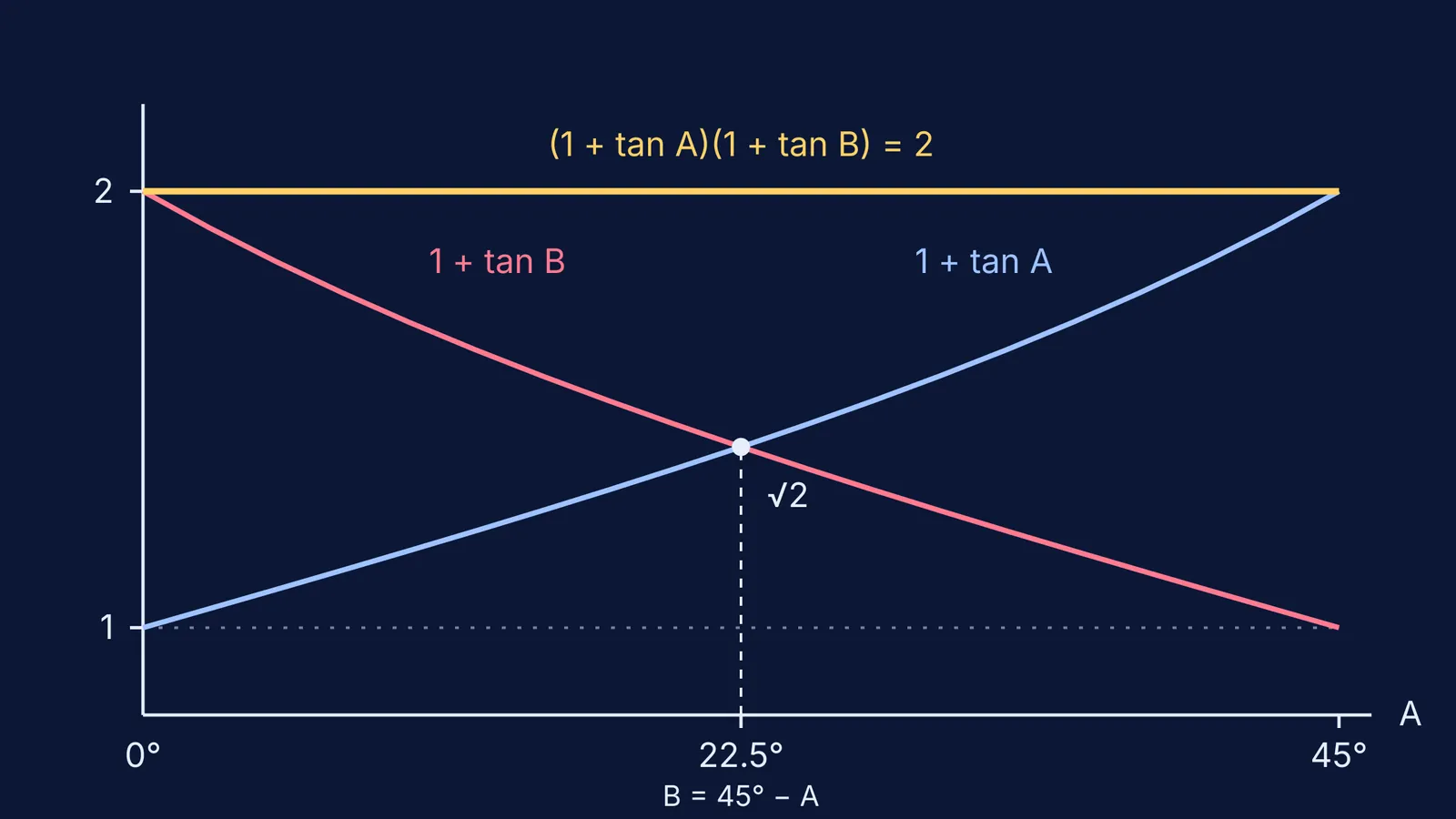
This is a standard Class 11 trigonometry question, usually asked as "if A + B = 45°, find (1 + tan A)(1 + tan B)". The answer is always 2, as long as tan A and tan B are defined. Once you see why, a 44-factor product shrinks to a few lines.
What is the tan(A + B) formula?
The NCERT Class 11 chapter on trigonometric functions states that if none of x, y and x + y is an odd multiple of π/2, then tan(x + y) = (tan x + tan y)/(1 − tan x tan y) (NCERT Class 11 Mathematics, Chapter 3, identity 10). The same chapter's table of values gives tan(π/4), that is tan 45°, as 1.
If you want to see where the formula comes from, our post on using compound angle formulas to find sin 15° and tan 75° works through it with exact values.
If A + B = 45°, how do you prove (1 + tan A)(1 + tan B) = 2?
Write p = tan A and q = tan B to keep things short.
Since A + B = 45°, tan(A + B) = tan 45° = 1.
By the formula, (p + q)/(1 − pq) = 1.
Cross-multiply: p + q = 1 − pq.
Rearrange: p + q + pq = 1.
Add 1 to both sides: 1 + p + q + pq = 2.
The left side factorises: (1 + p)(1 + q) = 2.
The whole proof rests on step 5: p + q + pq is one short of a product of two brackets, so adding 1 completes the factorisation.
How do you find (1 + tan 1°)(1 + tan 2°)…(1 + tan 44°)?
Pair each angle with the one that makes 45° with it.
1° and 44°
2° and 43°
3° and 42°
and so on, down to 22° and 23°
The angles 1° to 44° split into 22 such pairs, and no angle is left over, because 45° cannot be split into two equal whole-degree angles. Each pair multiplies to 2, so the product is 2²², which is 4,194,304.
Variations change the count, so count before you write the power.
Going up to 45°: the extra factor is 1 + tan 45° = 2, so the product becomes 2²³.
A middle term: with half-degree steps you meet 22.5°, which pairs with itself. Setting A = B = 22.5° gives (1 + tan 22.5°)² = 2, so 1 + tan 22.5° = √2 and tan 22.5° = √2 − 1, a neat way to get that value.
Fewer factors: (1 + tan 5°)(1 + tan 40°)(1 + tan 10°)(1 + tan 35°) has two pairs, so it equals 4.
The same pairing idea runs through our post on sin² 5° + sin² 10° + … + sin² 90° and the complementary pairing trick. There the angles pair to 90°; here they pair to 45°.
Does it work the other way, and what about cot?
Yes, with one care point. If (1 + tan A)(1 + tan B) = 2, then reversing the steps gives tan(A + B) = 1, which means A + B = 45° + n × 180° for an integer n, not only 45°. In questions about acute angles, that leaves 45°.
Two cousins come from the same idea:
When A + B = 135°: tan(A + B) = −1, which leads to p + q = pq − 1, and then (1 − tan A)(1 − tan B) = 2.
The cot version: when A + B = 45°, the NCERT formula cot(A + B) = (cot A cot B − 1)/(cot B + cot A) equals 1, and the same steps give (cot A − 1)(cot B − 1) = 2.
If you want more practice moving between tan A, tan B and tan(A + B), try our post on finding tan(A + B) when tan A and tan B are the roots of a quadratic.
Common mistakes to avoid
Writing tan(A + B) = tan A + tan B. Tan is not additive. tan 20° + tan 25° is about 0.830, not 1.
Miscounting pairs. List the first and last pairs, then count. 1° to 44° gives 22 pairs; 1° to 45° gives 22 pairs plus a 2.
Forgetting the condition. The formula needs none of A, B and A + B to be an odd multiple of 90°. Say so in a proof.
If you get stuck halfway through a proof like this, the Fermi Problem Library has worked problems with a step-by-step solver that explains the reasoning rather than printing an answer. If the gap is in the formula itself, the Fermi Concept Library gives each mathematics concept its own lesson and shows its place in the map.
Next time you see a long product of 1 + tan terms, add the angles in pairs before you calculate anything.