On this page
Integrals such as ∫x√(x + 1) dx and ∫x/√(2x + 3) dx turn up often in Class 12 integration practice. No standard formula fits them, because the x outside the root gets in the way. One substitution fixes both: call the whole root t. Below: two worked examples, a definite integral and a four-line recipe for any root of a linear expression.
Why put t² = ax + b instead of u = ax + b?
Both are legal uses of the same rule. OpenStax Calculus Volume 1, section 5.5 states it as Theorem 5.7: if u = g(x), then ∫f(g(x))g′(x)dx = ∫f(u)du = F(g(x)) + C.
The difference is what comes after. In its Example 5.33, OpenStax integrates x/√(x − 1) with u = x − 1 and gets (2/3)(x − 1)^(3/2) + 2(x − 1)^(1/2) + C, working with half powers throughout. With t² = ax + b, √(ax + b) is simply t, every term becomes a whole power of t, and you integrate a polynomial. Fewer fractional exponents means fewer places to drop a factor of 2 or 3 under exam pressure.
The set-up to memorise:
t² = ax + b, with t ≥ 0, so √(ax + b) = t
x = (t² − b)/a
2t dt = a dx, so dx = (2t/a) dt
How do you integrate x√(x + 1) by substitution?
Here a = 1 and b = 1.
Put t² = x + 1. Then x = t² − 1, dx = 2t dt and √(x + 1) = t.
Rewrite: ∫x√(x + 1) dx = ∫(t² − 1) · t · 2t dt = ∫(2t⁴ − 2t²) dt.
Integrate: (2/5)t⁵ − (2/3)t³ + C.
Put t back: (2/5)(x + 1)^(5/2) − (2/3)(x + 1)^(3/2) + C.
If you take out (2/15)(x + 1)^(3/2) as a common factor, this becomes (2/15)(x + 1)^(3/2)(3x − 2) + C, a tidier form of the same answer.
How do you integrate x/√(2x + 3)?
Now a = 2, b = 3 and the root is in the denominator. The t from dx cancels the t from the root.
Put t² = 2x + 3. Then x = (t² − 3)/2 and 2t dt = 2 dx, so dx = t dt.
Rewrite: ∫x/√(2x + 3) dx = ∫[(t² − 3)/2] · (1/t) · t dt = (1/2)∫(t² − 3) dt.
Integrate: t³/6 − 3t/2 + C.
Put t back and tidy: (2x + 3)^(3/2)/6 − (3/2)√(2x + 3) + C = (1/3)(x − 3)√(2x + 3) + C.
An easy slip here is writing dx = 2t dt out of habit from the first example. Always differentiate t² = ax + b afresh: the a matters.
For the related family where a linear factor sits outside the root in the denominator, see how to integrate 1/((px + q)√(ax + b)) and its three cousins.
What happens to the limits in a definite integral?
Change them with the substitution, and you never go back to x. OpenStax gives this as Theorem 5.8 in the same section: with u = g(x), the integral from a to b becomes the integral from g(a) to g(b) in u.
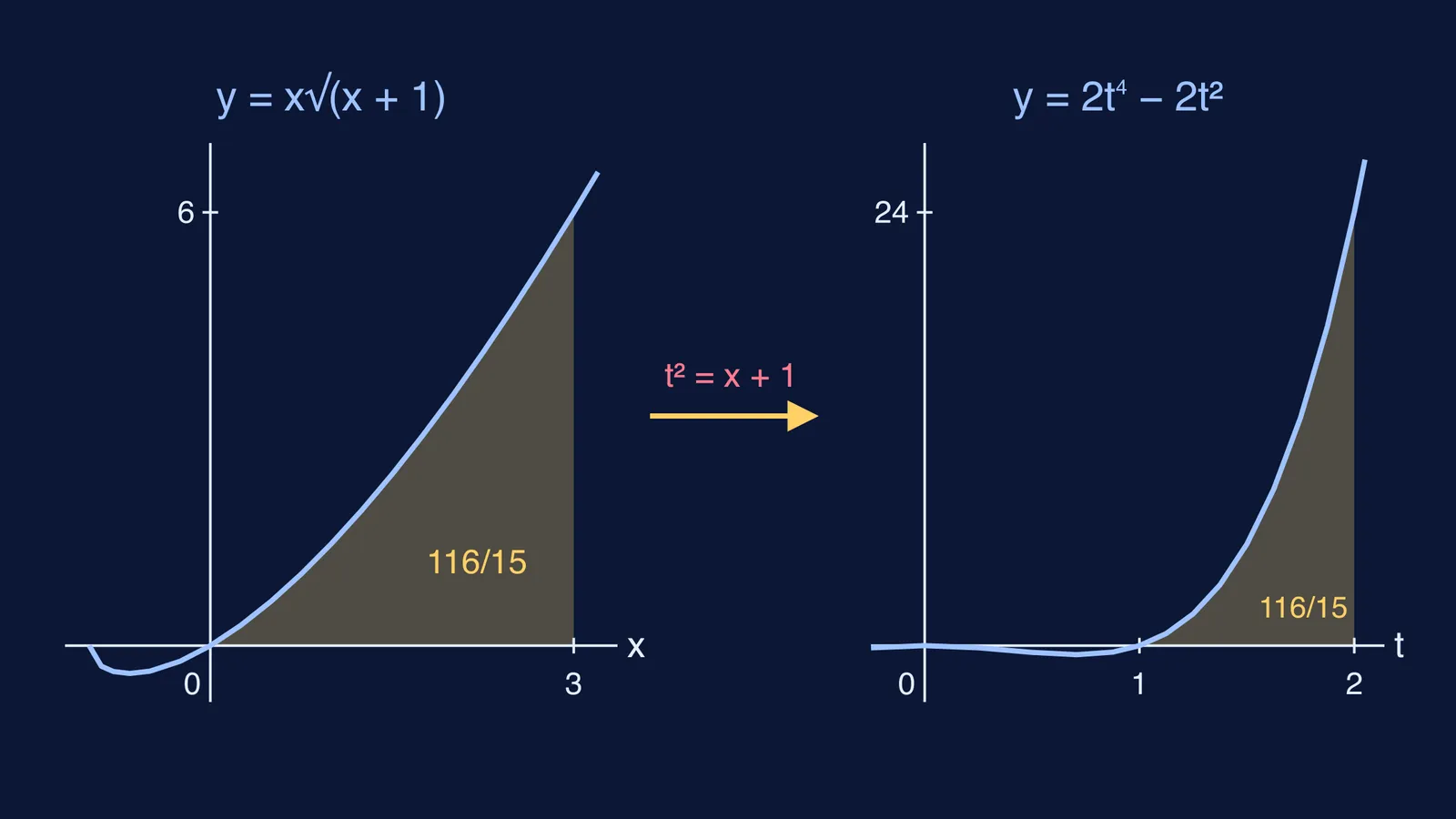
Take ∫x√(x + 1) dx from x = 0 to x = 3. With t² = x + 1 and t ≥ 0, x = 0 gives t = 1 and x = 3 gives t = 2. So the integral is ∫(2t⁴ − 2t²) dt from 1 to 2, which is (2/5)(32 − 1) − (2/3)(8 − 1) = 62/5 − 14/3 = 116/15. The picture at the top shows both shaded areas: different curves, same 116/15. More in our post on changing limits in definite integrals.
A four-line recipe for any √(ax + b)
Use this when the only root is √(ax + b) and the rest is a polynomial in x.
Write t² = ax + b and solve for x.
Differentiate: 2t dt = a dx. Write dx in terms of t and dt.
Replace √(ax + b) with t and every x with (t² − b)/a. Simplify to a polynomial (or a simple fraction) in t.
Integrate, then either put t = √(ax + b) back or, for a definite integral, use the new limits.
If you find the right substitution but lose the answer in the algebra, the Fermi Problem Library has worked problems with a step-by-step solver that explains the reasoning rather than printing an answer. If substitution itself still feels shaky, the Fermi Concept Library gives every mathematics concept its own lesson, including the chain rule that substitution comes from. Whatever tool gives you an answer, check it by differentiating before you trust it.