

On this page
An integral like ∫dx/((x+3)√(x+1)) looks stuck because of the square root. One substitution clears it. The same idea covers four forms, written ∫dx/(P√Q), where P and Q are each linear or quadratic in x. The goal every time is the one stated in this guide to integrating irrational functions: pick a substitution that turns the integrand into a rational function of the new variable.
How do you integrate 1/((px+q)√(ax+b))?
Put ax + b = t². Then x = (t² − b)/a and dx = (2t/a) dt, while px + q becomes (pt² + aq − bp)/a. Substitute and the t from dx cancels the t from the root:
∫dx/((px+q)√(ax+b)) = 2∫dt/(pt² + aq − bp)
Now look at the sign of (aq − bp)/p.
If it is positive, you get an arctan, using ∫dt/(t² + k²) = (1/k) arctan(t/k).
If it is negative, you get a log, using ∫dt/(t² − k²) = (1/2k) ln|(t − k)/(t + k)|.
If aq − bp = 0, P is just a multiple of Q, and the integral is a plain power of (ax + b).
Worked example. Find ∫dx/((x+3)√(x+1)). Here a = 1, b = 1, p = 1, q = 3, so aq − bp = 2. Put x + 1 = t², so dx = 2t dt and x + 3 = t² + 2. The integral becomes 2∫dt/(t² + 2) = √2 arctan(t/√2). Put t back: the answer is √2 arctan(√(x+1)/√2) + C.
Which substitution should you use for each form?
Look at Q, the expression under the root, first, then at P.
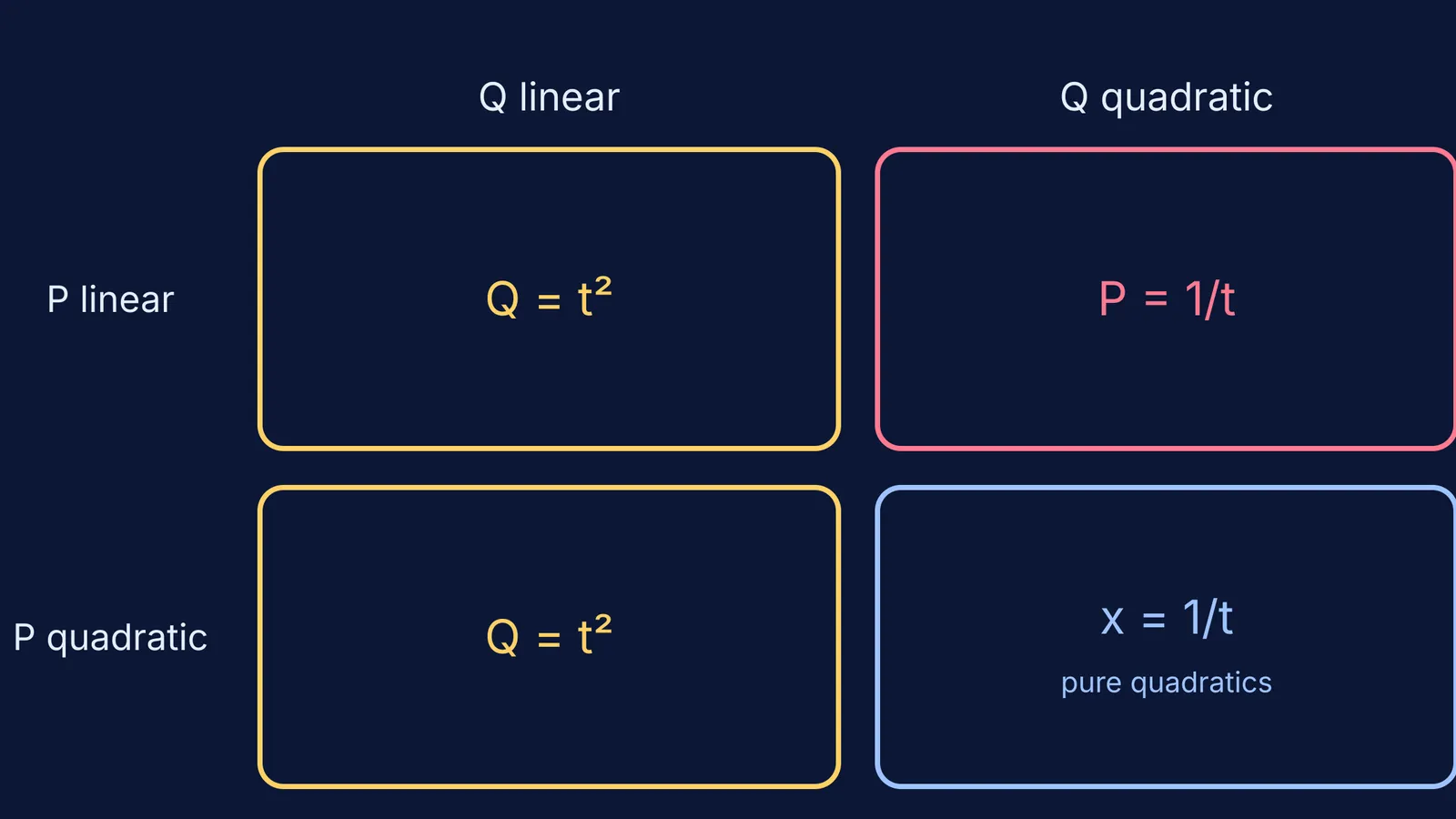
P linear, Q linear: put Q = t². This is the form above.
P quadratic, Q linear: put Q = t² again. P becomes a polynomial in t², and partial fractions finish the job.
P linear, Q quadratic: put P = 1/t (that is, px + q = 1/t). The linear factor turns into a power of t, and you are left with 1 over the root of a quadratic in t. Complete the square and use a standard formula.
P and Q both pure quadratics (ax² + b and cx² + d, with no x term): put x = 1/t. Then substitute again, with u² equal to the new quadratic under the root.
Forms 1 and 2 make the root a perfect square. Forms 3 and 4 reach the same goal as Euler substitutions, which rationalise a quadratic under a root.
What do the other three forms look like when worked out?
Form 2: find ∫dx/((x² + 2x)√(x+1)). Put x + 1 = t², so x = t² − 1 and dx = 2t dt. Then x² + 2x = x(x + 2) = (t² − 1)(t² + 1) = t⁴ − 1. The integral becomes 2∫dt/(t⁴ − 1). Split it: 2/(t⁴ − 1) = 1/(t² − 1) − 1/(t² + 1). The answer is (1/2) ln|(t − 1)/(t + 1)| − arctan t + C, with t = √(x+1). See also using a substitution first, then partial fractions.
Form 3: find ∫dx/((x+1)√(x² + 1)) for x > −1. Put x + 1 = 1/t, so x = 1/t − 1 and dx = −dt/t². Then x² + 1 = (2t² − 2t + 1)/t². The powers of t cancel and you get −∫dt/√(2t² − 2t + 1) = −(1/√2)∫dt/√((t − 1/2)² + 1/4). The standard formula ∫du/√(u² + k²) = ln|u + √(u² + k²)| gives −(1/√2) ln|t − 1/2 + √(t² − t + 1/2)| + C, with t = 1/(x+1).
Form 4: find ∫dx/((1 + x²)√(1 − x²)) for 0 < x < 1. Put x = 1/t, so dx = −dt/t². The integral becomes −∫t dt/((t² + 1)√(t² − 1)). Now put u² = t² − 1, so t dt = u du and t² + 1 = u² + 2. That leaves −∫du/(u² + 2) = −(1/√2) arctan(u/√2). Since u = √(1 − x²)/x, the answer is −(1/√2) arctan(√(1 − x²)/(√2 x)) + C.
A quick cross-check: x = sin θ turns the same integral into ∫dθ/(1 + sin²θ), which gives (1/√2) arctan(√2 x/√(1 − x²)). The two answers differ by a constant, because arctan k + arctan(1/k) = π/2 for k > 0. Our post on why two correct integrals can differ by a constant explains more.
How do you check an answer like this?
Differentiate it. If you get the original integrand back, the answer is right. This catches sign slips, especially the minus sign from dx = −dt/t². Our guide to checking any integral by differentiating it shows how.
If you pick the right substitution but lose the thread halfway through, the Fermi Problem Library has worked problems with a step-by-step solver that explains the reasoning rather than printing an answer.


