

On this page
Integration can look intimidating when trigonometric expressions are tangled up in fractions. But when you are faced with an integral like ∫ [cos x / ((1 + sin x)(2 + sin x))] dx, a powerful approach is to combine two core techniques: a substitution followed by partial fractions.
Why use substitution and partial fractions together?
The method of partial fractions is explicitly built for rational functions—expressions where one polynomial is divided by another. However, many exam questions intentionally present you with trigonometric, logarithmic, or exponential fractions.
You cannot apply partial fractions directly to sines and cosines. But if you can spot a function and its exact derivative in the integrand, substituting that function for a new variable turns the complicated expression into a neat polynomial fraction. From there, splitting the fraction makes integrating the individual pieces straightforward. This two-step process breaks a problem that looks impossible into two familiar, manageable tasks.
How do you solve ∫ [cos x / ((1 + sin x)(2 + sin x))] dx?
Let us walk through the method step by step, using a classic trigonometric integral as our example.
Step 1: Substitute to remove the trigonometry First, look at the denominator. It is entirely written in terms of sin x. Now look at the numerator: it is cos x, which is the exact derivative of sin x. This tells us exactly what substitution to use.
Let t = sin x.
Differentiating both sides with respect to x gives dt/dx = cos x, which we rearrange to dt = cos x dx.
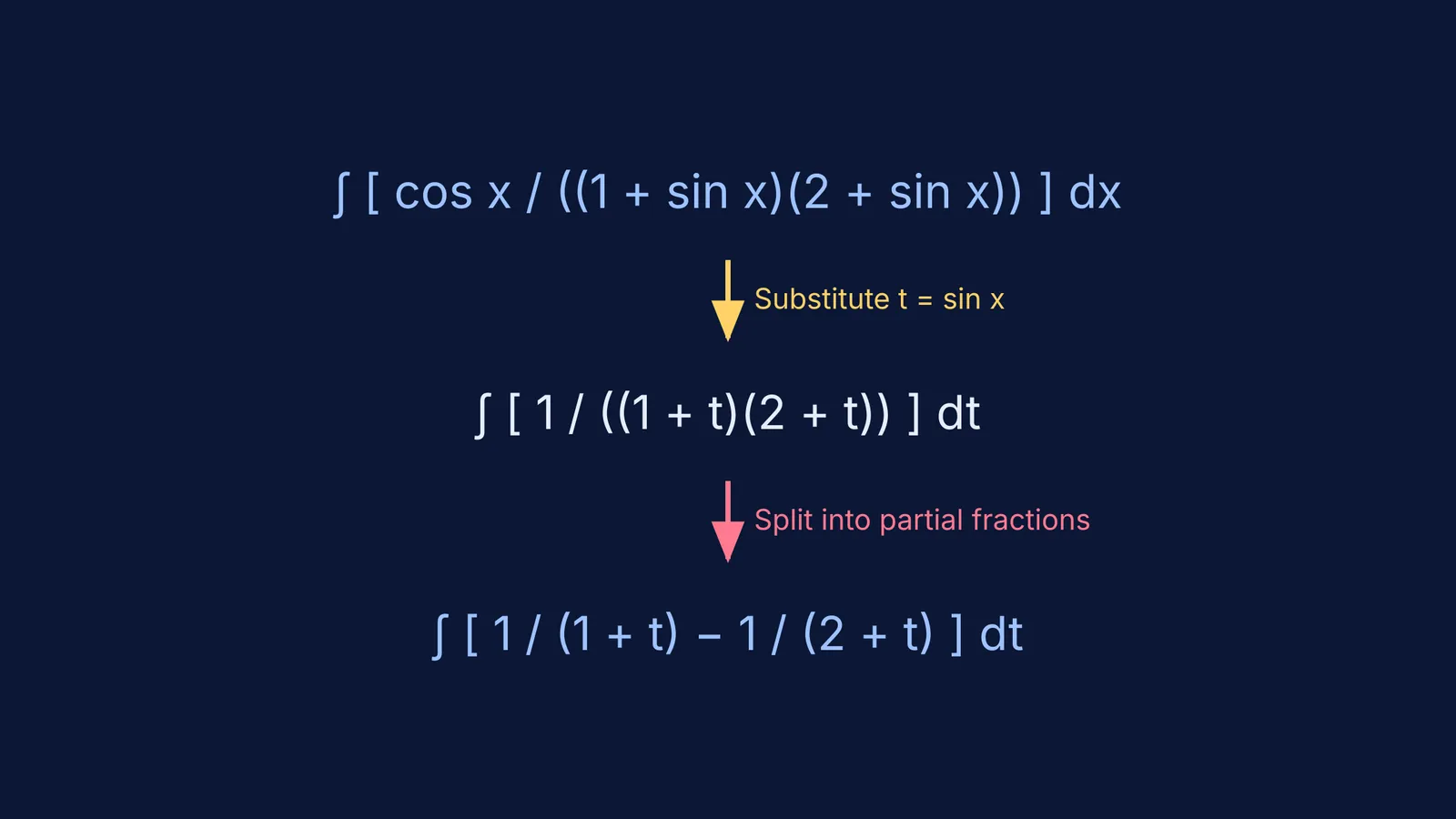
Now, replace all the terms in x with t. The entire numerator (cos x dx) becomes dt, and the integral simplifies perfectly: ∫ [1 / ((1 + t)(2 + t))] dt
Step 2: Split the rational function Now we have a proper rational function, where the degree of the numerator (0) is strictly less than the degree of the denominator (2). Because the denominator is already neatly factored, we can split it into partial fractions.
We set up the equation: 1 / ((1 + t)(2 + t)) = A / (1 + t) + B / (2 + t)
Multiplying everything by the common denominator (1 + t)(2 + t) gives us a simple linear equation: 1 = A(2 + t) + B(1 + t)
To find the constants A and B, we substitute the roots of the factors: If we set t = −1: 1 = A(2 − 1) + B(0), which simplifies to A = 1. If we set t = −2: 1 = A(0) + B(1 − 2), which simplifies to 1 = −B, so B = −1.
Our integral is now cleanly separated into two elementary fractions: ∫ [1 / (1 + t) − 1 / (2 + t)] dt
Step 3: Integrate and substitute back We can integrate each term directly using the standard logarithmic form ∫ (1/x) dx = ln |x|: ln |1 + t| − ln |2 + t| + C
Using the standard laws of logarithms, specifically ln a − ln b = ln(a/b), we combine the terms: ln |(1 + t) / (2 + t)| + C
Finally, to finish the problem, we must replace our temporary variable t with our original substitution sin x to get the final answer: ln |(1 + sin x) / (2 + sin x)| + C
A framework for tackling mixed-method integrals
When you sit down to solve a calculus paper, it helps to have a mental checklist. If an integral looks too complex for a single standard formula, try running through these three steps:
Look for the derivative: Check the numerator. Is it the derivative of an inner function found in the denominator? If you see cos x on top and sin x below, or e^x on top and e^x below, let that inner function be t.
Check for rational forms: After making the substitution, does the integral look like a polynomial divided by a polynomial? If the denominator can be factored into linear terms, set up your partial fractions immediately.
Track your variables: Always remember to substitute your temporary variable t back into the original variable x at the very end. If you are calculating a definite integral, you can skip this final step by changing your upper and lower limits at Step 1, as we explore in our guide to u-substitution with bounds: change the end points, skip going back.
When else does this mixed method work?
This sequence of substitution followed by partial fractions is a recurring pattern in calculus. It works whenever the denominator is a polynomial in a function f(x) and the numerator is a multiple of f'(x).
However, if your integral involves terms like 1 / (a + b cos x) without a handy sine derivative waiting in the numerator, you cannot use this method. You will need a different trigonometric approach altogether, such as Integrating 1/(a + b cos x) with the tan(x/2) substitution.
When you are learning integration for competitive exams like JEE Main or JEE Advanced, knowing which method to apply comes with practice. The Fermi Problem Library has worked problems with a step-by-step solver that explains the reasoning rather than printing an answer. Rather than stalling on algebraic manipulation, Fermi's AI tutor can work out what you already know and build a plan for the session to strengthen your fundamentals.


