

On this page
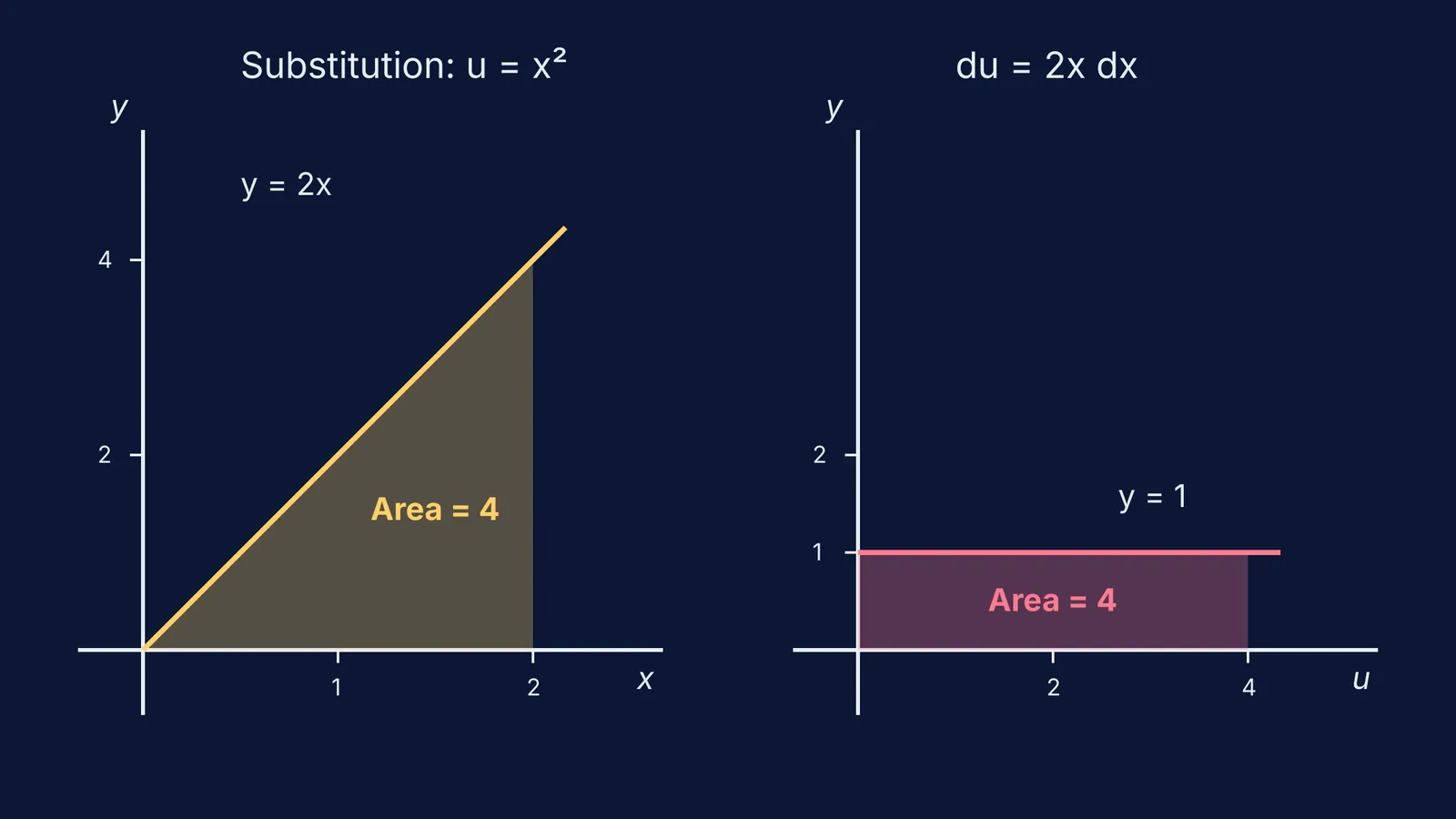
A definite integral evaluates to a number representing an area or an accumulated total. When you use the substitution method to crack a difficult integral, you replace a complicated expression involving x with a simpler variable, u.
However, a common trap in exams like JEE Main and NEET is changing the variable inside the integral while leaving the old x limits on the integration bounds. This creates a mathematically invalid expression and often leads to the wrong numerical answer.
Here is the correct approach to changing limits, why it works, and how it protects you from calculation errors.
Do you have to change limits when using substitution?
Yes, the limits on a definite integral specify where the accumulation starts and stops in terms of a specific variable. If the original integral is with respect to x (indicated by the dx), the limits are x-values.
According to OpenStax Calculus Volume 1, when evaluating a definite integral by substitution where u = g(x), you must change the limits of integration from a and b to g(a) and g(b).
Some students treat the definite integral as an indefinite one: they find the antiderivative in terms of u, swap the original x expression back in, and then apply the original x limits. While this can yield the right answer, it introduces extra algebraic steps where minus signs and coefficients are easily lost.
Updating the limits immediately creates a clean break. Once the integral is written entirely in terms of u, the variable x vanishes from the problem forever. You integrate, plug in your new u limits, and arrive directly at your final number.
How do you change limits in a definite integral?
Consider evaluating the integral of 2x(x² + 1)³ dx from x = 0 to x = 1.
The natural substitution is the inner expression: u = x² + 1. Differentiating both sides gives du = 2x dx.
Instead of writing an intermediate integral with mixed variables, calculate the new limits immediately using your substitution equation.
Find the new lower limit: Plug the old lower limit (x = 0) into u = x² + 1. The new lower limit is 0² + 1 = 1.
Find the new upper limit: Plug the old upper limit (x = 1) into the equation. The new upper limit is 1² + 1 = 2.
The entire integral translates cleanly into ∫ u³ du from u = 1 to u = 2.
Evaluating this is straightforward. The antiderivative is u⁴ / 4. Applying the limits 1 and 2 gives (2⁴ / 4) − (1⁴ / 4), which simplifies to 16/4 − 1/4 = 15/4. You reached the exact answer without ever bringing the (x² + 1) expression back into your working.
What happens when new limits are identical?
Changing the limits can occasionally simplify a problem so much that no integration is needed at all.
Take the integral of x cos(x²) dx from x = −1 to x = 1.
If you choose the substitution u = x², you evaluate the new limits:
New lower limit: When x = −1, u = (−1)² = 1.
New upper limit: When x = 1, u = 1² = 1.
The bounds of the new integral are from u = 1 to u = 1. A definite integral with identical upper and lower bounds is always exactly zero. By changing the limits early, you spot the zero immediately, saving minutes of unnecessary integration.
How do you handle trigonometric substitutions?
When dealing with trigonometric substitutions, changing limits is especially useful because converting the antiderivative back to x often requires drawing a reference triangle, which can be time-consuming and error-prone.
Consider evaluating the integral of √(1 - x²) dx from x = 0 to x = 1.
A standard substitution is x = sin(θ), which means dx = cos(θ) dθ. Instead of finding the indefinite integral and later using inverse trigonometric functions to return to x, you change the limits to θ immediately.
Find the new lower limit: Set x = 0 in x = sin(θ). The angle θ that gives sin(θ) = 0 is 0.
Find the new upper limit: Set x = 1 in x = sin(θ). The angle θ that gives sin(θ) = 1 is π/2.
Your new integral is purely in terms of θ, running from θ = 0 to θ = π/2. The integrand becomes √(1 - sin²(θ)) cos(θ) dθ, which simplifies to cos²(θ) dθ.
Evaluating the definite integral of cos²(θ) from 0 to π/2 using the half-angle formula is standard practice. You find the area is π/4, all without ever converting your answer back to x or dealing with expressions like arcsin(x). Changing the limits keeps the trigonometry isolated and prevents algebraic mistakes.
Getting unstuck with Fermi
Integration demands recognizing patterns. Sometimes the substitution is obvious, but other times you might need trigonometric identities before you can even define u. If you are struggling to see which substitution to use in standard forms, the Concept Library maps out the underlying patterns. You can also explore worked examples involving integrals of standard root forms and integrating 1/(a + b cos x).
When you hit a block on a specific homework question, Fermi's AI tutor can work out what you already know and build a plan for the session. Rather than just giving you the final evaluated integral, Fermi checks your understanding as it goes, drawing graphs and guiding you through the limit change yourself.


