On this page
The Strecker synthesis builds an amino acid from small, simple molecules. Each step is a reaction you already know, so you can work out the answer instead of memorising it.
What is the Strecker synthesis?
In 1850 Adolph Strecker reported a reaction that makes alanine from acetaldehyde, ammonia and hydrogen cyanide, as a 2014 study in the Beilstein Journal of Organic Chemistry puts it. His original paper appeared in Justus Liebigs Annalen der Chemie, volume 75.
The Strecker synthesis is the reaction of an imine (or something that behaves like one) with hydrogen cyanide, followed by hydrolysis of the nitrile. Eric Jacobsen's group, writing in Nature in 2009, called it "an especially versatile chemical method for the synthesis of racemic alpha-amino acids".
The one idea to hold on to: the aldehyde's carbonyl carbon becomes the alpha carbon of the amino acid. The aldehyde's R group becomes the side chain, and the cyanide supplies the extra carbon that ends up as COOH. So RCHO gives RCH(NH2)COOH.
What are the steps of the Strecker mechanism?
Imine formation. Ammonia attacks the carbonyl carbon of the aldehyde, then water is lost, giving an imine, R-CH=NH. In acid it is often protonated to an iminium ion, which is even more open to attack.
Cyanide addition. Cyanide adds to the carbon of the C=N bond, giving an alpha-aminonitrile, R-CH(NH2)-CN. This is the same nucleophilic addition you saw in cyanohydrin formation from HCN and carbonyl compounds, with C=N in place of C=O.
Hydrolysis. Heating with acid (or base) converts the C≡N group into COOH, by way of an amide. If nitrile hydrolysis is rusty, see how nitriles turn into acids, amines and ketones.
The Beilstein study modelled the alanine case with DFT calculations. In the first stage, which ends with the aminonitrile, the slowest step it found is a proton transfer with a calculated barrier of 9.6 kcal/mol. In the second stage, the slowest step is hydrolysis of the cyano group, with a much higher calculated barrier of 34.7 kcal/mol.
Which aldehyde gives which amino acid?
Work backwards. Write the amino acid as R-CH(NH2)-COOH, remove the COOH, and turn the CH(NH2) into CHO. Whatever is left is the aldehyde you need.
Alanine (R = CH3) comes from ethanal, CH3CHO. This is Strecker's original 1850 reaction.
Valine (R = (CH3)2CH) comes from 2-methylpropanal, (CH3)2CHCHO.
Phenylalanine (R = C6H5CH2) comes from phenylethanal, C6H5CH2CHO.
Glycine (R = H) comes from methanal, HCHO.
Try one yourself: leucine has R = (CH3)2CHCH2. Strip it back and you get (CH3)2CHCH2CHO, which is 3-methylbutanal. A quick check: the amino acid always has exactly one more carbon than the aldehyde.
Why does the Strecker synthesis give a racemic mixture?
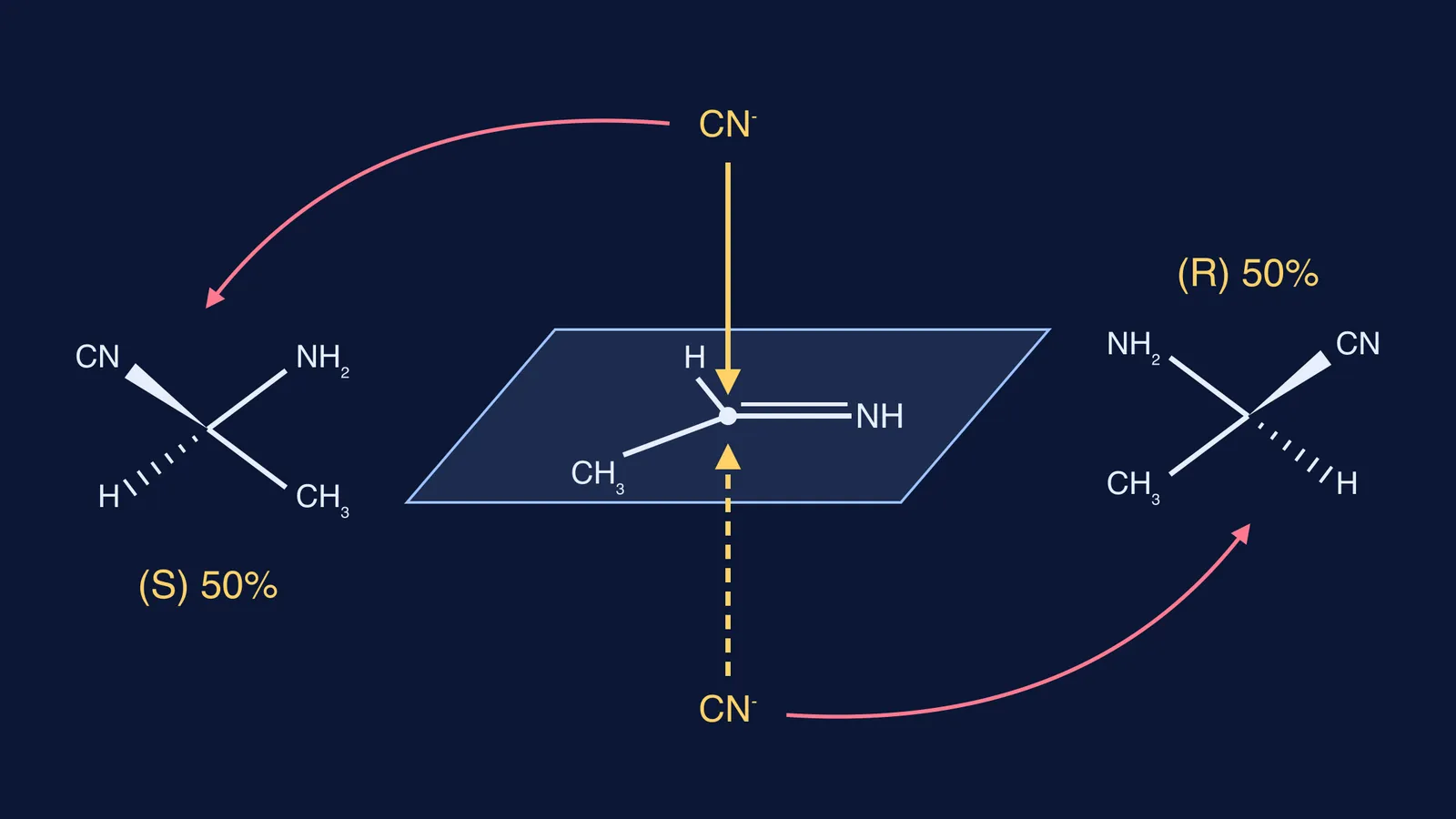
The imine carbon is trigonal planar, so it has two faces. Nothing in the flask favours one face over the other, so cyanide adds to each face equally often. Attack from one face gives the (S) aminonitrile and attack from the other gives its mirror image, the (R) aminonitrile. The Beilstein paper states it plainly: the traditional Strecker reaction gave racemic alpha-aminonitriles, mixtures of equal amounts of R and S forms. Hydrolysis leaves the alpha carbon untouched, so the amino acid is racemic too.
Glycine is the exception. Its alpha carbon carries two hydrogens, so it has no chiral centre and there is nothing to be racemic about.
To get one enantiomer, you either separate the mixture (see racemic mixtures and how they are resolved) or steer the cyanide to one face. In the 2009 Nature paper, Jacobsen's group used a simple chiral amido-thiourea catalyst to control the cyanide-addition step. This gave highly enantiomerically enriched non-natural amino acids, and the catalyst worked with aqueous cyanide salts, which the authors note are safer and easier to handle than other cyanide sources.
How do you answer a Strecker question in an exam?
Run through this checklist first:
Circle the carbonyl carbon. It becomes the alpha carbon, so it gets both the NH2 and the COOH.
Name the intermediates in order: imine, then alpha-aminonitrile, then amino acid.
Count carbons. The product has one more than the aldehyde.
Check the side chain. If R is not H, the product is a racemic mixture. If R is H, it is glycine, which is not chiral.
If the question asks for a single enantiomer, the answer involves resolution or a chiral catalyst, not the plain Strecker reaction.
If you keep matching the wrong aldehyde to the amino acid, the Fermi Problem Library has worked problems with a step-by-step solver that explains the reasoning rather than just printing an answer. If imines or chirality still feel shaky, the Fermi Concept Library gives each chemistry concept its own lesson, so you can fix the gap before going back to the mechanism.