On this page
Every stoma is a pore that lets carbon dioxide in for photosynthesis and lets water out by transpiration, and its two guard cells set the pore's width to balance the two (Jezek and Blatt, Plant Physiology, 2017). Here is how they do it, with real measurements and one calculation.
What are guard cells?
NCERT Class 11 Biology describes each stoma as two bean-shaped guard cells enclosing a pore; their outer walls are thin, their inner walls facing the pore are highly thickened, and they have their own chloroplasts (NCERT Class 11 Biology, Chapter 6). In grasses they are dumbbell shaped, as our explainer on dumbbell vs bean-shaped guard cells shows. To see them yourself, make a leaf peel temporary mount.
How do guard cells open a stoma?
The 2017 review of guard-cell transport by Mareike Jezek and Michael Blatt sets out the steps (Plant Physiology):
A proton pump (H+-ATPase) uses ATP to push H+ out of the guard cell, leaving the inside of the membrane negative.
That voltage draws K+ into the cell through potassium channels.
Chloride and malate build up with the potassium, along with sugars, so the solute content rises.
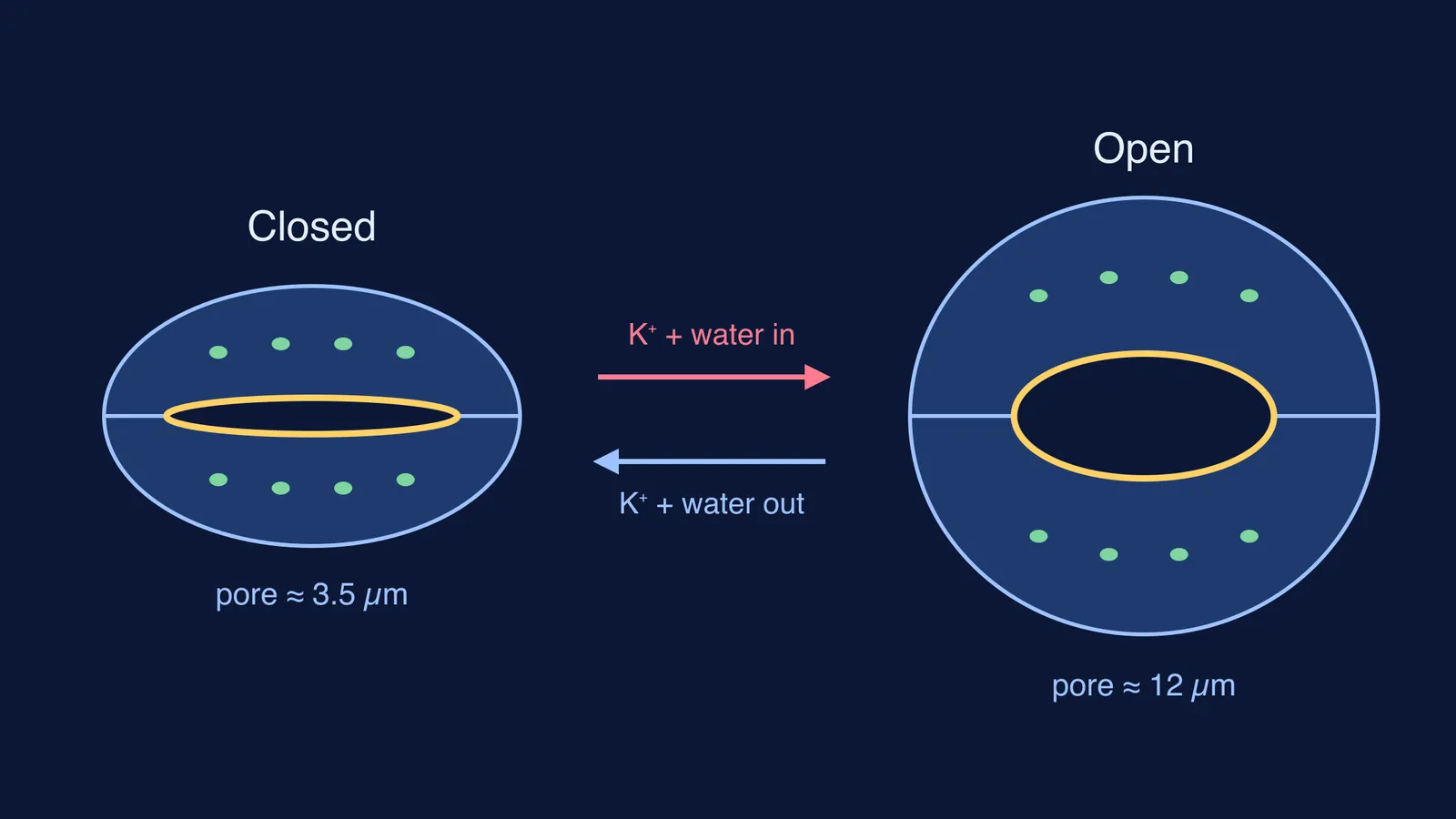
Water moves in by osmosis towards the higher solute concentration, the guard cells swell, turgor rises, and the pair bows apart to open the pore.
Light promotes opening, the review notes. For broad bean (Vicia faba), the same review's Table I lists guard-cell volume of 2.7-3.7 picolitres closed and 4.0-7.5 picolitres open, turgor of 1-4 atm closed and 3.5-6 atm open, and a pore 1-6 micrometres wide closed and 8-16.5 micrometres open (Jezek and Blatt, 2017). The solute difference between the open and closed states often exceeds 300 to 400 mosmol per litre, according to that review.
Does the thick inner wall really bend the cell?
The classic explanation: the thickened inner wall resists stretching, so a swelling guard cell curves outward and the pore gapes. A 2017 study in Current Biology by Ross Carter and colleagues, using atomic force microscopy and computer models of Arabidopsis guard cells, concluded that differential radial thickening of the guard cells plays a very limited role in opening (Carter et al., 2017). Instead, the ends of the stomatal complex are stiff and pinned down, which stops it lengthening and makes the pore more sensitive to turgor. For school and NEET-UG answers, write the NCERT version; just know the mechanics is still being studied.
Why do stomata close?
Closing runs the process backwards: guard cells metabolise their solutes or release them, water leaves, turgor falls, and the cells straighten and seal the pore (Jezek and Blatt, 2017). The main triggers:
Drought. Plants show a significant rise in ABA under drought stress, and ABA rapidly increases to start stomatal closure when soil water runs short (Aslam et al., International Journal of Molecular Sciences, 2022).
ABA at the membrane. ABA suppresses the proton pump and the inward potassium channels, and opens anion channels and outward potassium channels so K+, chloride and malate flow out (Jezek and Blatt, 2017). NCERT calls ABA the stress hormone because it stimulates stomatal closure (NCERT Class 11 Biology, Chapter 13).
High carbon dioxide. Like ABA, elevated CO2 switches on guard-cell signalling that closes the pore (Kim et al., Annual Review of Plant Biology, 2010).
Cactus and pineapple flip the usual daytime timing, and our post on CAM plants opening stomata at night explains why.
How strong is the osmotic pull? A worked example
NCERT Class 12 Chemistry gives the van't Hoff equation for osmotic pressure, Π = CRT, with R = 0.083 L bar per mol per K (NCERT Class 12 Chemistry, Chapter 1). Plug in the solute change of 300 to 400 mosmol per litre from the guard-cell review (Jezek and Blatt, 2017).
C = 300 mosmol per litre = 0.300 osmol per litre; T = 298 K (25 °C).
Π = 0.300 × 0.083 × 298 = 7.4 bar.
At 400 mosmol per litre: Π = 0.400 × 0.083 × 298 = 9.9 bar.
That is the ideal pull, an upper limit. The measured turgor rise in broad bean is smaller, but the sum shows that a few hundred milliosmoles of potassium salts is enough to inflate a guard cell.
How should you write this in an exam?
A five-line answer that covers the marks:
Light activates the H+-ATPase; H+ is pumped out of the guard cells.
K+ enters, with Cl- and malate, so guard-cell solute concentration rises.
Water enters by osmosis; turgor increases.
The thick inner walls and thin outer walls make the turgid cells bow apart, opening the pore.
In water stress, ABA causes K+ and anions to leave, water follows, guard cells become flaccid and the pore closes.
If osmotic pressure or water potential is the weak link, the Fermi Concept Library gives each concept its own lesson. To practise the calculation side, the Fermi Problem Library has worked problems with a step-by-step solver that explains the reasoning rather than printing an answer.