

On this page
Two diagrams of stomata in your Class 11 textbook look nothing alike. One shows two curved, bean-shaped cells around an oval pore. The other shows two narrow cells with swollen ends, lying side by side like a pair of dumbbells. The difference is real, it is a standard textbook comparison, and the reason behind it is one of the neater stories in plant anatomy.
What does NCERT say about guard cells and subsidiary cells?
The definitions you need are all in one paragraph of NCERT Class 11 Biology, Chapter 6, Anatomy of Flowering Plants:
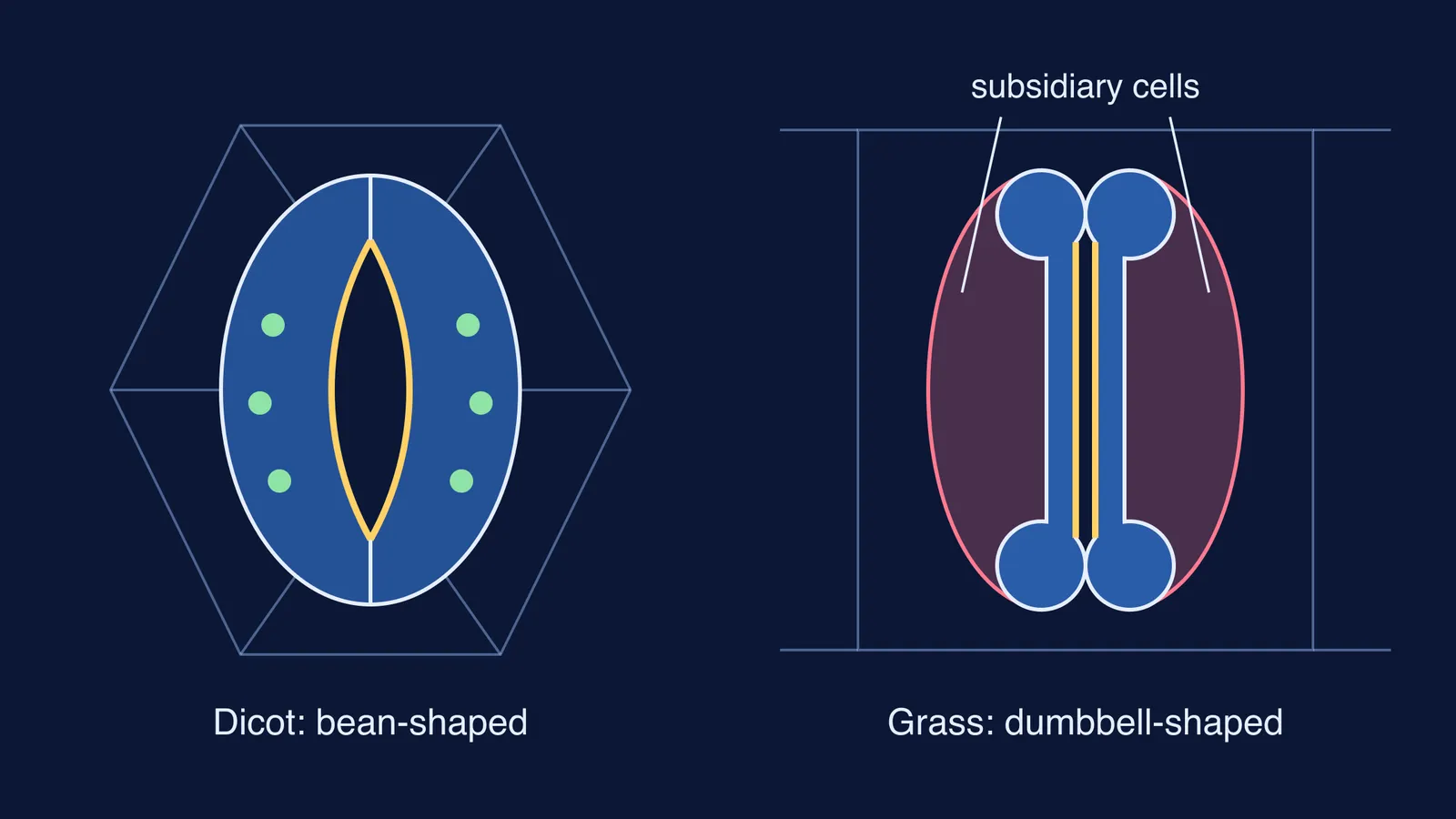
Each stoma is made of two bean-shaped guard cells that enclose the stomatal pore.
In grasses, the guard cells are dumb-bell shaped.
The outer walls of guard cells (away from the pore) are thin, and the inner walls (towards the pore) are highly thickened.
Guard cells have chloroplasts and control the opening and closing of stomata.
Sometimes a few epidermal cells next to the guard cells become specialised in shape and size. These are called subsidiary cells.
The stomatal apparatus is the stomatal aperture, the guard cells and the subsidiary cells around them, taken together (Figure 6.1 in the chapter).
The stomatal apparatus is not just the pore, or the pore plus the guard cells. If subsidiary cells are present, they count too.
Dumbbell vs bean-shaped guard cells: what is actually different?
Set the two figures in the NCERT chapter side by side and compare three things.
Shape: a bean-shaped guard cell curves around one side of an oval pore. A dumbbell-shaped guard cell is a narrow rod with a bulb at each end, and the pore is a slit between the two rods.
Neighbours: in grasses, a subsidiary cell lies along the outer side of each guard cell. A 2017 Science paper describes this as subsidiary cells flanking two dumbbell-shaped guard cells (Raissig et al., 2017).
Speed: in a comparison of four species, Peter Franks and Graham Farquhar measured how fast stomata opened in light. The dumbbell stomata of wheat were about an order of magnitude faster than those of the other three, whose stomata were variants of the kidney form (Franks and Farquhar, 2007, Plant Physiology).
Why do grasses need subsidiary cells?
Mechanically, a subsidiary cell is a problem before it is a help. In the Franks and Farquhar study, subsidiary cells had a large mechanical advantage over the guard cells, so they resisted opening. The authors concluded that wheat stomata could not reach full aperture unless the turgor pressure in the subsidiary cells dropped substantially while the stomata opened. Put simply, the neighbours have to slacken as the guard cells swell.
The team led by Dominique Bergmann of Stanford University and Carnegie Science tested what happens when the neighbours are missing. Working with Brachypodium distachyon, a relative of wheat, they found a gene, BdMUTE, that is needed for subsidiary cells to form. Their measurements on plants without subsidiary cells supported the old idea that subsidiary cells allow more responsive stomata and a wider range of pore openings (Raissig et al., 2017, Science). The Carnegie Science news release says these plants performed poorly, with stomata that resembled the two-celled kind found in other plants.
Tradescantia's place among the monocots is listed on its taxonomy page. Its stomata are described in the same 2007 paper.
How do you draw and label both in an exam?
Practise this until each sketch takes under a minute. For a bean-shaped stoma:
Draw an oval for the outline of the stoma.
Draw a narrow lens shape down the middle. That is the pore.
Thicken the lines along the pore. These are the thick inner walls.
Add three small dots in each guard cell for chloroplasts.
Label: guard cell, stomatal pore, chloroplast, thick inner wall, epidermal cell.
For a dumbbell-shaped stoma:
Draw two thin parallel rods with a small gap between them. The gap is the pore.
Add a round bulb at both ends of each rod.
Thicken the walls of the rods that face the pore.
Draw a dome-shaped subsidiary cell along the outer side of each guard cell.
Label: guard cell, subsidiary cell, stomatal pore, epidermal cell. Then bracket the whole group and label it stomatal apparatus.
Before you move on, check yourself against these questions:
Can you define the stomatal apparatus in one sentence without leaving anything out?
Can you say which walls of the guard cell are thick, and which are thin?
Can you explain why subsidiary cells resist opening and still make grass stomata more responsive?
If guard cells, bulliform cells and bundle sheath cells start to blur together, the Fermi Concept Library gives every concept in biology its own lesson and its place in the map, so you can see stomata next to the rest of leaf anatomy.


