On this page
If FeCl₂ and FeCl₃ were both called "iron chloride", you couldn't tell them apart. Stock notation fixes that with a number in brackets: iron(II) chloride and iron(III) chloride. Below: the rule, three worked examples and a checklist.
What is Stock notation in chemistry?
The German chemist Alfred Stock proposed the system in a two-page paper in Angewandte Chemie in 1919 (Stock, 1919). It is now part of the official IUPAC rules for inorganic names.
In the IUPAC Red Book (2005), Section IR-5.4.2.2, the oxidation number is written as a Roman numeral in parentheses placed immediately after the name of the element it refers to. Four details from that section are worth knowing:
No space before the bracket: silver(I) fluoride, not silver (I) fluoride.
The number can be zero, written 0, as in pentacarbonyliron(0) for [Fe(CO)₅].
It can be negative if you write the minus sign, as in sodium pentacarbonylmanganate(−I). You never write a plus sign.
Fractions are not used in names, even when an average oxidation state works out to one.
How do you find the Roman numeral? Three worked examples
The method is the same every time. Use the known charge of the other part, then share the balancing positive charge equally among the metal atoms.
Write the charge on each anion: chloride −1, oxide −2.
Add up the total negative charge in the formula.
Divide the matching positive charge by the number of metal atoms.
Put that number, in Roman numerals, after the metal's name.
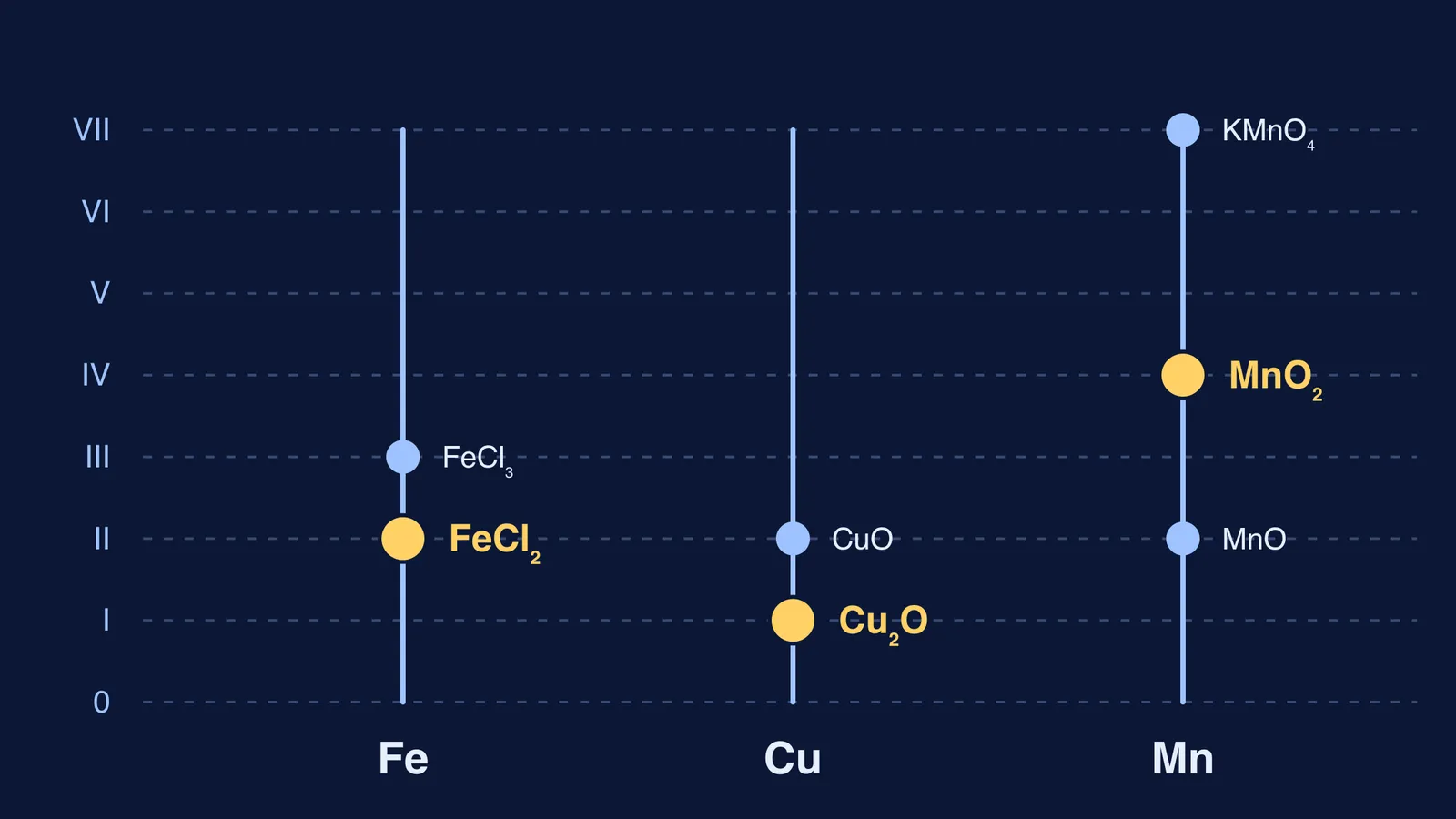
FeCl₂. Two chlorides give −2. One iron atom must carry +2. The name is iron(II) chloride.
Cu₂O. One oxide gives −2. Two copper atoms share +2, so each is +1. The name is copper(I) oxide.
MnO₂. Two oxides give −4. One manganese atom carries +4. The name is manganese(IV) oxide. The Red Book also accepts manganese dioxide for MnO₂, a plain name that counts atoms instead of giving the oxidation state.
Mixed cases follow the same logic. The Red Book names Fe₃O₄ iron(II) diiron(III) oxide: one iron at +2 and two at +3, which balances four oxides at −8. If finding oxidation numbers still feels shaky, the method for tricky elements is in our post on the oxidation number of oxygen in OF₂, H₂O₂ and KO₂.
When do you need the Roman numeral in a name?
You need it when the metal commonly forms more than one ion. Iron forms Fe²⁺ and Fe³⁺, and copper forms Cu⁺ and Cu²⁺, so their names need the numeral.
You leave it out when there is no choice. LibreTexts' introductory chemistry chapter on ionic names/05%3A_Molecules_and_Compounds/5.07%3A_Naming_Ionic_Compounds) puts it simply: sodium forms only a 1+ ion, so "sodium(I)" adds nothing. Sodium chloride is the full name.
The Red Book advises using oxidation numbers only when there is no uncertainty about them, and offers the charge number as an alternative: iron(2+) sulfate for FeSO₄. For Hg₂Cl₂ it gives dimercury(2+) chloride, though many school books still say mercury(I) chloride. In exams, use the name your board's textbook uses.
How is Stock notation different from -ous and -ic names?
The older system uses suffixes. LibreTexts/05%3A_Molecules_and_Compounds/5.07%3A_Naming_Ionic_Compounds) gives ferrous for Fe²⁺ and ferric for Fe³⁺, cuprous for Cu⁺ and cupric for Cu²⁺: -ous is the lower charge and -ic the higher. The suffix tells you "lower" or "higher" but not the number, so a pair of suffixes cannot cover a metal like manganese, which forms several oxidation states. Stock notation gives the number directly.
NCERT's Class 11 redox chapter also writes the numeral on the formula itself. Its worked Problem 7.3 (reproduced with answers here) turns FeO, Fe₂O₃ and MnO₂ into Fe(II)O, Fe₂(III)O₃ and Mn(IV)O₂. For the history of how compound names got their shape, see how Guyton de Morveau and Lavoisier named compounds in 1787.
A 30-second check before you write a name
Does the metal form more than one common ion? If not, skip the numeral.
What is the total charge of the anions?
Did you divide by the number of metal atoms, not just copy the subscript?
Is the numeral Roman, in brackets, with no space after the name?
Is the anion named correctly (chloride, oxide, sulfate)?
If your numerals keep coming out wrong because the oxidation number rules are hazy, the Fermi Concept Library covers every concept in chemistry, each with its own lesson. For practice, the Fermi Problem Library has worked problems with a step-by-step solver that explains the reasoning rather than printing an answer. In complexes, the same numerals appear inside names like ferrate(II), and our guide to why anionic complexes end in -ate picks up from there.