

On this page
In 1787, four French chemists published a book that changed how chemists name substances. Louis-Bernard Guyton de Morveau, Antoine Lavoisier, Claude-Louis Berthollet and Antoine-François de Fourcroy proposed that a compound’s name should tell you what it is made of (EBSCO Research Starters). That is why the ending of a name like sodium sulfate tells you about oxygen.
What were chemicals called before 1787?
Up until 1780, names described looks, places or people. The Linda Hall Library gives “oil of vitriol, liver of sulfur, butter of antimony, and Glauber’s salt” as names that said little about composition.
Oil of vitriol was sulfuric acid, named for its oily look. Sugar of lead was lead acetate, named for its sweet taste even though it is poisonous (EBSCO Research Starters). Glauber’s salt is hydrated sodium sulfate, named after the chemist Johann Rudolf Glauber (1604–1670) (Wikipedia: sodium sulfate).
Who wrote the Méthode de nomenclature chimique, and when?
Guyton de Morveau (1737–1816) was a chemist from Dijon, and he published his first essay on a new chemical nomenclature in 1782 (Wikipedia). In it he argued that elements should have simple names and compounds should have names that show what elements they are made of (Linda Hall Library).
Guyton met Lavoisier in 1785, and the two decided to build Lavoisier’s oxygen theory into the reform (Linda Hall Library). The four chemists met almost daily in 1786 and 1787. Lavoisier read a paper on the new language to the French Academy of Sciences on 17 April 1787, and the book came out that year (EBSCO Research Starters).
A Le Moyne College exhibit on the book calls it the basis for naming binary inorganic compounds, a system “still in common use more than two centuries later”.
How do -ic, -ous, -ate, -ite and -ide work?
Lavoisier set out the rules in his 1789 *Elements of Chemistry* (free on Project Gutenberg):
An acid is named after the element it is built on: sulfur gives sulfuric acid, phosphorus gives phosphoric acid, charcoal gives carbonic acid.
Less oxygen gets -ous and more gets -ic: sulfurous and sulfuric acid, nitrous and nitric acid.
Salts of an -ic acid end in -ate. Every salt of sulfuric acid is a “sulphat”, such as sulphat of potash or sulphat of iron.
Salts of an -ous acid end in -ite, as in sulphites and phosphites.
Sulfur joined to a metal with no oxygen became a “sulphuret”. Today we say sulfide.
Lavoisier counted 24 known bases, so sulfur’s two acids could make 48 neutral salts, 24 sulphites and 24 sulphats, all named by one rule (Project Gutenberg).
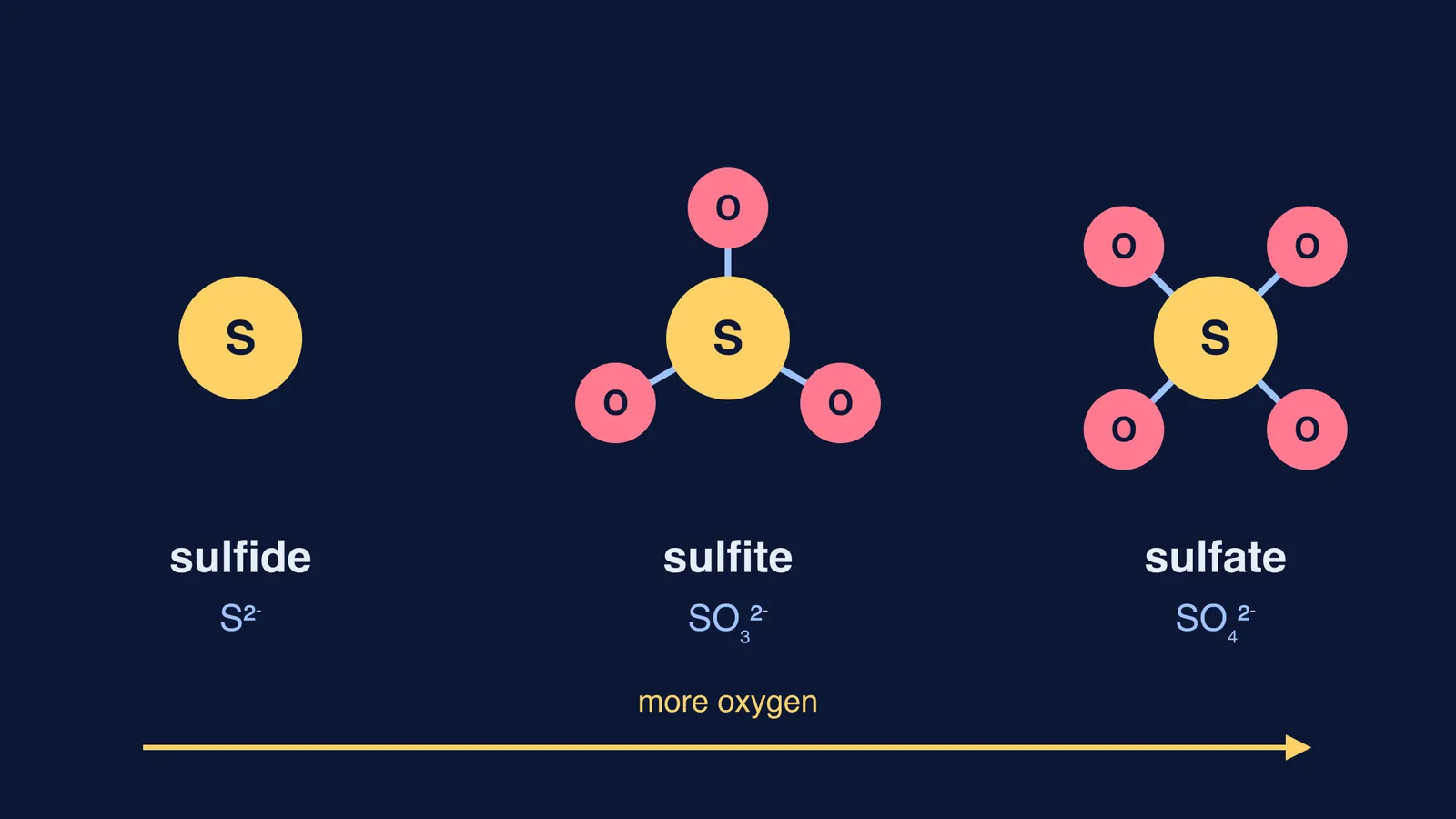
In modern formulas, sulfite is SO₃²⁻ (Wikipedia: sulfite) and sulfate is SO₄²⁻ (Wikipedia: sulfate). As the Linda Hall Library puts it, the form sulfate, sulfite or sulfuric shows the proportions of sulfur and oxygen, while sulfide shows that there is no oxygen.
How do you name a salt with the 1787 rules?
Take Na₂SO₃ and work through it:
Split it into the metal and the rest: sodium, and SO₃.
Find the main element in the rest. It is sulfur, so the stem is sulf-.
Compare it with the -ate ion you know. Sulfate is SO₄²⁻, and this has one oxygen fewer, so the ending is -ite.
Put the metal first and the ion second: sodium sulfite.
The same steps work for KNO₂. Nitrate is NO₃⁻ (Wikipedia: nitrate) and nitrite is NO₂⁻ (Wikipedia: nitrite), so KNO₂ is potassium nitrite. FeS has no oxygen, so it is a sulfide: iron(II) sulfide in modern names.
Check your answer with these questions:
No oxygen in a simple ion like S²⁻? Use -ide.
Oxygen, and it matches the ion you learned as -ate? Use -ate.
One oxygen fewer than that? Use -ite.
Naming the acid instead? -ate becomes -ic acid and -ite becomes -ous acid.
If the endings still blur, every chemistry concept has its own lesson in the Fermi Concept Library. To practise, the Fermi Problem Library has worked problems with a step-by-step solver that explains the reasoning rather than printing an answer.
Why does a naming system still matter?
In the preface to *Elements of Chemistry*, Lavoisier quoted the philosopher Condillac: “We think only through the medium of words.” He wrote that a project he thought was only about names “transformed itself by degrees” into a treatise on chemistry (Project Gutenberg). He also recalled a letter from the Swedish chemist Torbern Bergman to Guyton de Morveau, urging him to spare no improper names: “those who are learned, will always be learned, and those who are ignorant will thus learn sooner.”
The system’s descendants still have an official home. The International Union of Pure and Applied Chemistry publishes today’s inorganic rules as *Nomenclature of Inorganic Chemistry, IUPAC Recommendations 2005*, known as the Red Book.
For the step before, read how Robert Boyle’s Sceptical Chymist doubted the four elements. Organic names follow the same idea, as in how to name bicyclic compounds. Parents can try helping a teen balance chemical equations at home.
Next time you write sodium sulfate, read it as Guyton and Lavoisier meant: sodium, sulfur and oxygen.


