On this page
It is 9 pm and the chemistry homework says: balance Fe + H2O → Fe3O4 + H2. You don't need to remember school chemistry to help. Balancing is a counting puzzle with one rule, and you can coach it with questions while your child holds the pencil.
What does balancing a chemical equation actually mean?
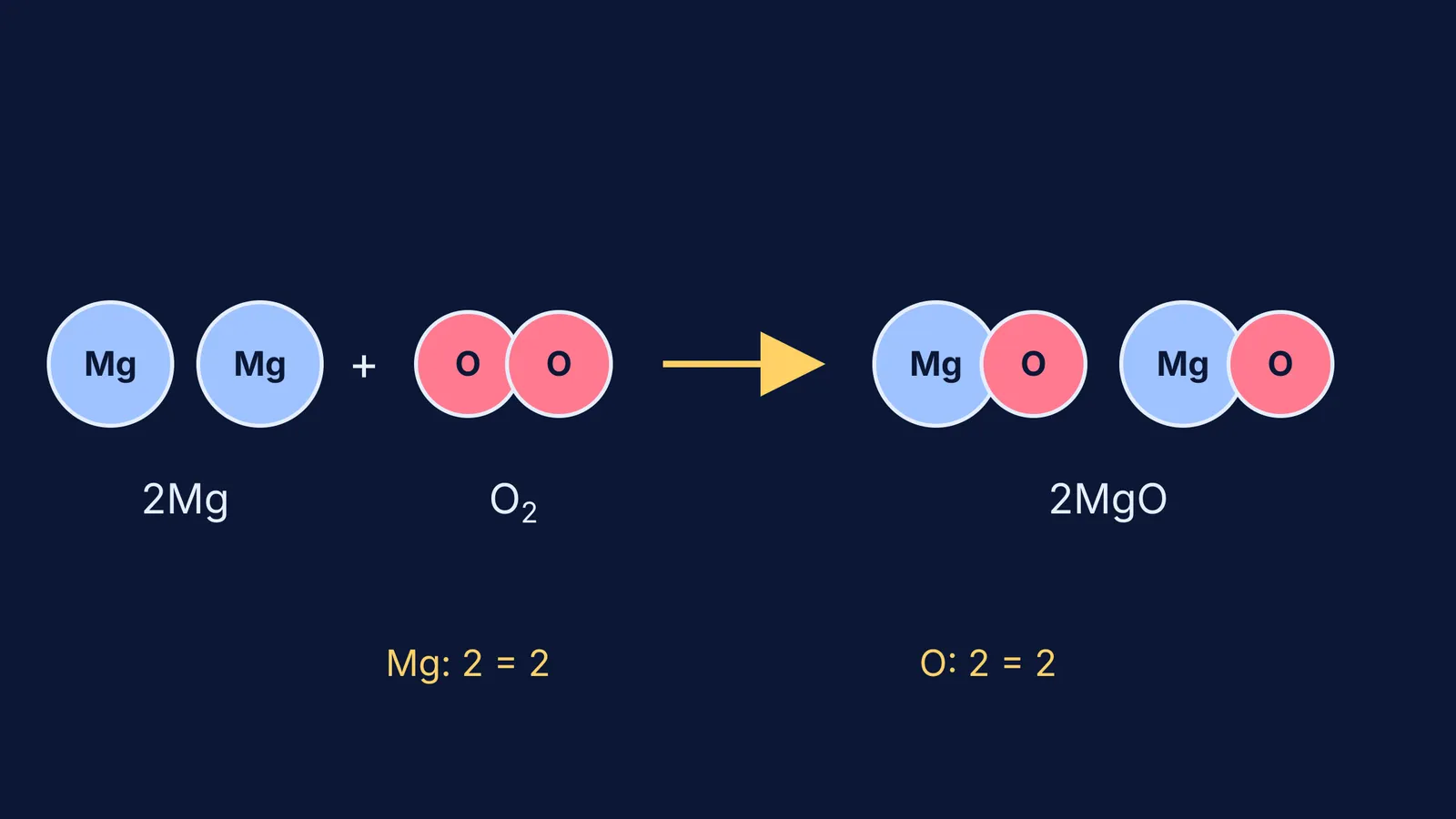
The Class 10 science chapter Chemical Reactions and Equations (reproduced on IIT Kanpur's SATHEE portal) starts from one law: mass can neither be created nor destroyed in a chemical reaction. So every atom on the left must turn up on the right. An equation that does not yet show this is called a skeletal equation; the chapter's example is Mg + O2 → MgO for magnesium burning in air.
Your child will meet two kinds of numbers:
Subscripts are the small numbers inside a formula. O2 is one molecule made of two oxygen atoms. They are fixed, because changing them changes the substance.
Coefficients are the big numbers in front. 2MgO means two units of magnesium oxide. These are the only numbers you may change.
The chapter states the rule plainly: we cannot alter the formulae of the compounds or elements involved.
Why do students get stuck on balancing equations?
Often the trouble is not arithmetic but what the numbers mean. W. L. Yarroch (1985, Journal of Research in Science Teaching) interviewed 14 high school chemistry students in depth. All of them balanced four simple equations correctly. Yet only five drew diagrams that matched the equations they had just balanced. The students who could not had a very poor grasp of subscripts and were willing to break the rule against changing them.
So a correct answer can hide a shaky idea.
How do you balance an equation step by step?
Start with a warm-up. In Mg + O2 → MgO, the left has 1 Mg and 2 O; the right has 1 Mg and 1 O. Put 2 in front of MgO: now the right has 2 Mg and 2 O. Put 2 in front of Mg. Done: 2Mg + O2 → 2MgO.
Now the homework one. The chapter's tip is to begin with the compound that has the most atoms, here Fe3O4.
Make two columns, left and right, and count. Fe: 1 and 3. H: 2 and 2. O: 1 and 4.
Fix oxygen. There are 4 O on the right and 1 on the left, so write 4 in front of H2O: Fe + 4H2O → Fe3O4 + H2.
Recount hydrogen. The left now has 8 H, the right has 2. Write 4 in front of H2, giving 8 on each side.
Fix iron. There is 1 Fe on the left and 3 on the right, so write 3 in front of Fe.
Recount every element: 3Fe + 4H2O → Fe3O4 + 4H2. Fe 3 and 3, H 8 and 8, O 4 and 4.
If the question asks for physical states, add them: 3Fe(s) + 4H2O(g) → Fe3O4(s) + 4H2(g). The (g) on water shows it is used as steam.
The textbook calls this the hit-and-trial method: you try the smallest whole-number coefficients until every count matches. Rubbing out a number is part of the method, not failure.
What should a parent say when the child is stuck?
The kind of help matters. A research synthesis by Patall, Cooper and Robinson (2008, Review of Educational Research) combined 14 studies that trained parents for homework involvement and found more homework completed and fewer homework problems among elementary school children. Across 22 samples from 20 correlational studies, parents setting rules about homework had a stronger link with achievement than other kinds of involvement, and involvement had a negative link with mathematics achievement. The authors conclude that different types of involvement have different relationships to achievement, which is one reason to coach with questions rather than take the pencil.
Try this script, one line at a time:
"Read the equation to me. Which elements are in it?"
"Make a left column and a right column. How many of each?"
"Which element is most uneven? Start there."
"Are you changing a big number or a small one?"
"Count everything once more before you call it done."
If three honest tries fail, stop. Mark it for the teacher tomorrow.
Where can your child practise next?
If the formulas themselves are the problem, start with how to write chemical formulas using valency in Class 9. For exam presentation, read how to write chemical equations in board exams for full marks.
If your child keeps making the same wrong move, the Fermi Problem Library has worked problems with a step-by-step solver that explains the reasoning rather than printing an answer, so they can see where their method went off.
Tonight, pick one equation, hand over the pencil and ask the first question.