On this page
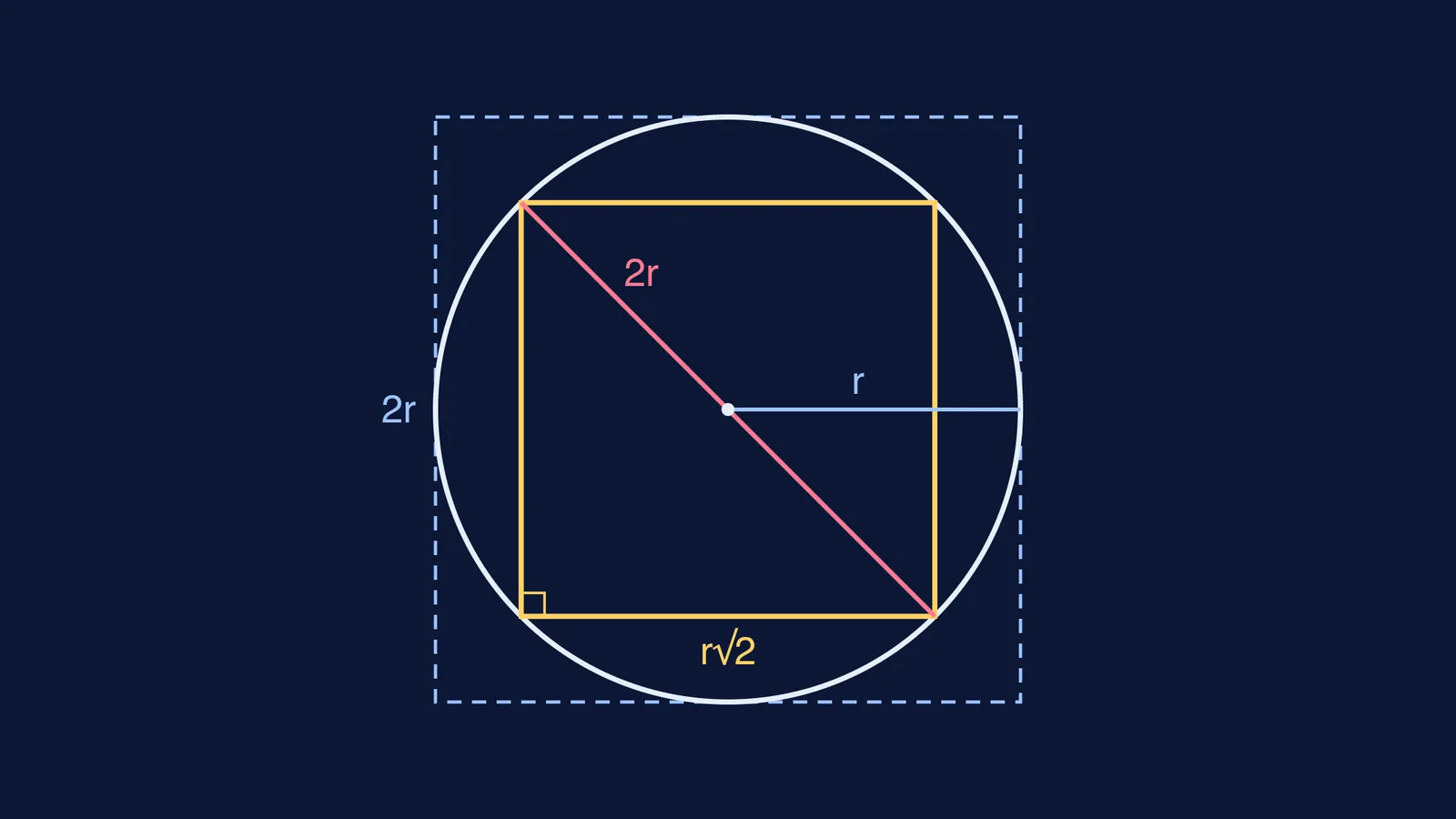
If a square sits inside a circle with all four corners on the circle, its side is r√2, where r is the radius. You do not need to memorise it: one picture and one use of Pythagoras gets you there, along with the area and the reverse case.
Why is the diagonal of an inscribed square equal to the diameter?
A square's two diagonals are equal and cut each other in half at the centre. So the centre of the square is the same distance from all four corners. That point is the centre of the circle through the corners, and that distance is the radius.
Each diagonal is therefore two radii laid end to end: it passes through the centre and touches the circle at both ends. That makes it a diameter, of length 2r.
There is a second way to see it. Each corner of the square is a right angle, and Thales' theorem on Wolfram MathWorld states that an angle inscribed in a semicircle is a right angle. Run it in reverse: a right angle with its vertex on a circle must stand on a diameter. The diagonal joining the other two corners is that diameter.
What is the side of a square inscribed in a circle of radius r?
Call the side a. The diagonal and two sides form a right-angled triangle, so:
a² + a² = (2r)²
2a² = 4r²
a² = 2r²
a = r√2
The side of a square inscribed in a circle of radius r is r√2, about 1.414r.
You can check this against a reference. The Wolfram MathWorld entry on the square gives the circumradius of a square with side a as R = (√2/2)a. Put a = r√2 into that and you get R = (√2/2)(r√2) = r, as it should be.
A quick coordinate check works too. With the centre at the origin, the corners are at (±r/√2, ±r/√2). Each satisfies x² + y² = r²/2 + r²/2 = r², so every corner is on the circle.
What changes when the circle is inside the square?
Now the circle touches the middle of each side. The distance across the square, side to side, is the circle's diameter. So the side is 2r and the area is 4r².
This matches the inradius on the MathWorld square page: a square of side a has inradius a/2.
Put the two cases next to each other and a neat fact drops out. For the same circle, the outer square has area 4r² and the inner square has area 2r², so the outer square is exactly twice the inner one. The diagram at the top shows both: the dashed square outside, the solid square inside.
Worked example: the shaded region
This is a common Class 10 style of question. A square is inscribed in a circle of radius 7 cm. Find the area of the region inside the circle but outside the square. Use π = 22/7.
Side of the square: 7√2 cm, about 9.9 cm.
Area of the square: 2r² = 2 × 49 = 98 cm².
Area of the circle: πr² = (22/7) × 49 = 154 cm².
Shaded area: 154 − 98 = 56 cm².
Now the reverse. A circle of radius 7 cm is inscribed in a square. The side is 14 cm, the square's area is 196 cm², and the region between them is 196 − 154 = 42 cm².
For more of these add-or-subtract problems, see our guide to the area of a shaded region with circles and squares.
Which mistakes cost marks here?
Using r instead of 2r for the diagonal. The diagonal crosses the whole circle, so it is the diameter.
Writing the side as 2r for the inscribed square. That is the circumscribed case.
Giving the side as r√2 when the question gave the diameter d. Then the side is d/√2.
Squaring a rounded side. A side of 9.9 cm gives 98.01 cm², not 98 cm², so use 2r² for the area instead.
Where does this idea go next?
The square is the n = 4 case of a regular polygon in a circle. The same centre-to-corner triangle gives the general formula in our post on the area of a regular polygon with n sides. And if you like finding a side from diagonals, the side of a rhombus from its diagonals uses the same halving trick.
If you want more practice, the Fermi Problem Library has worked problems with a step-by-step solver that explains the reasoning rather than printing an answer, so you can see which length is the diameter before any algebra starts. If the gap is Pythagoras or circle basics themselves, the Fermi Concept Library gives each mathematics concept its own lesson.