

On this page
Shaded-region questions look scary because the shaded shape has no name: a leaf, a curved star, "whatever is left" inside a square. You never need a formula for that shape. You need two decisions: which named pieces it is made of, and whether to add them or subtract them from something bigger.
Which formulas do you actually need?
Most school-level shaded-region problems use only four building blocks: the square or rectangle, the triangle, the full circle (πr²) and the sector. NCERT's Class 10 chapter Areas Related to Circles gives the sector formula: the area of a sector of angle θ is (θ/360) × πr², with θ in degrees.
The same chapter defines a segment through subtraction: area of a segment = area of the sector − area of the triangle. That one line is the whole method in miniature. For a refresher, see our explainer on degrees, radians, arc length and sector area, and for chord-cut pieces see the area of a minor segment of a circle.
Two quick facts save time. A quadrant is a sector with θ = 90°, so its area is πr²/4. Four equal quadrants of radius r together make exactly one full circle, πr².
How do you decide whether to add or subtract?
Before you write any numbers, look at the shaded part and ask three questions.
Is the shaded part built from pieces placed side by side? If you can cut it along straight lines or radii into sectors, triangles and rectangles that do not overlap, add them.
Is the shaded part "what's left over"? If it is a big shape with pieces cut out of it (a square minus circles, a circle minus a square), subtract the unshaded pieces from the whole.
Do two pieces overlap? Add both pieces, then subtract the overlap once, because you counted it twice.
Write the plan in words before using numbers, for example "shaded = square − 4 quadrants". It stops you from mixing up pieces halfway through.
Worked example 1: a square with quadrants at each corner
A square has side 14 cm. At each corner, a quadrant of radius 7 cm is drawn. The region inside the square but outside all four quadrants is shaded. Find its area. (Use π = 22/7.)
The shaded part is what's left, so subtract.
Plan: shaded = square − 4 quadrants
Square: 14 × 14 = 196 cm²
Four quadrants of radius 7 cm = one circle: (22/7) × 7 × 7 = 154 cm²
Shaded area: 196 − 154 = 42 cm²
Worked example 2: the leaf inside a square
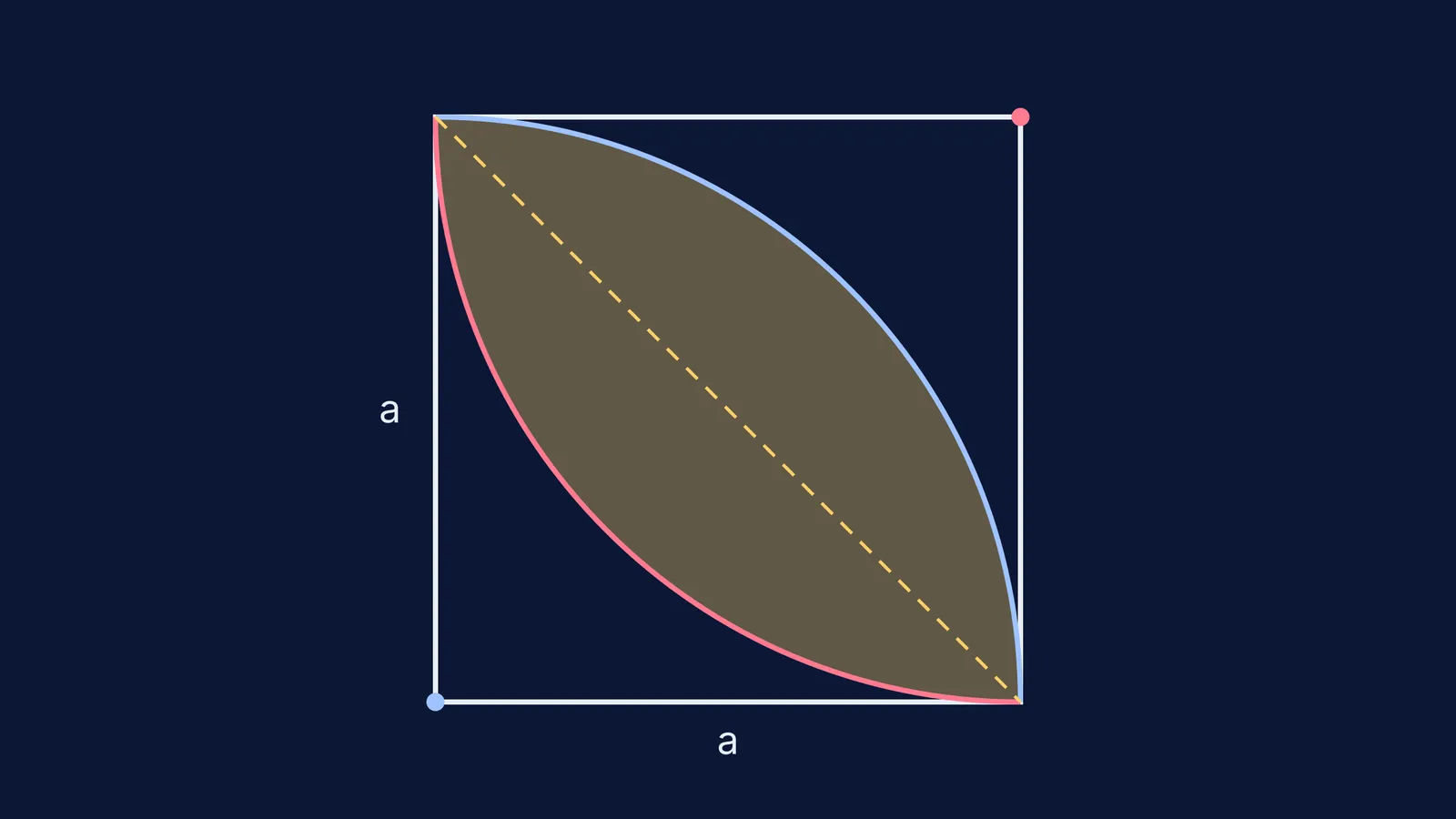
A square has side 14 cm. Two quadrants of radius 14 cm are drawn, centred at two opposite corners. They overlap in a leaf shape, which is shaded. This is the figure at the top of this post.
Solve it two ways and check that they agree.
Method A, overlap (add, then subtract). The two quadrants together cover the whole square, but the leaf is covered twice.
One quadrant: (1/4) × (22/7) × 14 × 14 = 154 cm²
Leaf = quadrant + quadrant − square = 154 + 154 − 196 = 112 cm²
Method B, split into segments (add). The diagonal cuts the leaf into two equal segments.
One segment = quadrant − right triangle = 154 − (1/2 × 14 × 14) = 154 − 98 = 56 cm²
Leaf = 2 × 56 = 112 cm²
Both give 112 cm². In general, for a square of side a, the leaf is a²(π/2 − 1).
What mistakes cost marks in shaded-region questions?
Radius or diameter? If a circle "touches all four sides" of a square of side 14 cm, its diameter is 14 and its radius is 7.
Wrong value of π. NCERT's exercise says "Unless stated otherwise, use π = 22/7", and some questions ask for 3.14 instead. Use what the question says.
Counting an overlap twice. If two shapes share a region, subtract the shared part once.
Forgetting square units. Area is in cm² or m², not cm.
Assuming corner arcs always make a full circle. Equal-radius sectors at a quadrilateral's four corners make one circle because the angles total 360°; at a triangle's three corners they make half a circle.
How should you practise?
Take five shaded-region questions from your textbook or past papers. For each, write only the plan in words ("shaded = circle − square", "leaf = 2 segments"). Then solve the two you were least sure about, and check one by a second method. A final sanity check: the shaded area must be positive and smaller than the whole figure.
If you get stuck on a figure, the Fermi Problem Library has worked problems with a step-by-step solver that explains the reasoning rather than printing an answer. If the gap is a concept, such as sectors or segments, the Fermi Concept Library gives each concept its own lesson.


