On this page
If you are revising the plant kingdom for CBSE or NEET-UG, the sporophyte and gametophyte question turns up in three forms: a definition, a "which is dominant" MCQ and a ploidy puzzle. All three come from two ideas: what each generation is made of, and what it makes.
What is the difference between a sporophyte and a gametophyte?
Land plants have a life cycle with "an alternation between a haploid, gametophytic and a diploid, sporophytic multicellular generation", as Karl Niklas and Ulrich Kutschera describe it in New Phytologist.
Sporophyte: diploid (2n). It makes spores by meiosis, so the spores are haploid.
Gametophyte: haploid (n). It grows from a spore and makes gametes.
NCERT's Class 11 chapter puts the bryophyte version plainly: the main plant body "produces gametes, hence is called a gametophyte", and some cells of the sporophyte "undergo reduction division (meiosis) to produce haploid spores" (NCERT Biology Class 11, Plant Kingdom).
The names do the remembering for you: the sporophyte is the spore plant and the gametophyte is the gamete plant. Because the gametophyte is already haploid, it does not need meiosis to make gametes. In flowering plants, the embryo sac forms through mitotic divisions, and the generative cell of the pollen grain divides mitotically to give two male gametes (NCERT Biology Class 12, Sexual Reproduction in Flowering Plants).
Which generation is dominant in each plant group?
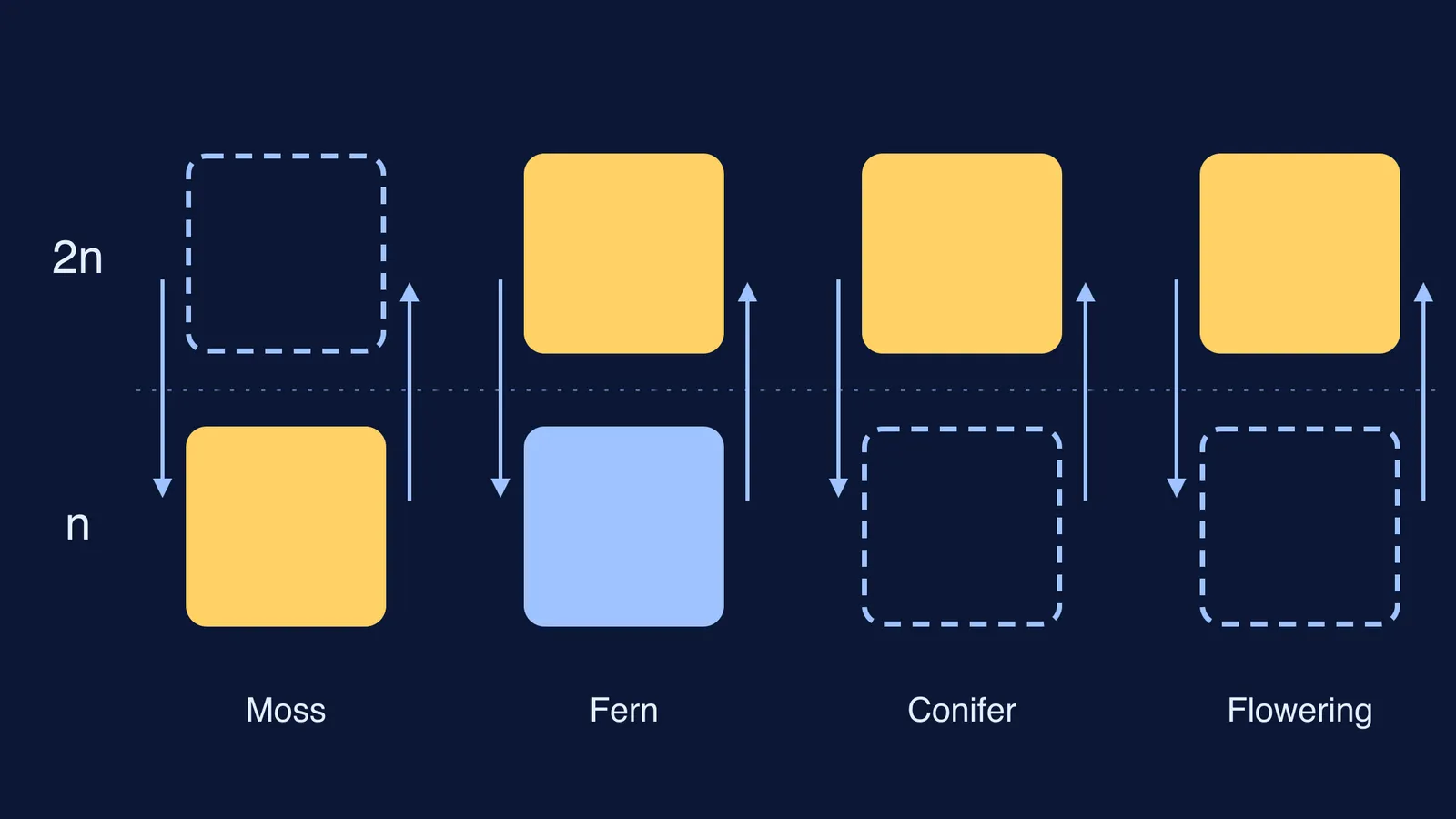
The dominant generation is the one you see and call "the plant". From bryophytes to flowering plants, it shifts from the gametophyte to the sporophyte. The points below come from NCERT's Plant Kingdom chapter unless another link is given.
The algal ancestors of land plants: Niklas and Kutschera review evidence that land plants descended from a charophyte-like ancestor whose life cycle had only a haploid multicellular generation.
Bryophytes (mosses, liverworts): the gametophyte dominates. The sporophyte, a foot, seta and capsule, "is not free-living but attached to the photosynthetic gametophyte and derives nourishment from it".
Pteridophytes (ferns, horsetails): the sporophyte dominates, with true roots, stems, leaves and vascular tissue. The gametophyte is a small, free-living, mostly photosynthetic prothallus.
Gymnosperms (Cycas, Pinus): the sporophyte dominates. The male and female gametophytes "do not have an independent free-living existence", and the pollen grain is the reduced male gametophyte.
Angiosperms (flowering plants): the flowering plant is the sporophyte. The pollen grain is the male gametophyte and the embryo sac, inside the ovule, is the female gametophyte; a typical embryo sac is 8-nucleate but 7-celled (NCERT Class 12).
Ferns are the turning point: the sporophyte dominates, yet both generations live on their own. For more on the fern gametophyte, read what a prothallus is. For why a moss capsule cannot survive alone, see why the bryophyte sporophyte depends on the gametophyte.
Where does meiosis happen in a moss, a fern and a flowering plant?
NCERT asks this as an end-of-chapter exercise: when and where does reduction division take place in a liverwort, a moss, a fern, a gymnosperm and an angiosperm? Check this worked answer against the Class 11 and Class 12 chapters. The pattern: meiosis always happens in the sporophyte, wherever spores are made.
Liverwort and moss: inside the capsule of the sporophyte. The spores germinate into new gametophytes.
Fern: in the spore mother cells inside sporangia, which are subtended by leaf-like sporophylls.
Gymnosperm: in the cones. In the ovule, the megaspore mother cell divides by meiosis into four megaspores; microspores form in the microsporangia of male cones.
Angiosperm: in the anther, where pollen mother cells form microspore tetrads (microsporogenesis), and in the ovule, where the megaspore mother cell gives four megaspores (megasporogenesis).
How do you work out ploidy in a sporophyte vs gametophyte question?
Use this three-step check on any cell an exam names:
Decide which generation the structure belongs to. Protonema, moss leaves, prothallus, Marchantia gemmae, pollen grains and the embryo sac are all gametophyte.
A gametophyte cell is n. A sporophyte cell, such as a capsule, fern leaf or root meristem cell, is 2n.
If it is a spore, it is n, just made by meiosis. If it is a zygote, it is 2n, just made by fertilisation.
Try it on items from NCERT's ploidy exercise. A protonemal cell of a moss, a leaf cell of a moss, a prothallus cell of a fern, a gemma cell of Marchantia and the ovum of a liverwort are all n. A zygote of a fern and a meristem cell of a monocot are 2n. The exception is the primary endosperm nucleus of a dicot: it is 3n, from a male gamete fusing with two polar nuclei (NCERT Class 12).
If one of these structures still feels shaky, the Fermi Concept Library gives every biology concept its own lesson and its place in the map. For practice beyond recall, the Fermi Problem Library has worked problems with a step-by-step solver that explains the reasoning rather than printing an answer.
Next, see how both generations fit into haplontic, diplontic and haplodiplontic life cycles.