On this page
Look closely at moss on a wet wall in the monsoon and you can see both generations of a bryophyte at once. The soft green cushion is the gametophyte. The thin stalk with a small capsule on top, growing up out of it, is the sporophyte. The NCERT Class 11 chapter on the plant kingdom says the sporophyte "is not free-living but attached to the photosynthetic gametophyte and derives nourishment from it" (NCERT Biology Class 11, Chapter 3: Plant Kingdom). Here is why, and how to write it in an exam answer.
What does "dominant gametophyte" mean in bryophytes?
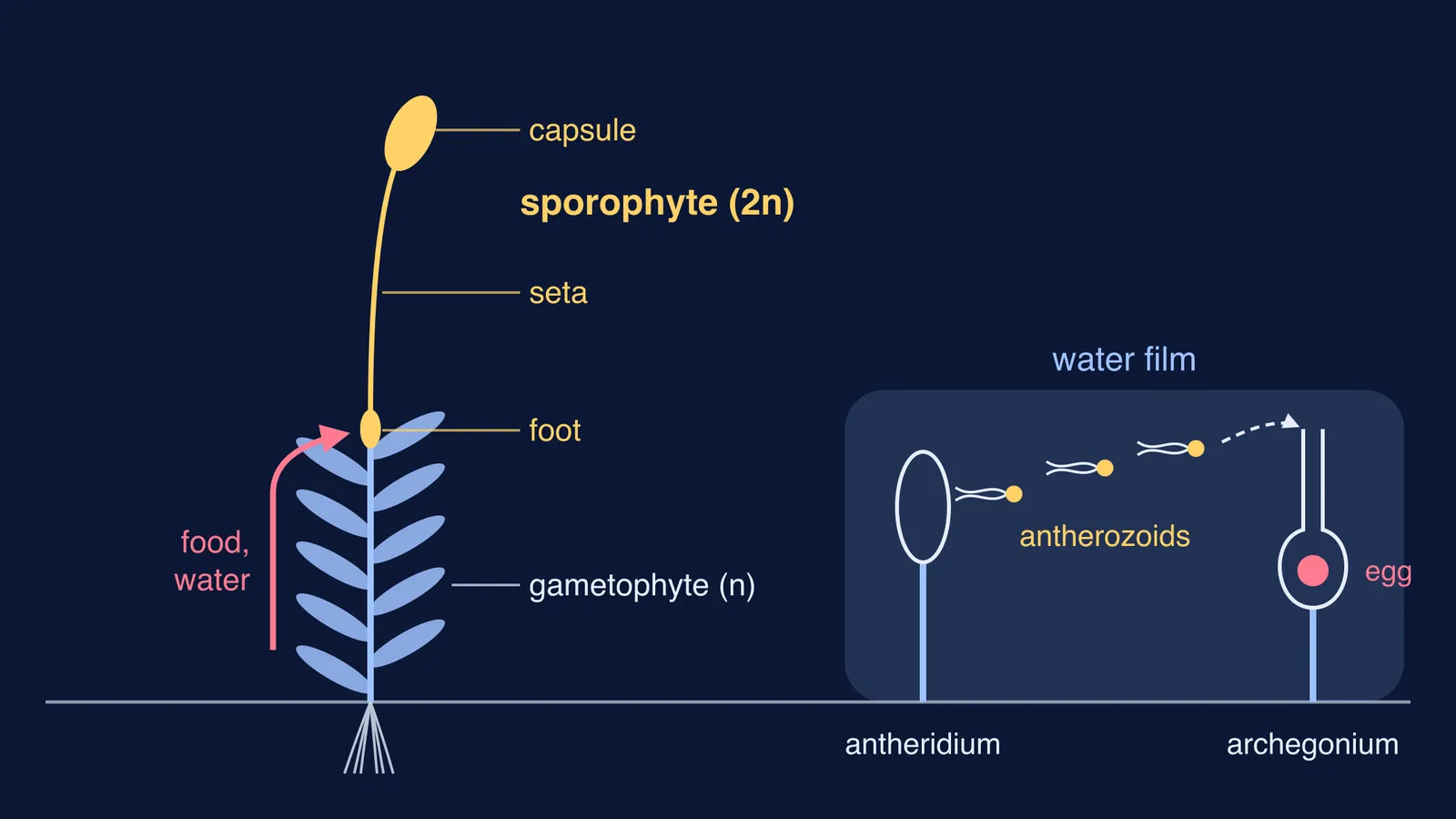
In bryophytes, the main plant body is haploid (n) and produces gametes, so it is called the gametophyte (NCERT, Plant Kingdom). It lives on its own: it photosynthesises, is anchored by rhizoids, and carries the sex organs: antheridia (male) and archegonia (female).
In mosses, the gametophyte has two stages: the protonema, a creeping, green, branched and often filamentous stage that grows from a spore, and the leafy stage, which bears the sex organs (NCERT). In a liverwort such as *Marchantia*, the gametophyte is a flat thallus.
The sporophyte (2n) grows from the zygote and has three parts: foot, seta and capsule. Inside the capsule, meiosis produces haploid spores, and each spore grows into a new gametophyte (NCERT). Ferns are the other way round: the plant you see is the sporophyte, and the gametophyte is a tiny fern prothallus. To see where bryophytes sit among the other patterns, read our guide to haplontic, diplontic and haplodiplontic life cycles.
Why does the bryophyte sporophyte depend on the gametophyte?
Where it grows. The zygote is never released. The sporophyte develops from it on the gametophyte, and its foot stays sunk in gametophyte tissue. In *Marchantia*, the anchor-shaped foot is embedded on the underside of the archegoniophore, the stalk that carries the female sex organs (Henry, Lopez and Renzaglia, Journal of Plant Research, 2020).
What it lacks. The sporophyte is only a foot, a seta and a capsule. It has nothing that reaches the soil, so it cannot take in water or minerals for itself.
How food crosses over. The foot sits in a placenta. The same 2020 paper describes this as a junction across which water and nutrients move from the gametophyte to the dependent sporophyte, with sugars and amino acids among them (Journal of Plant Research). The paper also reports that both generations have transfer cells with extensive wall ingrowths at this junction, cells specialised for moving material across.
"Dependent" does not mean the sporophyte cannot photosynthesise at all. A 2021 study of the hornwort *Phaeoceros*, from a third group of bryophytes, notes that its sporophyte can fix enough carbon to maintain itself, but needs sugar and nutrients from the gametophyte to keep growing (Henry et al., Bryophyte Diversity and Evolution, 2021).
Why do bryophytes need water to reproduce?
The antheridium produces biflagellate antherozoids. The archegonium is flask-shaped and holds a single egg. The antherozoids are released into water, reach the archegonium, and one fuses with the egg to form the zygote (NCERT, Plant Kingdom). With no film of water, there is no fertilisation, no zygote and so no sporophyte.
That is why NCERT calls bryophytes the amphibians of the plant kingdom: they can live on soil but depend on water for sexual reproduction, and they usually grow in damp, humid, shaded places (NCERT).
One finding goes beyond the syllabus. In a 2006 study in *Science*, Nils Cronberg, Rayna Natcheva and Katarina Hedlund showed that fertile moss shoots attract springtails and mites, which carry moss sperm and enhance fertilisation (Science, 2006). For your exam, water is still the answer NCERT gives.
How do you write this in a 3-mark answer?
Try this question: "Why is the moss sporophyte called dependent, and why do bryophytes need water for fertilisation?" A full answer makes four points, one line each:
The main plant body is the haploid gametophyte. It is photosynthetic and independent.
The sporophyte (foot, seta, capsule) develops from the zygote on the gametophyte and is not free-living.
Its foot stays embedded in the gametophyte and takes nourishment from it.
The male gametes are biflagellate antherozoids. They must swim through water to the archegonium to fertilise the egg.
Common slips to check for:
Calling the leafy moss plant the sporophyte. It is the gametophyte.
Writing that spores form by mitosis. They form by meiosis inside the capsule.
Giving bryophytes true roots, stems or leaves. NCERT says they lack them.
Mixing up antherozoids (swimming male gametes) and pollen.
Swapping bryophytes and ferns. In pteridophytes the sporophyte is the main plant.
If gametophyte, sporophyte and alternation of generations still blur together, the Fermi Concept Library gives each concept in biology its own lesson and shows its place in the map, so you can see how the ideas connect. For more practice spotting the traits that set each plant group apart, try our plant groups odd-one-out facts.