On this page
Both are single cells. In ferns and mosses both are usually haploid, and the same species makes both at different stages of its life. Yet one can build a whole new plant by itself, and the other does nothing until it meets a partner. That one difference is the key to spore-vs-gamete questions in Class 11 botany.
What is the difference between a spore and a gamete?
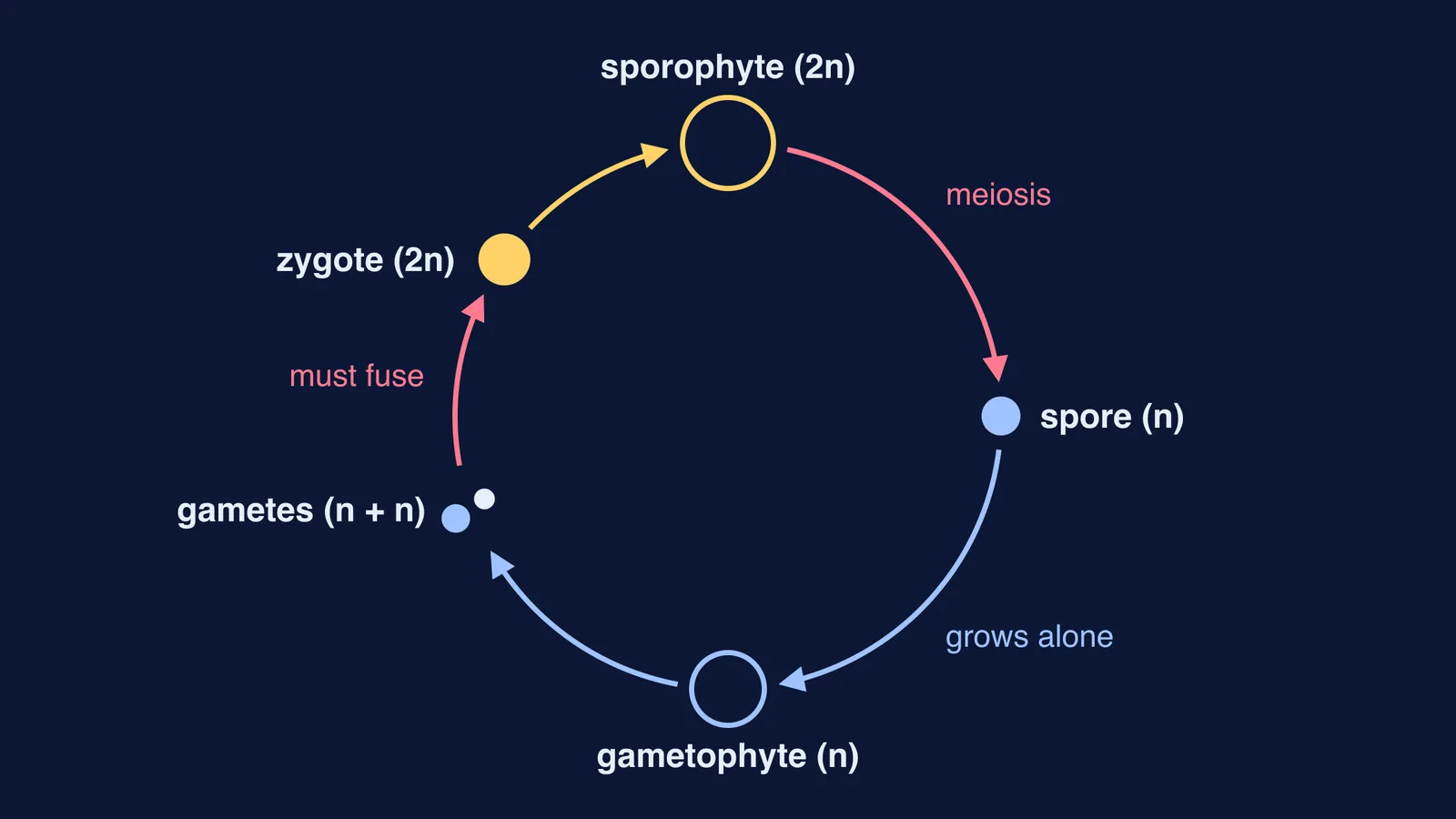
A spore germinates and develops on its own, while a gamete must combine with another gamete to form a zygote before developing further, as the Wikipedia entry on spores puts it.
A gamete is a reproductive cell of an animal or plant; in animals the female gametes are eggs and the male gametes are sperm, according to the NHGRI genetics glossary.
In plants the two cells come from different stages. OpenStax Biology 2e explains that diploid sporocytes, or mother cells, produce haploid spores by meiosis, while the gametophyte gives rise to gametes by mitosis. A life cycle with both a haploid and a diploid multicellular stage is called alternation of generations.
Side by side:
Needs a partner? Spore: no. Gamete: yes, it must fuse with another gamete.
Made by: Spore: the sporophyte, by meiosis. Gamete: the gametophyte, by mitosis.
Grows into: Spore: a gametophyte. Gamete: nothing alone; after fusion, a zygote that becomes the sporophyte.
Made in: Spores form in a sporangium, literally a vessel for spores. Sperm come from the antheridium and the egg sits in the archegonium.
Built for: Spores of seedless plants have thick walls containing a tough polymer, sporopollenin. Their sperm have flagella and swim through moisture to the archegonium.
How does a fern use spores and gametes?
Turn over a mature fern frond and you see brown dots. OpenStax explains that these are sori, groups of sporangia on the underside of each mature frond. Our post on the brown dots under fern leaves shows what to look for on a real plant.
The fern cycle, from the same OpenStax section:
The leafy fern you see is the sporophyte, the dominant stage.
Spores are produced by meiosis in the sporangia and released into the air.
A spore that lands somewhere suitable germinates by itself into a small heart-shaped gametophyte, the prothallus. No fusion: this is the spore's job.
The prothallus produces both antheridia and archegonia.
Sperm with multiple flagella swim to the archegonium, which releases a chemical that guides them, and fuse with the egg. This is the gametes' job.
The zygote develops into a new sporophyte that emerges from the archegonium.
Step 5 is why seedless plants need a moist place to reproduce: the sperm has to swim.
How does a moss use spores and gametes?
The order is the same in a moss, but the balance flips. OpenStax notes that moss gametophytes are the dominant phase of the life cycle, so the green cushion you see is haploid.
A haploid spore germinates and forms first a protonema, then the leafy gametophyte.
Male and female gametangia develop at the tips of separate gametophores.
The sperm swims down the neck of the archegonium and unites with the egg.
The zygote grows into a sporophyte that stays attached to the gametophyte by its foot and depends on it for nutrients.
Spore mother cells in the sporangium undergo meiosis to make haploid spores, released as the peristome opens and closes with moisture.
For the moss NCERT uses, see our walk-through of the Funaria moss life cycle from protonema to sporophyte.
How do you tell a spore from a gamete in an exam question?
Run the cell through three questions, in this order:
Can it grow into something without a partner? Yes means spore.
Which generation made it? Sporophyte means spore; gametophyte means gamete.
What comes next? A gametophyte means it was a spore; a zygote means two gametes fused.
Worked examples:
"The prothallus of a fern develops from a ___." Use question 3 in reverse: the prothallus is a gametophyte, and gametophytes grow from spores. Answer: spore.
"In a moss, the cell made by meiosis in the sporangium is a ___." Use question 2: the sporangium belongs to the sporophyte. Answer: spore.
"The cell that swims to the archegonium in a fern is a ___." Use question 1: it cannot grow alone and must reach the egg. Answer: male gamete, or sperm.
If n and 2n still feel shaky, read haploid vs diploid cells with plant and animal examples first. To see where alternation of generations sits beside meiosis, mitosis and fertilisation, the Fermi Concept Library gives every biology concept its own lesson and its place in the map. When a life-cycle question goes wrong, the Fermi Problem Library has a step-by-step solver that explains the reasoning rather than printing an answer.
Try the three questions on the next life-cycle diagram you meet, and label every arrow "alone" or "fuse".