

On this page
Funaria is the moss that the NCERT Class 11 Biology chapter on the plant kingdom names first among its examples of mosses, and its Figure 3.2 shows a Funaria gametophyte with the sporophyte growing on top (NCERT, Plant Kingdom). For CBSE and NEET-UG, questions on it usually come down to two things: the order of the stages, and which parts are haploid or diploid. Here is the cycle, then a quick way to draw it.
What are the stages of the Funaria moss life cycle?
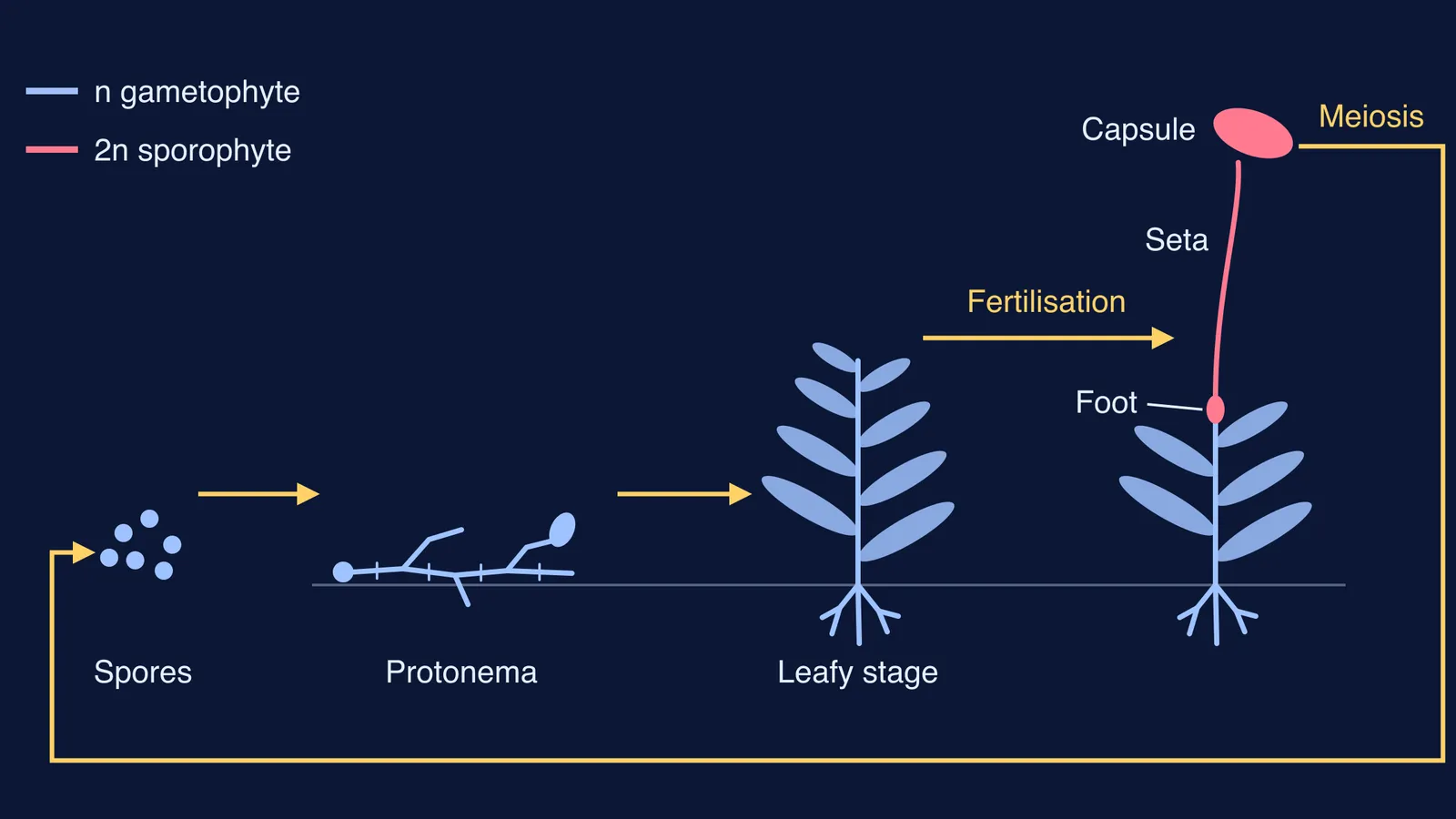
The main stage in a moss's life cycle is the gametophyte, and it comes in two stages: protonema and leafy stage (NCERT, Plant Kingdom). In order:
Spore (n). A haploid spore lands on damp soil and germinates.
Protonema (n). NCERT calls it "a creeping, green, branched and frequently filamentous stage" that develops directly from the spore.
Leafy stage (n). It grows from the secondary protonema as a lateral bud, and has upright, slender axes with spirally arranged leaves and multicellular, branched rhizoids.
Sex organs and fertilisation. Antheridia and archegonia form at the apex of the leafy shoots. In bryophytes, the antherozoids are released into water and reach the archegonium, where one fuses with the egg to form a zygote.
Sporophyte (2n). The zygote grows into a sporophyte made of a foot, seta and capsule.
Meiosis and new spores (n). Spores form inside the capsule after meiosis, and the cycle starts again.
What is the protonema, and how does the leafy stage grow from it?
The protonema is the young moss: green threads on the soil with no leaves and no sex organs. The leafy shoots you see on a wet wall start as buds on it, and in the lab Funaria gets there within weeks. In a 2020 study in Frontiers in Plant Science, researchers spread Funaria hygrometrica spores on a nutrient medium. They collected germinating spores after 3 days and protonema at 2 weeks, and young leafy buds emerged after 3 weeks (Kirbis et al., 2020). Those are lab conditions, not an outdoor timetable.
What are the foot, seta and capsule of the moss sporophyte?
The zygote and the sporophyte that grows from it are the only diploid (2n) stages of the cycle, and the sporophyte never lives on its own. NCERT says the bryophyte sporophyte "is not free-living but attached to the photosynthetic gametophyte and derives nourishment from it" (NCERT, Plant Kingdom).
Foot: the base, embedded in the tip of the leafy shoot. It anchors the sporophyte and draws nourishment from the gametophyte.
Seta: the stalk that lifts the capsule into the air. In Funaria hygrometrica, the seta is 2 to 4.5 cm long (Kirbis et al., 2020).
Capsule: where spores form after meiosis. The same paper describes it as asymmetric, with a lid (operculum) that comes off to reveal small hygroscopic teeth, the peristome, whose movement helps control spore release.
NCERT sums this up as mosses having "an elaborate mechanism of spore dispersal", and its sporophyte is "more elaborate than that in liverworts". The reason the sporophyte depends on the leafy plant is explained in our post on why the bryophyte sporophyte depends on the gametophyte.
How do you draw and label the moss life cycle in an exam?
Use two colours, or two line styles if you only have a pen:
Draw a loop of five boxes: spore, protonema, leafy stage, sporophyte on the leafy stage, capsule releasing spores.
Draw everything haploid (n) in one style and the sporophyte (2n) in the other. Only the zygote and the sporophyte (foot, seta and capsule) are 2n.
Write "fertilisation" on the arrow where n becomes 2n, and "meiosis" at the capsule where 2n becomes n.
Label rhizoids, leaves and main axis on the gametophyte, and foot, seta and capsule on the sporophyte, as in NCERT Figure 3.2.
Then check for these common slips:
Spores germinating straight into a leafy plant (the protonema stage is missing).
The sporophyte drawn as a separate plant on the soil.
Meiosis placed at spore germination instead of in the capsule.
The calyptra labelled as part of the sporophyte.
Where does Funaria fit in the plant kingdom chapter?
Mosses are one half of the bryophytes; liverworts like Marchantia are the other. Both need water for fertilisation, which is the idea behind why bryophytes are called amphibians of the plant kingdom. For the Indian side of the story, read about Shiv Ram Kashyap and the study of mosses and liverworts in India.
If the n and 2n stages still blur together, the Fermi Concept Library gives every biology concept its own lesson and its place in the map, so you can set the bryophyte life cycle beside algae and pteridophytes. To practise, the Fermi Problem Library has worked problems with a step-by-step solver that explains the reasoning rather than printing an answer.


