On this page
Bryophytes are often the least loved part of the NEET Plant Kingdom chapter: small, green and easy to confuse. One Indian botanist spent his life on them, walking the Western Himalayas to find species no one had described. This post covers who Shiv Ram Kashyap was, what he found, and how to use his favourite plants, the liverworts, to get the bryophyte questions right.
Who was Shiv Ram Kashyap?
The fullest record is his obituary by H. Chaudhuri in Current Science, December 1934. Kashyap was born on 6 November 1882 at Jhelum and died suddenly at Lahore on 26 November 1934, of heart failure. The obituary says that even half an hour before his death he was at his work.
His early path was unusual. He trained in medicine first, at the Medical School in Agra, receiving his diploma in 1904 at the top of the list, and served two years in the Medical Service of the United Provinces. As a private candidate he also topped the Panjab University's B.Sc. examination. In 1906 he left medicine to become Assistant Professor of Biology at Government College, Lahore. He passed the M.Sc. in botany in 1909, went to Cambridge in 1910, and took honours in the Natural Sciences Tripos in 1912. Back in Lahore he became Professor of Botany, and from 1919 University Professor.
What honours did he receive?
The same obituary lists them. He was the first secretary of the Indian Botanical Society, founded in 1920, and its President in 1925. He presided over the Botany Section of the Indian Science Congress at Bombay in 1919, and over the whole Indian Science Congress in 1932, which the obituary calls "the highest honour that the Indian scientists could confer on him." Panjab University gave him an honorary Doctor of Science in 1933.
What did he discover?
The obituary names three main subjects: the sexual generation of Equisetum (horsetails), the liverworts of the Western Himalayas, and the flora of Tibet. One of his early papers described the sexual stage of Equisetum debile growing at Lahore, which looked quite different from what was known from European and American species.
Liverworts were his chief subject. He "described 4 new genera and over 30 new species of Liverworts." His monograph, Liverworts of the Western Himalayas and the Panjab Plain, Part I published by the University of the Panjab in 1929 and Part II in 1932, brought them together. In the 1929 volume, four genera carry his name as author: Stephensoniella, Aitchisoniella, Sauchia and Sewardiella.
In its preface he explains why he wrote it. The existing works on Indian liverworts were in Latin, without illustrations, and either out of date or too large and costly for an ordinary student. He wanted a handy, illustrated volume that would get Indian students interested in this group.
The obituary also describes him as a great traveller who crossed the Himalayas into Tibet at nine different places, collecting plants, and who kept planning field trips after falling seriously ill on one.
What does NEET expect you to know about bryophytes?
The NCERT Class 11 chapter Plant Kingdom gives the core facts. Use Kashyap's liverworts as your anchor example:
Amphibians of the plant kingdom. Bryophytes live on land but need water for sexual reproduction.
The main plant body is haploid. It makes gametes, so it is the gametophyte.
Sex organs. The antheridium makes biflagellate antherozoids; the flask-shaped archegonium holds a single egg. Fertilisation needs water.
The sporophyte is not free-living. It stays attached to the gametophyte and depends on it for food. Some of its cells undergo meiosis to form haploid spores.
Liverworts. The plant body is usually a flat, dorsiventral thallus, as in Marchantia. Asexual reproduction is by fragmentation or by gemmae, green multicellular buds in gemma cups.
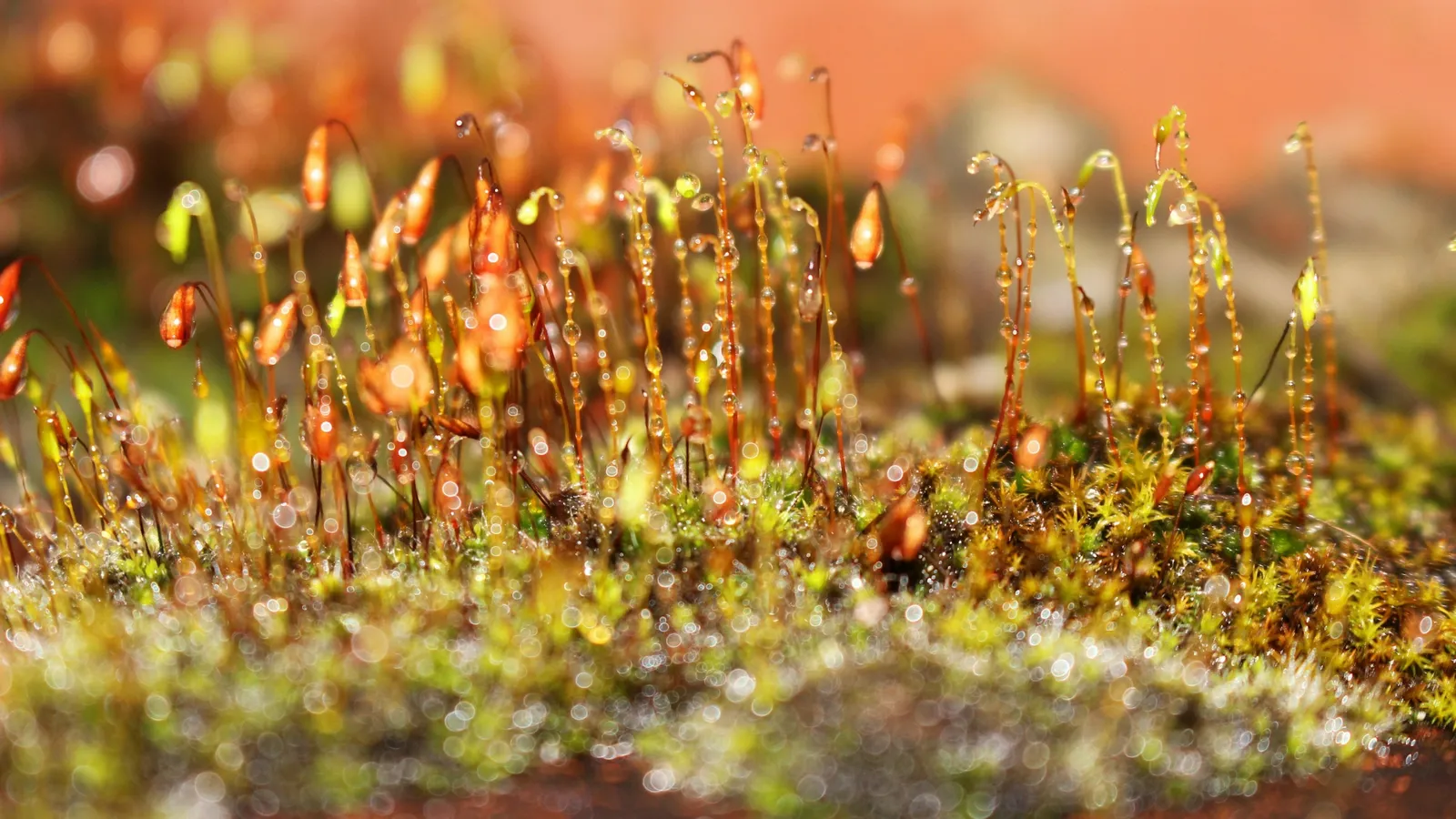
Mosses. The gametophyte has two stages, the protonema and the leafy stage. Examples are Funaria, Polytrichum and Sphagnum, which gives peat.
Worked example: ploidy questions
NCERT's exercises ask for the ploidy of cells such as a moss protonema, a moss leaf, a Marchantia gemma and a liverwort ovum. Work them out with one rule: anything that is part of the gametophyte is haploid (n); the zygote and the sporophyte before meiosis are diploid (2n).
Protonema cell of a moss. It grows from a spore, so it is gametophyte: n.
Leaf cell of a moss. The leafy stage is gametophyte: n.
Gemma cell of Marchantia. A bud of the thallus: n.
Ovum of a liverwort. Made in the archegonium on the gametophyte: n.
Capsule wall of a moss sporophyte. Sporophyte tissue before meiosis: 2n.
Which mistakes do students make?
Calling the moss plant you see diploid. In bryophytes the green plant is the gametophyte. It is the opposite of ferns and flowering plants.
Thinking bryophytes have true roots or leaves. They have rhizoids and leaf-like or stem-like structures only.
Mixing up gemmae and spores. Gemmae are asexual buds of the gametophyte. Spores come from meiosis in the sporophyte.
Our NEET Plant Kingdom guide covers algae, pteridophytes and gymnosperms in the same way.
What can a student take from Kashyap's way of working?
Go and look. His results came from years of collecting across the mountains, not from books.
Write for the student. He wrote his monograph because no affordable, illustrated book existed for Indian learners.
Put the work first. The obituary reports that when friends urged him to rest, he would reply, "Why, my life is not more important than my work." You can admire the dedication and still look after your health.
You can read about another Indian plant scientist in our post on Janaki Ammal. If alternation of generations keeps getting muddled, the Fermi Concept Library covers every concept in physics, chemistry, biology, mathematics and computing.
Try this today: draw the bryophyte life cycle from memory, mark every stage n or 2n, and check it against Figure 3.2 and the text in your NCERT book.