On this page
Green, slimy threads in a pond can be Spirogyra. NCERT's Class 10 Activity 7.4 asks you to collect dark green pond water with filaments, put one or two on a slide with a drop of glycerine, and look under a microscope (NCERT Class 10 Science, Chapter 7). Here is what you will see, part by part, and how to turn it into a clean labelled diagram.
What does Spirogyra look like under a microscope?
Spirogyra grows as unbranched filaments one cell thick, according to a 2014 study that identified the species Spirogyra ellipsospora by its shape and DNA (Wongsawad and Peerapornpisal, Saudi Journal of Biological Sciences). The same paper says there are more than 400 species of Spirogyra in the world. In S. ellipsospora, the cells were 45 to 90 µm wide and 110 to 225 µm long, each with 2 to 3 chloroplasts.
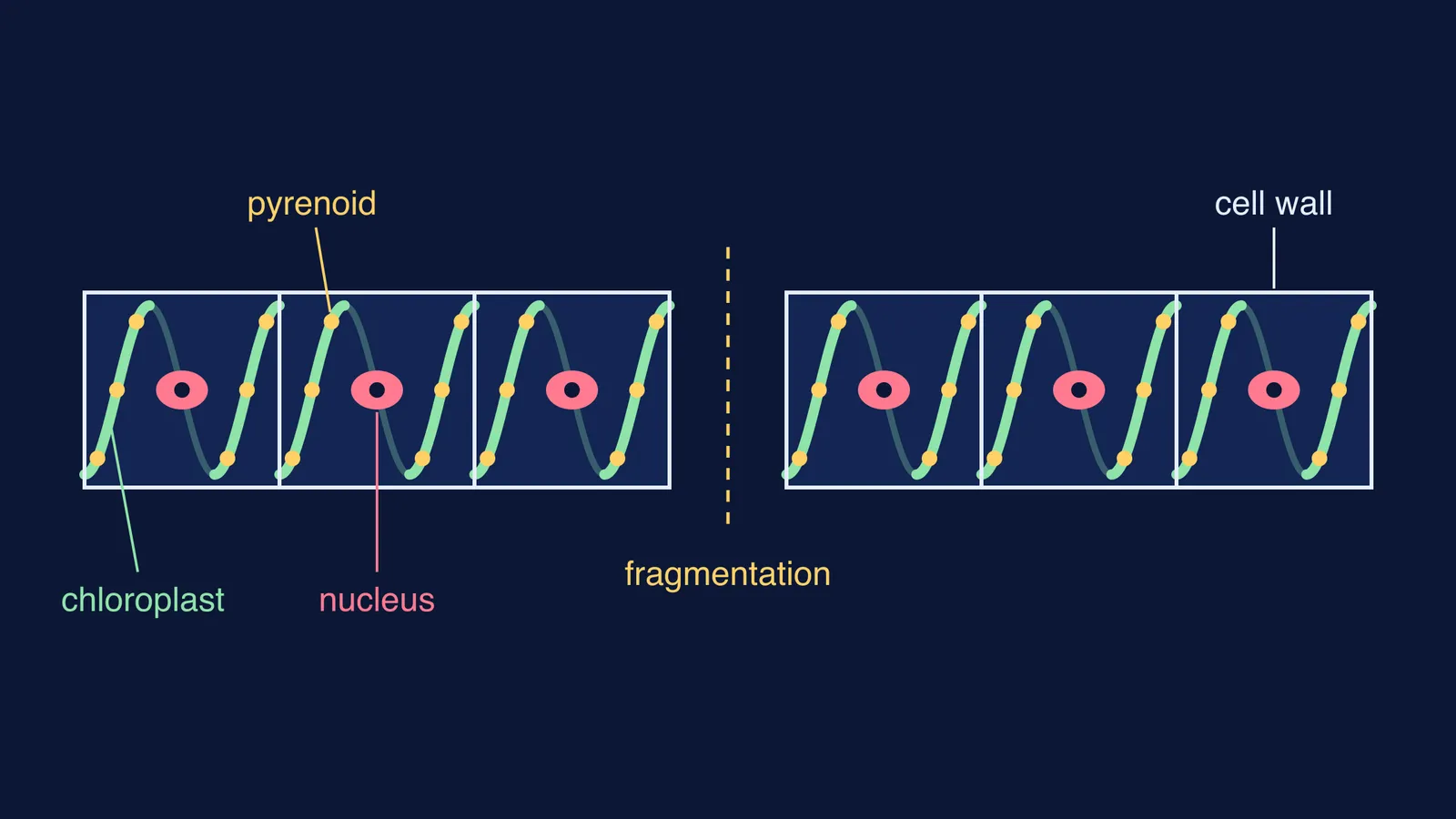
Every cell in the filament has the same parts. Look for these:
Cell wall: green algae usually have a rigid wall with an inner layer of cellulose and an outer layer of pectose (NCERT Class 11 Biology, Plant Kingdom).
Chloroplast: a green ribbon, or several, winding round the inside of the wall.
Pyrenoids: small round bodies spaced along each ribbon.
Nucleus: in the centre of the cell, with a large, dark nucleolus (A Photographic Atlas for Botany, LibreTexts/04:_Protists/4.06:_Green_Algae)).
Activity 7.4 asks whether you can identify different tissues in the filament. The expected answer is no: the cells all look alike, and NCERT builds on that observation to explain fragmentation.
Why is the Spirogyra chloroplast called spiral or ribbon-shaped?
The name Spirogyra refers to the helical or spiral arrangement of its chloroplasts, which is the main diagnostic characteristic of the genus (Wongsawad and Peerapornpisal, 2014). NCERT lists the shapes of green algal chloroplasts as discoid, plate-like, reticulate, cup-shaped, spiral or ribbon-shaped, depending on the species (NCERT Class 11 Biology, Plant Kingdom). Spirogyra combines the last two: a flat ribbon wound into a spiral.
Picture green tape wound round the inside of a glass tube. From the side, the strip nearest you shows as slanted bands all leaning one way, with the back half fainter. Compare it with the cup-shaped chloroplast of Chlamydomonas, the unicellular green alga.
What are pyrenoids in Spirogyra?
Pyrenoids are storage bodies located in the chloroplasts of most green algae, and they contain protein besides starch (NCERT Class 11 Biology, Plant Kingdom). In Spirogyra they sit along each ribbon like beads on a string. The LibreTexts botany atlas describes them as darkened regions where carbon fixation happens (A Photographic Atlas for Botany/04:_Protists/4.06:_Green_Algae)).
How does Spirogyra reproduce by fragmentation?
Spirogyra simply breaks up into smaller pieces upon maturation, and these pieces or fragments grow into new individuals (NCERT Class 10 Science, section 7.2.2). NCERT contrasts this with many multicellular organisms, whose specialised cells are organised into tissues and organs, so splitting cell by cell would not work for them. Fragmentation is easy to confuse with regeneration in Planaria; our guide to regeneration vs fragmentation sets the two side by side.
Spirogyra also reproduces sexually. Its gametes are non-flagellated but similar in size, so NCERT calls the fusion isogamous (NCERT Class 11 Biology, Plant Kingdom). Two filaments link up through a conjugation tube: one grows from each cell of one filament and induces a matching tube on the cells of the other (A Photographic Atlas for Botany/04:_Protists/4.06:_Green_Algae)).
How do you draw and label Spirogyra for the exam?
Draw two long parallel lines for the filament. Add cross walls to make three or four cells, each a little longer than wide.
In each cell, draw the chloroplast as slanted bands from one side wall to the other, all leaning the same way.
Add small circles at even gaps along each band. These are the pyrenoids.
Draw the nucleus as an oval near the centre of one cell, with a dot for the nucleolus.
Label the cell wall, the chloroplast (spiral, ribbon-shaped), a pyrenoid, the nucleus and a cross wall.
For a fragmentation question, draw a second, shorter piece beside the first with a clear gap, and write that each fragment grows into a new filament.
If the spiral still feels hard to picture, the Fermi Concept Library covers every concept in biology, each with its own lesson and its place in the map.
Which Spirogyra mistakes cost marks?
Calling the chloroplast cup-shaped. That is Chlamydomonas; Spirogyra's is spiral and ribbon-shaped.
Drawing branches. Spirogyra filaments are unbranched.
Leaving out pyrenoids, the storage bodies NCERT names for green algae.
Calling Spirogyra a blue-green alga. NCERT says cyanobacteria, also called blue-green algae, are not algae any more; Spirogyra is a green alga in Chlorophyceae. Our comparison of green, brown and red algae covers the three classes.
Writing budding or spore formation as the way it multiplies without gametes. NCERT's Class 10 example for Spirogyra is fragmentation, which the Class 11 book calls vegetative reproduction.
When you move on to practice questions, the Fermi Problem Library has worked problems with a step-by-step solver that explains the reasoning rather than printing an answer.