On this page
NCERT's Class 11 Biology, Chapter 3 fits peat, fuel, packing material and rock colonisation into a few dense lines. Here is each use, the property behind it, and a frame for a short answer.
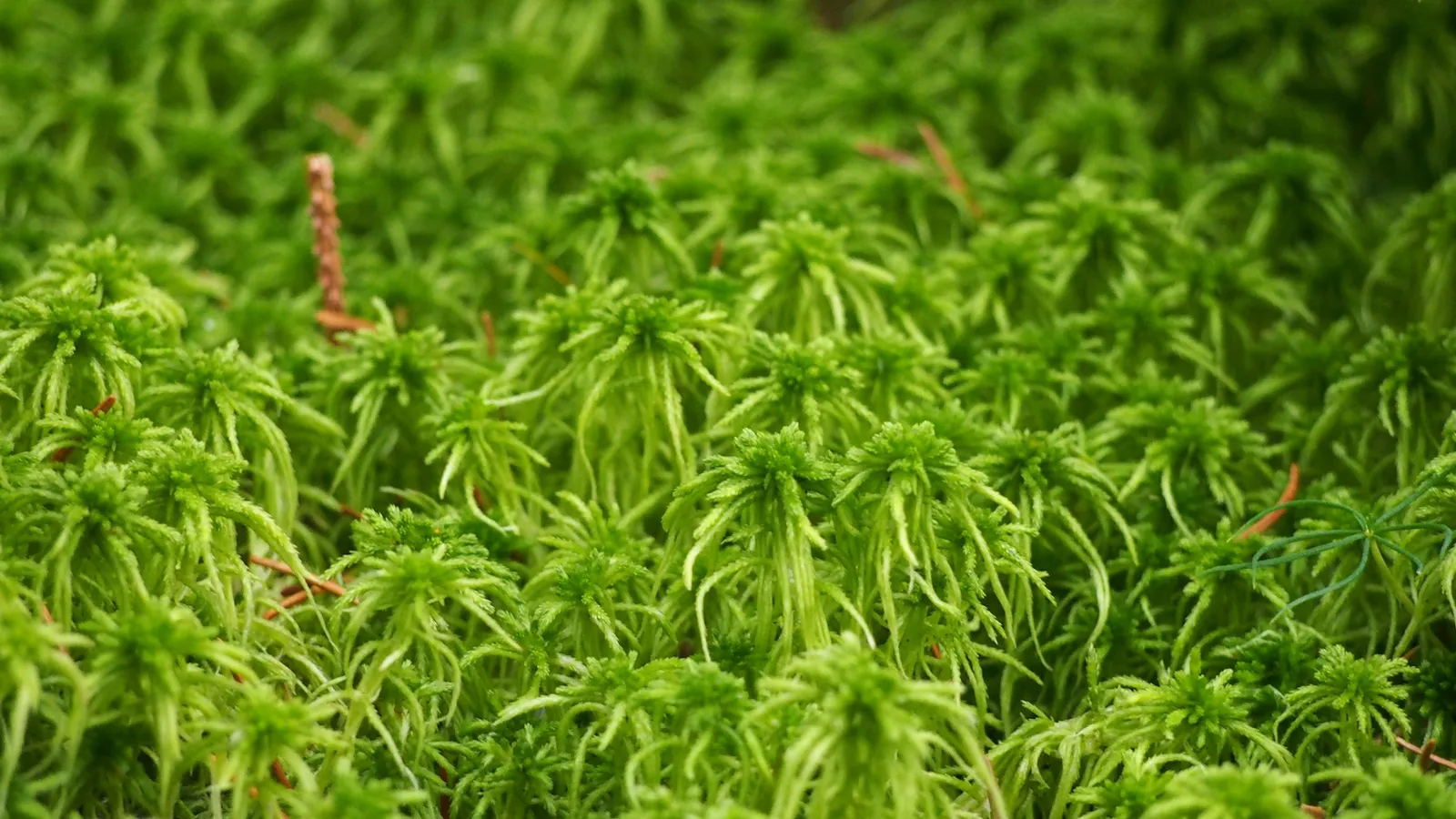
What is Sphagnum peat moss?
Sphagnum is a moss, a bryophyte, and NCERT lists it with Funaria and Polytrichum as common examples of mosses (NCERT, section 3.2.2). As in every moss, the main plant body is the haploid gametophyte. If that stage is hazy, our walk through the Funaria moss life cycle from protonema to sporophyte covers it.
In a bog, much of the peat is dead Sphagnum. In peatlands, year-round waterlogging slows decay so much that dead plants pile up to form peat, according to the IUCN issues brief on peatlands. Ecologist Penny Anderson, writing for CIEEM, notes that Sphagnum supplies about 99.5% of the material reaching the permanently waterlogged lower layer of a bog, where peat builds up.
Why does Sphagnum hold so much water?
The answer is in its leaves. Large hyaline cells, with pores opening to the outside, hold water and are surrounded by smaller cells that carry the chloroplasts (CIEEM).
Sphagnum can hold 16 to 26 times its dry weight in water, depending on the species (CIEEM).
Phenols in its cell walls also slow decay by holding back bacteria, the same source notes, which helps dead moss build up as peat.
Worked example: 40 g of dry Sphagnum holds 16 x 40 = 640 g to 26 x 40 = 1,040 g of water. Since 1 g of water is about 1 mL, that is roughly two-thirds of a litre to a litre.
What is Sphagnum peat used for?
NCERT says it directly: species of Sphagnum provide peat that has long been used as fuel, and as packing material for sending living material over long distances, because of their capacity to hold water (NCERT, section 3.2).
Fuel. Dried peat burns. In Ireland, Bord na Móna had its last full peat harvest in 2018 and later formally ended all peat harvesting on its lands, after the ESB's midlands power stations closed (Bord na Móna).
Packing material. Damp moss around living plants keeps them from drying out in transit, the water-holding property at work.
Wound dressings. Water-holding and decay resistance made Sphagnum an important wound dressing in the First World War (CIEEM).
Why is digging and burning peat a problem?
Peatlands cover at least 3% of the world's land surface, and their soils hold more than 600 gigatonnes of carbon, more than all other vegetation, forests included (IUCN).
Drained peatlands release an estimated 1.9 gigatonnes of CO2-equivalent a year, around 5% of human greenhouse gas emissions, the same IUCN brief says.
Peat forms at about 1 mm a year, so 1 metre takes around 1,000 years to build (Northern Ireland Assembly). Burning it releases that stored carbon far faster.
How do mosses help in succession on rocks?
Bryophytes play an important role in plant succession on bare rock and soil, NCERT says. Mosses, along with lichens, are the first organisms to colonise rocks. They break down the rock surface so higher plants can grow, and their dense mats soften falling rain and prevent soil erosion (NCERT, section 3.2).
For the full sequence to a climax community, see ecological succession: primary, secondary and climax communities. For why mosses still need water to reproduce, read why bryophytes are called amphibians of the plant kingdom.
How should you answer 'economic importance of bryophytes'?
NCERT opens by saying bryophytes in general are of little economic importance, then lists the exceptions. Match each use to the property that explains it; that link earns the marks.
Food: some mosses provide food for plant-eating mammals, birds and other animals.
Fuel: Sphagnum forms peat, which is dried and burned.
Packing material: Sphagnum holds water, so it keeps living material moist in transit.
Pioneer on rock: mosses and lichens colonise bare rock first and break it down for higher plants.
Soil protection: dense moss mats reduce the impact of rain and prevent erosion.
If gametophyte, sporophyte and haploid still blur together, the Fermi Concept Library gives each biology concept its own lesson and its place in the map. For practice, the Fermi Problem Library has worked problems with a step-by-step solver that explains the reasoning.
Next time you reread section 3.2, say the five uses and their reasons aloud before checking the page.