
On this page
Q = mcΔT works only because Class 11 problems treat specific heat c as a constant. OpenStax's University Physics notes that "in general, specific heat also depends on temperature", so a precise definition uses a tiny change in temperature: c = (1/m) dQ/dT (OpenStax University Physics Volume 2, section 1.4). When a JEE question writes c = a + bT or c = aT³, it is telling you to use that definition.
Why does Q = mcΔT fail when specific heat changes?
Q = mcΔT assumes every degree of warming costs the same energy. If c rises with T, the last kelvin costs more than the first. So start from the definition: for a small step dT, the heat needed is dQ = mc dT. Add up all the small steps from T₁ to T₂:
Q = m ∫ c(T) dT, with limits T₁ to T₂.
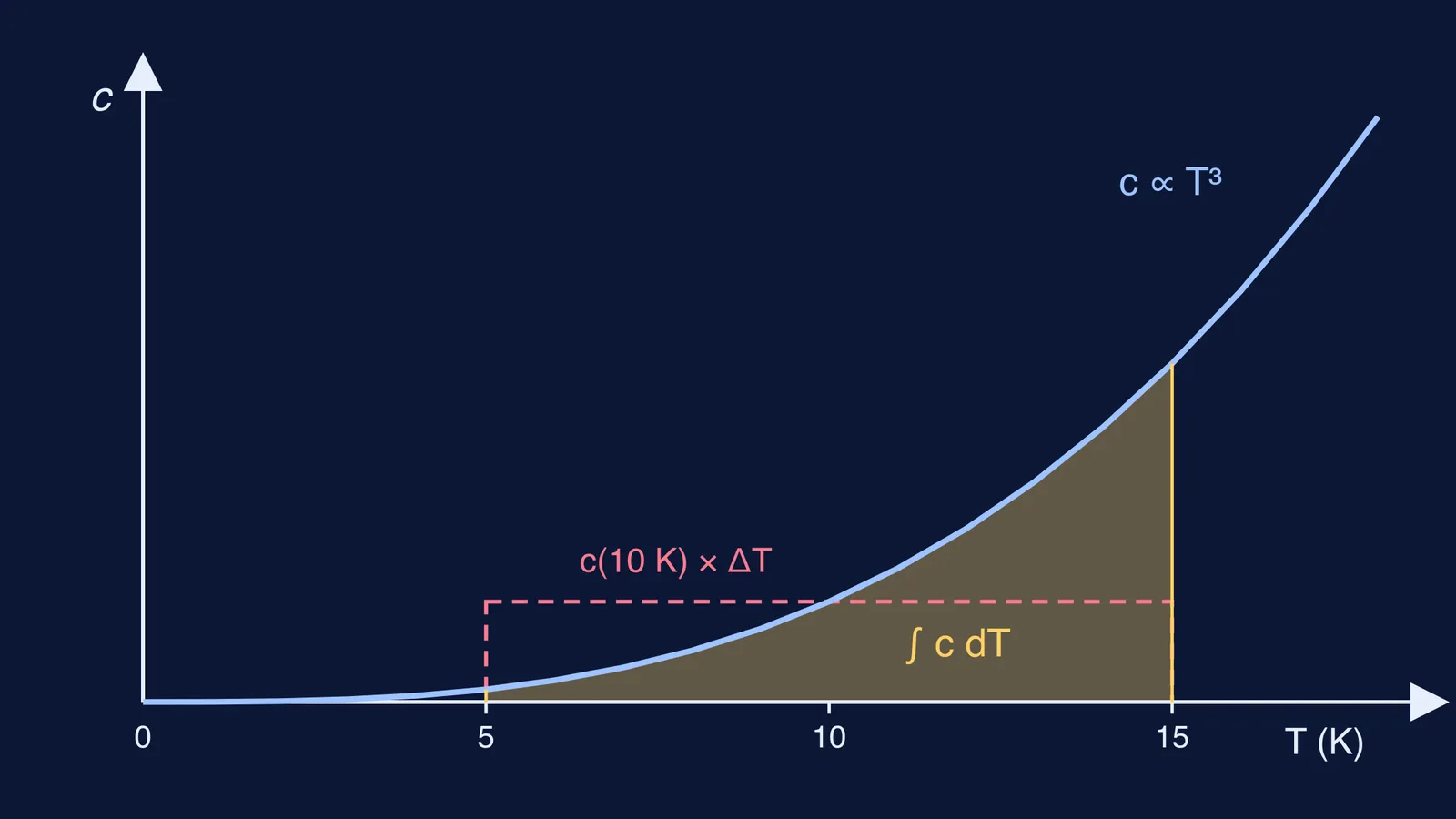
On a graph of c against T, the integral is the area under the curve from T₁ to T₂. Q = mcΔT is the special case where that area is a rectangle. If this feels shaky, see why integration gives the area under a curve.
How do you find the heat when c = a + bT?
A practice example, with numbers we chose: a 2 kg block has c = a + bT, with a = 300 J/(kg·K), b = 0.5 J/(kg·K²) and T in kelvin. Find the heat needed to warm it from 300 K to 500 K.
Write the integral: Q = m ∫ (a + bT) dT from 300 to 500.
Integrate: Q = m [aT + bT²/2] from 300 to 500.
Substitute: Q = 2 × [300 × 200 + 0.25 × (500² − 300²)].
Simplify: 500² − 300² = 160,000, so Q = 2 × (60,000 + 40,000) = 200,000 J = 200 kJ.
Check: c is 450 J/(kg·K) at 300 K and 550 at 500 K, so Q must lie between 180 kJ and 220 kJ. It does.
Shortcut: when c is a straight line in T, the average of c at the two ends is exact. Here (450 + 550)/2 = 500, and 2 × 500 × 200 = 200 kJ. This works only for a straight line.
What about c = aT³ at low temperatures?
Near absolute zero, the specific heat of many solids grows as T³ (the Debye law). OpenStax's worked example takes 24.0 g of sodium chloride with c = 3.33 × 10⁴ J/(kg·K) × (T/321 K)³, where 321 K is the Debye temperature of NaCl, and warms it from 5 K to 15 K. Integrating kT³ gives Q = mk(T₂⁴ − T₁⁴)/4 = 0.302 J.
Here both shortcuts break. By our arithmetic from the same formula, using c at 10 K gives about 0.242 J, roughly 20% too low; averaging c at 5 K and 15 K gives about 0.423 J, roughly 40% too high. For a curved c(T), only the integral is safe. At high temperatures the curve levels off instead: see the Dulong and Petit law.
Does this matter for real materials?
Yes, though less dramatically. The NIST Chemistry WebBook entry for copper gives solid copper's molar heat capacity as a fitted polynomial in T, valid from 298 K to 1358 K. From its coefficients, our arithmetic gives about 24.5 J/(mol·K) at 300 K and about 28.0 J/(mol·K) at 900 K. Integrating from 300 K to 900 K gives about 15.9 kJ per mole; using the 300 K value throughout gives 14.7 kJ, about 7% too low.
Which integration slips cost the most marks?
Each line below uses the c = a + bT example, where the right answer is 200 kJ.
Forgetting the ½ on bT² gives 280 kJ.
Squaring the difference, (T₂ − T₁)² instead of T₂² − T₁², gives 140 kJ.
Dropping the lower limit, as if the T₁ terms were zero, gives 425 kJ.
Celsius in a kelvin formula: using 27 and 227 gives 145.4 kJ. ΔT is the same in both scales; T² is not.
Pulling c out of the integral gives 180 or 220 kJ.
Moles for kilograms: if c is molar, use n, not m. See specific heat vs heat capacity.
How should you practise this before an exam?
Rewrite three solved Q = mcΔT problems with c = a + bT, solve them, then run the sanity check.
Do one c = aT³ problem and also work out both shortcuts, so you see the error yourself.
Write all four steps (integral, antiderivative, substitute, simplify) every time.
If the set-up trips you more than the algebra, the Fermi Problem Library has worked problems with a step-by-step solver that explains the reasoning rather than printing an answer. If the idea of specific heat itself is the gap, the Fermi Concept Library gives each concept in physics its own lesson.
Next time you see T inside c, write dQ = mc dT first.