On this page
Heat one mole of copper, aluminium or silver by 1 K and you need roughly the same energy each time: about 25 joules (NCERT Table 12.3). Pierre-Louis Dulong and Alexis-Thérèse Petit spotted this pattern in 1819, in a paper in *Annales de Chimie et de Physique* (citation and English quotation at Le Moyne College's Classic Chemistry site). In English, their conclusion reads: "The atoms of all simple bodies have exactly the same capacity for heat."
Why is the molar heat capacity of a solid 3R?
Picture each atom in a crystal tied to its neighbours by springs. It vibrates along x, y and z, and each direction is a small oscillator with kinetic and potential energy.
The law of equipartition of energy says that in thermal equilibrium, every squared term in the energy carries an average of ½k_BT (NCERT Class 11 Physics, Kinetic Theory, section 12.5). One oscillator has two such terms (½mv² and ½ky²), so on average it holds k_BT. Three directions give each atom 3k_BT.
For a mole, multiply by Avogadro's number: U = 3k_BT × N_A = 3RT. That is the derivation in section 12.6.4 of the same NCERT chapter. A solid barely expands, so almost all the heat you supply goes into U, and C = ΔU/ΔT = 3R.
NIST's CODATA value of R is exactly 8.314462618 J/(mol·K) (NIST), so 3R = 24.94 J/(mol·K).
For the gas side, see our guide to degrees of freedom and specific heats in kinetic theory.
Does copper really follow the Dulong and Petit law?
Check it yourself in four steps.
Take copper's specific heat from Table 12.3 of the NCERT Kinetic Theory chapter: 386.4 J/(kg·K).
Take copper's molar mass as 63.54 g, the value used in a critical review of copper data by G. K. White and S. J. Collocott (Journal of Physical and Chemical Reference Data, 1984). That is 0.06354 kg.
Multiply: 386.4 × 0.06354 = 24.55 J/(mol·K).
Compare: 24.55 ÷ 24.94 = 0.984, so copper comes within 2% of 3R.
NCERT's table rounds copper to 24.5 J/(mol·K), alongside 24.4 for aluminium, 25.5 for silver and 24.9 for tungsten. Carbon, at 6.1, is the one NCERT calls an exception. If step 2 trips you up, our explainer on specific heat vs heat capacity sorts out per kilogram versus per mole.
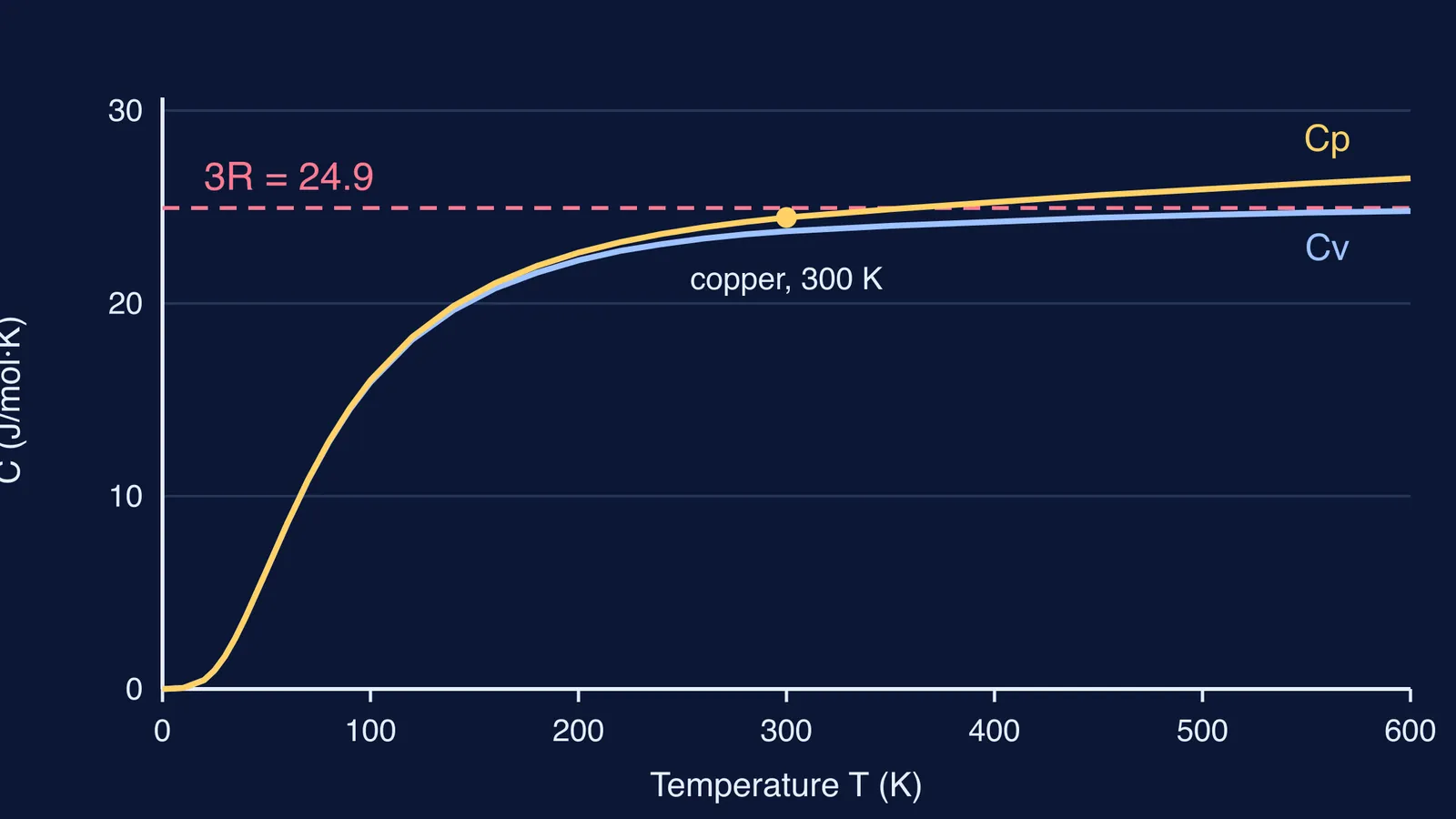
White and Collocott list copper at 300 K as Cp = 24.45 and Cv = 23.74 J/(mol·K). Equipartition predicts Cv, and copper's Cv keeps climbing: 24.79 J/(mol·K) at 600 K and 24.94 at 700 K, then slightly above 3R at higher temperatures. Cp runs higher because the metal expands as it warms. So 3R is the value a solid's vibrations approach once it is warm enough; room temperature is close, not exactly there.
Why does the Dulong and Petit law fail at low temperature?
Cool the copper and the 3R rule falls apart. The same review gives Cp at lower temperatures (White and Collocott, 1984):
100 K: 16.01 J/(mol·K), about 64% of 3R
50 K: 6.15 J/(mol·K), about 25%
20 K: 0.462 J/(mol·K), under 2%
10 K: 0.0555 J/(mol·K)
Equipartition assumes an oscillator can take any amount of energy, however small. In quantum physics a vibration's energy comes in steps, and when k_BT is much smaller than one step, most vibrations freeze out and stop absorbing heat.
Einstein brought Planck's quantum idea to this problem in 1907, in a paper titled "Planck's theory of radiation and the theory of specific heat" (Annalen der Physik, 1907). Peter Debye followed in 1912 with "On the theory of specific heats" (Annalen der Physik, 1912). Debye's result is the T³ law. White and Collocott give the lattice part as C ≈ 1944 (T/θ_D)³ J/(mol·K) for an element well below its Debye temperature θ_D.
Copper's numbers show the cube: halving the temperature from 20 K to 10 K cuts Cp by a factor of 8.3, close to 2³ = 8.
When can you use 3R in an exam question?
A quick checklist, using the copper data from White and Collocott:
Is it an element near room temperature or hotter? Use C ≈ 3R ≈ 25 J/(mol·K). For copper this is within 2% at 300 K.
Is it cold? At 100 K copper is already about a third below 3R. If a question says "low temperature" or gives a Debye temperature, switch to the T³ law.
Is it carbon? Don't trust 3R: NCERT lists 6.1 J/(mol·K).
Is the answer wanted per kilogram? Divide 3R by the molar mass in kg.
The rule also works in reverse, which is how it was once used to estimate atomic masses (see how Dulong and Petit weighed atoms with heat). NCERT gives silver a specific heat of 236.1 J/(kg·K), so 24.94 ÷ 236.1 = 0.106 kg/mol: about 106 g/mol from one heating measurement.
To see where equipartition sits among related ideas, the Fermi Concept Library gives each concept its own lesson and its place in the map. To practise, the Fermi Problem Library has worked problems with a step-by-step solver that explains the reasoning rather than printing an answer.