On this page
What happens when you stir something into water? Some things vanish, some sink, some float. Here is a five-glass kitchen test, the real numbers behind it, and why fish can breathe underwater.
What do soluble and insoluble mean in Class 6?
In Chapter 6, "Materials Around Us", of NCERT's Class 6 textbook Curiosity, materials that completely disappear when mixed in water are called soluble, and materials that do not disappear even after stirring for a long time are called insoluble (NCERT Curiosity, Chapter 6). The book's Activity 6.7 puts a teaspoon each of sugar, salt, chalk powder, sand and sawdust into five glass tumblers of water. The chapter also asks, "Do liquids like oil, vinegar and honey dissolve in water? Explore." So the home version below swaps in cooking oil.
How do you test salt, sugar, sand, chalk and oil at home?
Fill five clear glasses about two-thirds with room-temperature water.
Write a prediction for each: will it disappear or not?
Add one level teaspoon each of sugar, salt, sand, chalk powder and cooking oil.
Stir each glass for one minute.
Wait five minutes, then look from the side, against a light.
Write what you see next to each prediction.
What you should see:
Sugar and salt: disappear; the water stays clear.
Sand: sinks; the water above clears quickly.
Chalk powder: the water turns milky, then the powder slowly settles.
Oil: sits in a layer on top, however hard you stir.
The textbook describes the oil result exactly: some liquids mix completely with water, while others "form a separate layer when left undisturbed for some time" (NCERT Curiosity, Chapter 6). Clear versus milky or layered is also the test in our guide to homogeneous and heterogeneous mixtures.
Does insoluble mean nothing dissolves at all?
No. In Class 6, insoluble means too little dissolves for you to see it go. Solubility is the most of a substance that dissolves in a fixed amount of water at a given temperature.
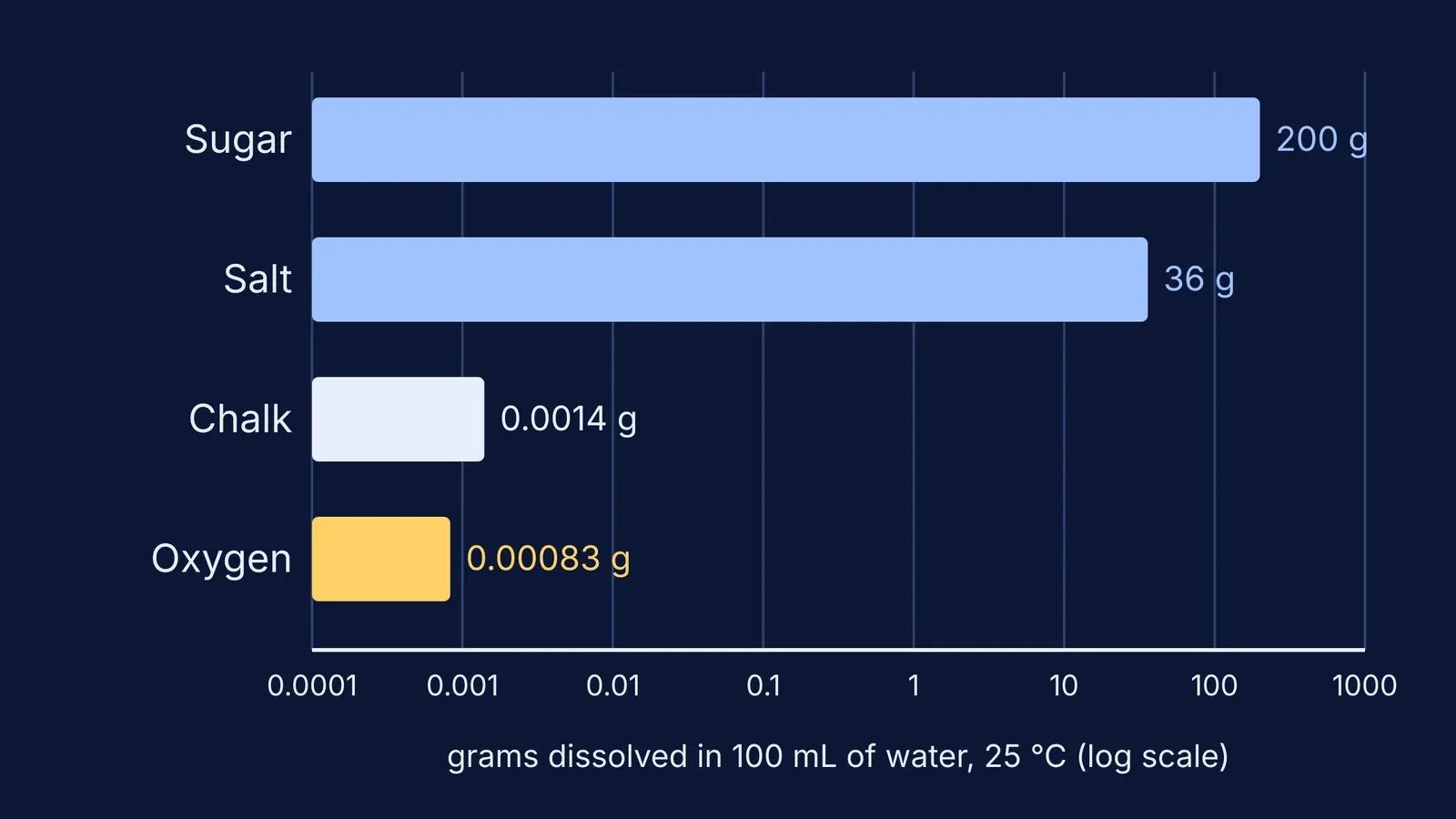
Salt (sodium chloride): 36.0 g dissolves in 100 g of water at 25 °C, according to the CRC Handbook value listed on PubChem.
Sugar (sucrose): about 200 g dissolves in 100 mL of water at 25 °C, according to the ILO-WHO chemical safety card listed on PubChem.
Natural chalk (calcium carbonate): about 14 mg dissolves in a litre of water at 25 °C, which the ILO-WHO safety card calls "very poor" (PubChem).
Many blackboard chalk sticks are made of gypsum (calcium sulfate) rather than calcium carbonate (Wikipedia). Gypsum dissolves more, about 0.2 g per 100 mL at 20 °C (PubChem), but still far less than salt.
Worked example for a 200 mL glass. Salt: 36 g per 100 g of water means about 72 g can dissolve. Natural chalk: 14 mg per litre means only about 2.8 mg can dissolve, far less than a pinch, so nearly all of your teaspoon stays as powder. To see where salt stops dissolving, read our post on how much salt dissolves in 100 mL of water.
Why can fish breathe oxygen dissolved in water?
NCERT's chapter notes that some gases are soluble in water and that oxygen dissolved in water "is very important for the survival of animals and plants that live in water" (NCERT Curiosity, Chapter 6).
The amounts are tiny. Fresh water fully saturated with oxygen holds 14.6 mg per litre at 0 °C, 9.1 mg at 20 °C and 7.6 mg at 30 °C, according to a California State Water Resources Control Board fact sheet. At 25 °C the same table gives 8.3 mg per litre, which is less, by mass, than the 14 mg of calcium carbonate you just called insoluble.
It is still enough. The fact sheet says California's objectives for warm-water fish keep dissolved oxygen above 5 to 6 mg per litre, depending on the region. The US Geological Survey defines water with less than 2 mg per litre as hypoxic. The fact sheet lists rising water temperature among the biggest causes of low oxygen; our post on why warm water holds less oxygen goes further.
What mistakes do students make with soluble and insoluble?
Calling chalk soluble because the water turns white. Milky means spread out, not dissolved; wait and it settles.
Calling oil soluble because it breaks into droplets when stirred. Wait, and the layer comes back.
Forgetting gases. Oxygen dissolves too, which is what the fish picture in NCERT's chapter is asking about.
If a word like solution or saturation feels fuzzy, the Fermi Concept Library has every concept in physics, chemistry, biology, mathematics and computing, each with its own lesson. When a question asks you to explain a result step by step, the Fermi Problem Library has worked problems with a step-by-step solver that explains the reasoning rather than printing an answer.
Tonight, set out five glasses, write your predictions first, and see how many you get right.