On this page
Sixth powers of sine and cosine look heavy, but the sum collapses to one short expression. You need two things you already know: the Pythagorean identity and the formula for a³ + b³. Once you see the substitution, the fourth-power version and both ranges take a few more lines.
Why does sin⁶x + cos⁶x equal 1 − 3 sin²x cos²x?
The first fact is trigonometry. The NCERT Class 11 textbook states that sin²x + cos²x = 1 for all real x (NCERT Class 11 Mathematics, Chapter 3, Trigonometric Functions).
The second fact is algebra. Expand (a + b)³ = a³ + 3a²b + 3ab² + b³ and move the middle terms across: a³ + b³ = (a + b)³ − 3ab(a + b). If you want a refresher on using this form, see our walk-through on evaluating a³ + b³ from the sum and product.
Now put them together:
Let a = sin²x and b = cos²x. Then sin⁶x = a³ and cos⁶x = b³.
The Pythagorean identity says a + b = 1.
So a³ + b³ = 1³ − 3ab(1) = 1 − 3 sin²x cos²x.
That is the whole proof. Nothing was expanded to the sixth power.
What is sin⁴x + cos⁴x in terms of sin²x cos²x?
Use the square version of the same idea: a² + b² = (a + b)² − 2ab. With a + b = 1, you get sin⁴x + cos⁴x = 1 − 2 sin²x cos²x.
Both answers improve once you bring in the double angle. NCERT lists sin 2x = 2 sin x cos x as a standard identity in the same chapter (NCERT Class 11, Chapter 3). Squaring it gives sin²x cos²x = (1/4) sin²2x, so:
sin⁴x + cos⁴x = 1 − (1/2) sin²2x
sin⁶x + cos⁶x = 1 − (3/4) sin²2x
In this form each expression depends on a single quantity, sin²2x. That is what makes the range easy.
What is the range of sin⁶x + cos⁶x?
NCERT shows that −1 ≤ sin x ≤ 1 for every real x (NCERT Class 11, Chapter 3). So sin 2x also lies between −1 and 1, and sin²2x lies between 0 and 1.
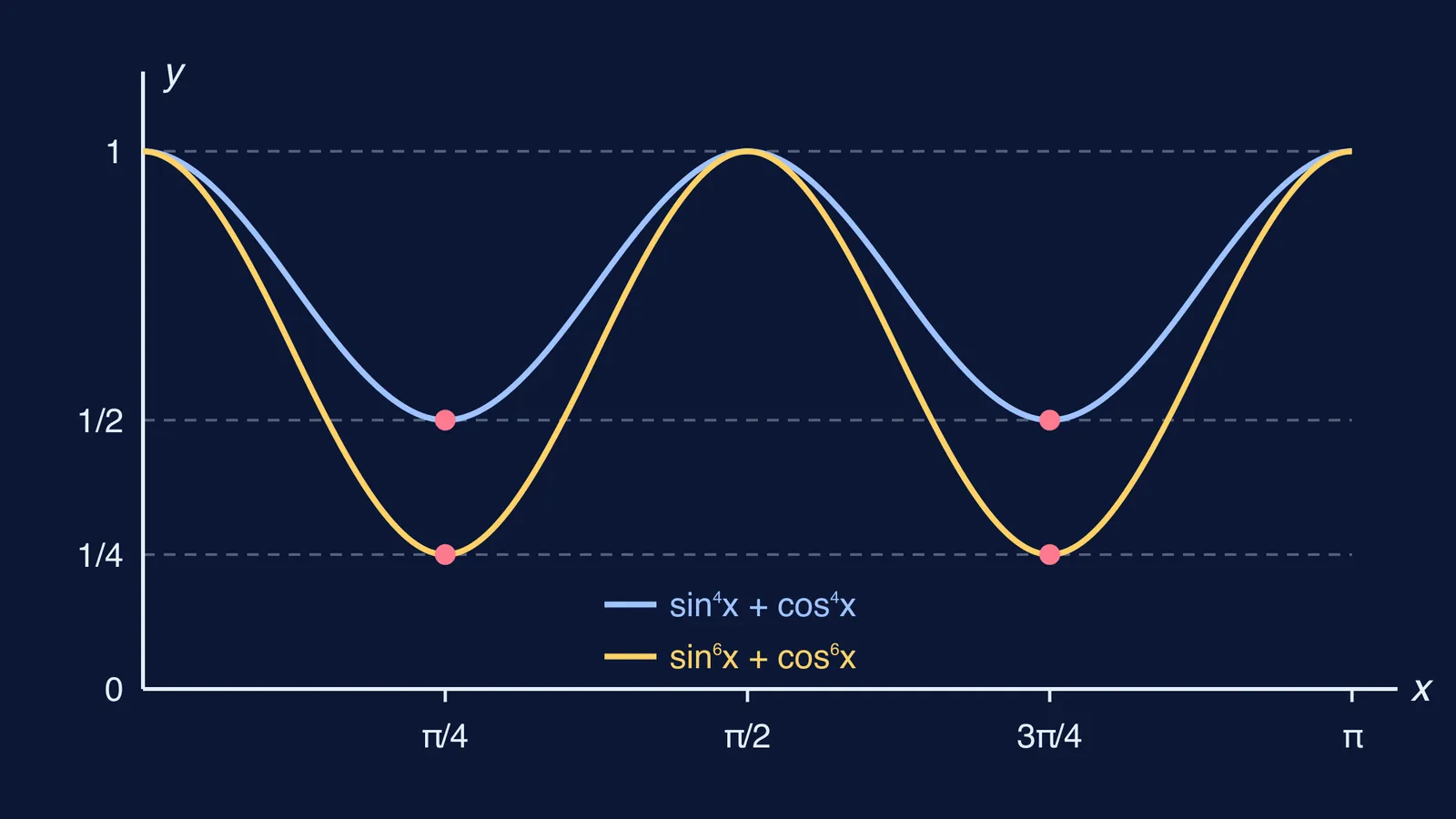
sin⁶x + cos⁶x: largest value 1, when sin 2x = 0 (for example x = 0 or x = π/2). Smallest value 1 − 3/4 = 1/4, when sin²2x = 1 (for example x = π/4). Range: [1/4, 1].
sin⁴x + cos⁴x: largest value 1 at the same points. Smallest value 1 − 1/2 = 1/2 at x = π/4. Range: [1/2, 1].
The graph at the top of this post shows both curves. Both peak at 1 and dip to their minima at π/4 and 3π/4, and the pattern repeats every π/2 because sin²2x does.
A common slip is to add the ranges of the parts: sin⁶x and cos⁶x each reach 1, so the sum "must" reach 2. It cannot, because they never reach 1 at the same x. For more on finding the true maximum of a trig expression, read our post on the absolute maximum of sin x + cos x on an interval.
How do you check the identity with a worked example?
Take x = π/6, where sin²x = 1/4 and cos²x = 3/4.
Directly: sin⁶x + cos⁶x = 1/64 + 27/64 = 28/64 = 7/16.
By the formula: 1 − 3(1/4)(3/4) = 1 − 9/16 = 7/16.
Fourth powers: 1/16 + 9/16 = 10/16, and 1 − 2(3/16) = 10/16.
Now a classic proof question: show that 2(sin⁶x + cos⁶x) − 3(sin⁴x + cos⁴x) + 1 = 0. Write t = sin²x cos²x. The left side becomes 2(1 − 3t) − 3(1 − 2t) + 1 = 2 − 6t − 3 + 6t + 1 = 0. The t terms cancel, which is why the answer is a constant for every x. If you like LHS-to-RHS proofs like this, our guide to three methods for proving trig identities has more.
A five-minute practice plan
Write a = sin²x, b = cos²x on the first line of any even-power question.
Reduce with a + b = 1 before doing anything else.
For a range, rewrite in terms of sin²2x and use 0 ≤ sin²2x ≤ 1.
Test your answer at x = 0 and x = π/4 before moving on.
Stretch: show sin⁸x + cos⁸x = 1 − 4t + 2t², with t = sin²x cos²x between 0 and 1/4, and find its range.
If you get stuck turning a power into an a³ + b³ form, the Fermi Problem Library has worked problems with a step-by-step solver that explains the reasoning rather than printing an answer. To revisit the identities themselves, the Fermi Concept Library gives every mathematics concept its own lesson.