

On this page
Finding the highest or lowest point of a curve requires more than just finding where its slope is zero. When a function is restricted to a specific interval, the boundary points matter just as much as the peaks and valleys in between.
According to the NCERT Class 12 Mathematics textbook (Chapter 6: Application of Derivatives), the method for finding the absolute maximum and absolute minimum values on a closed interval requires evaluating the function at all critical points and both endpoints.
What is the absolute maximum of sin x + cos x on the interval [0, π]?
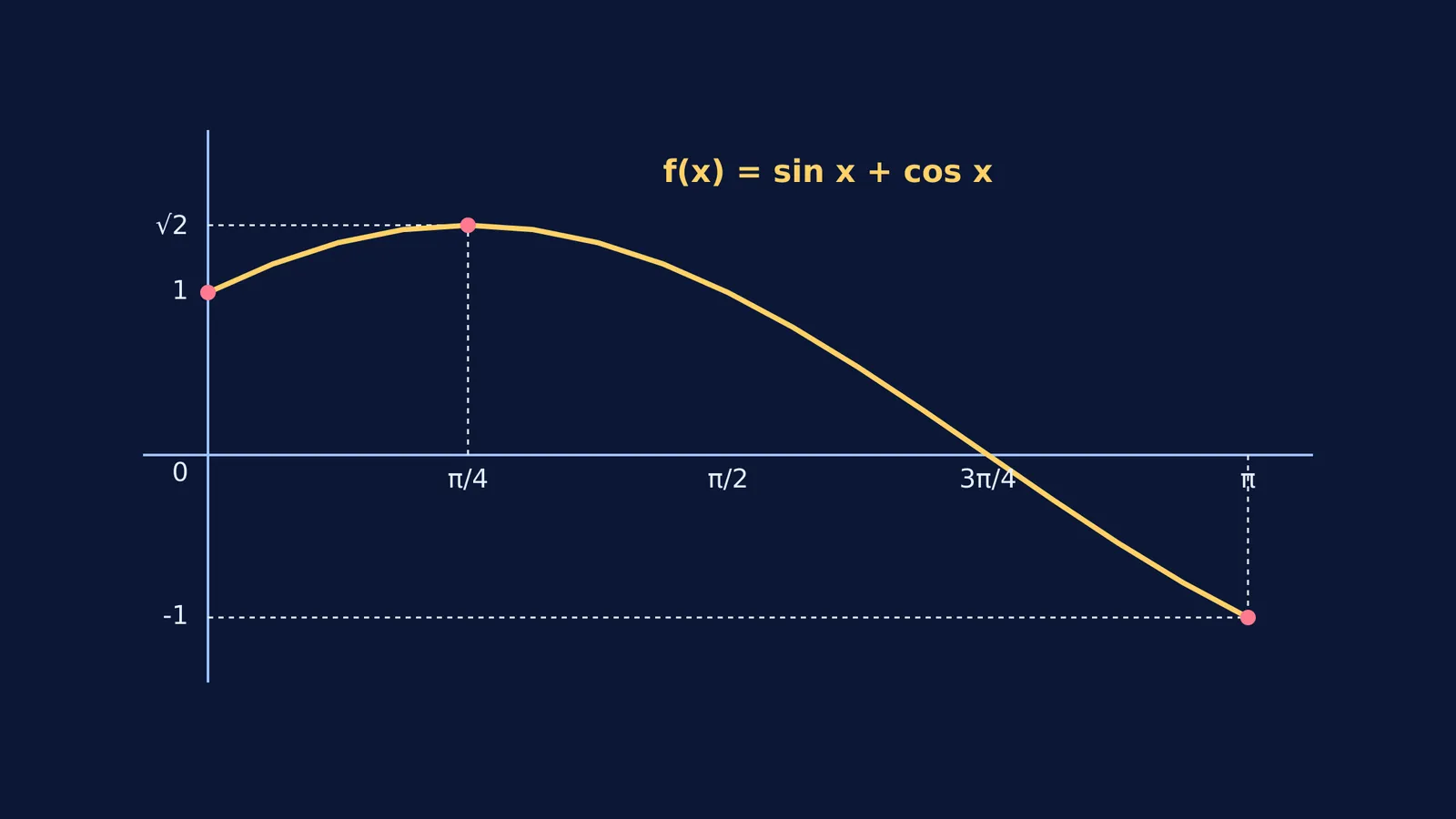
For the function f(x) = sin x + cos x, the absolute maximum on the interval [0, π] is √2. The absolute minimum on the same interval is -1.
To see why, we have to look at the whole curve from x = 0 to x = π. We cannot assume the highest point is where the curve flattens out; we must prove it using a rigorous process. If you only look at the points where the tangent is horizontal, you might find a local peak, but it might not be the highest point overall if the curve keeps rising towards one of the edges.
This difference between local and absolute extrema is a fundamental concept in calculus. A local maximum is just the highest point in its immediate neighbourhood. An absolute maximum is the highest point across the entire specified interval.
How do you use the closed interval method?
The standard procedure to find absolute extrema on a closed interval [a, b] involves four steps. Let us apply them to f(x) = sin x + cos x.
Step 1: Find the critical points First, find where the derivative is zero or undefined. Critical points tell us where the function might have a local peak or valley.
Differentiate the function: f'(x) = cos x - sin x.
Set it to zero: cos x - sin x = 0, which means cos x = sin x.
Divide by cos x to get tan x = 1.
In the interval [0, π], the only angle where the tangent is 1 is x = π/4.
If we had found a critical point outside our interval, for example at x = 5π/4, we would ignore it. We only care about what happens between x = 0 and x = π.
Step 2: Identify the endpoints The boundaries of our given interval are the starting point x = 0 and the ending point x = π. These are just as important as the critical points.
Step 3: Evaluate the function at all these points Now, plug the critical points and the endpoints back into the *original* function, f(x) = sin x + cos x, not the derivative. The derivative only tells us about the slope, but we want the actual height of the curve.
At the left endpoint (x = 0): f(0) = sin(0) + cos(0) = 0 + 1 = 1.
At the critical point (x = π/4): f(π/4) = sin(π/4) + cos(π/4) = 1/√2 + 1/√2 = 2/√2 = √2 (approximately 1.414).
At the right endpoint (x = π): f(π) = sin(π) + cos(π) = 0 - 1 = -1.
Step 4: Compare the results Look at the values we calculated: 1, √2, and -1. The largest value is √2, and the smallest is -1. Therefore, the absolute maximum is √2 at x = π/4, and the absolute minimum is -1 at x = π.
Why do students lose marks on endpoint checks?
A common mistake in calculus exams is finding the critical point, performing the first or second derivative test to confirm it is a local maximum, and stopping there.
For a continuous function on a closed interval, the absolute highest or lowest value might be at the edge. If you skip Step 3, you risk missing the true global extremum. This is especially true for monotonic functions or when finding the maximum volume of a cylinder inscribed in a sphere.
Consider if our interval was [π/2, π]. The critical point at x = π/4 is now outside the interval. The maximum would be at the left endpoint f(π/2) = 1, and the minimum at the right endpoint f(π) = -1. Checking boundaries is essential. Exploring these edge cases is a core skill you can practice in the Fermi Concept Library.
Can you solve this using trigonometry?
You can also solve this specific problem without calculus by condensing the expression into a single trigonometric term. This is often faster for multiple-choice questions.
Using the trigonometric identity a sin x + b cos x = √(a² + b²) sin(x + α): f(x) = sin x + cos x = √(1² + 1²) (1/√2 sin x + 1/√2 cos x) = √2 sin(x + π/4).
Since the maximum value of any sine function is 1, the maximum possible value of f(x) is √2 × 1 = √2. Because the angle (x + π/4) reaches π/2 (where sine is 1) when x = π/4, and this point is inside our interval [0, π], the absolute maximum is indeed √2.
The minimum of the sine function over all real numbers is -1, which would make the minimum of f(x) equal to -√2. However, we are restricted to [0, π]. Here, the highest angle (x + π/4) reaches is 5π/4 (at x = π). The sine of 5π/4 is -1/√2, making f(π) = √2 × (-1/√2) = -1. This confirms our calculus result.
This algebraic approach is a reliable way to check your calculus work, much like using the quadratic interval method to find the range of sin² x + cos x or evaluating concavity and points of inflection.


