

On this page
When preparing for competitive exams like JEE Main, trigonometry problems frequently conceal algebraic structures beneath periodic ratios. A classic challenge asks for the range of f(x) = sin² x + cos x. While mixing a quadratic sine term with a linear cosine term may suggest using derivatives, an algebraic substitution offers a faster, cleaner path.
By rewriting the expression as a quadratic in cos x and enforcing natural trigonometric bounds, you can find the exact maximum and minimum values without guesswork.
How do you convert sin² x + cos x into a quadratic function?
The main obstacle in evaluating f(x) = sin² x + cos x is the presence of two distinct trigonometric ratios. Because sin x and cos x vary simultaneously, you cannot analyze each term separately and add their individual ranges.
The solution is to express the entire function through a single ratio. The Pythagorean identity establishes that sin² x + cos² x = 1, as documented in OpenStax Calculus Volume 1, Section 1.3. Replacing sin² x with 1 − cos² x yields f(x) = −cos² x + cos x + 1.
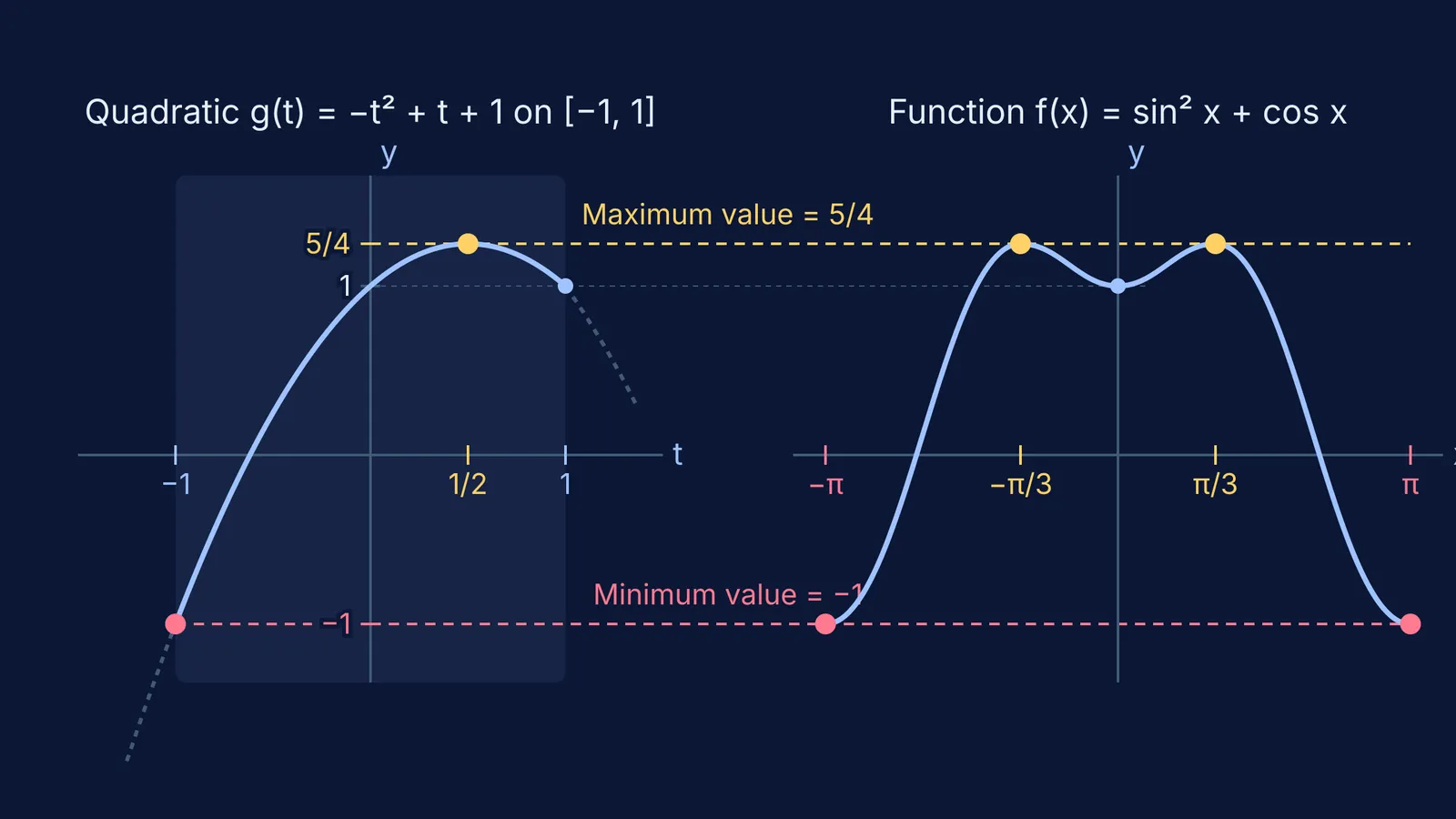
Substituting t = cos x transforms this into the quadratic polynomial g(t) = −t² + t + 1. This reduces a trigonometric problem to quadratic analysis: rather than tracking angles across quadrants, you only need to evaluate a downward-opening parabola.
Why does the interval [−1, 1] change the quadratic extrema?
Over all real numbers, a quadratic with a negative leading coefficient like g(t) = −t² + t + 1 has no minimum; it plunges toward −∞. But here, t represents cos x, so its domain is restricted to the closed interval [−1, 1], as confirmed in OpenStax Calculus Volume 1, Section 1.3. Thus, g(t) exists only on t ∈ [−1, 1].
Under the Extreme Value Theorem, every continuous function on a closed, bounded interval achieves both an absolute maximum and minimum, as established in OpenStax Calculus Volume 1, Section 4.3. These extrema occur only at two places:
Interior critical points where the derivative vanishes (the parabola's vertex).
Boundary endpoints of the interval (t = −1 and t = 1).
This avoids the mistake of assuming the minimum is −∞. In our guide on finding the absolute maximum and minimum on a closed interval, we explore how boundary checks capture the true behavior of clipped domains.
What is the step-by-step range calculation for sin² x + cos x?
With g(t) = −t² + t + 1 on t ∈ [−1, 1], find the range by testing the vertex and both endpoints:
Locate the vertex: for a quadratic a t² + b t + c, the vertex lies at t = −b / (2a). Here, a = −1 and b = 1, giving t = 1/2. Because 1/2 lies in [−1, 1], this critical point is attainable. Evaluating g(1/2) gives −(1/2)² + 1/2 + 1 = 5/4. Since the parabola opens downward, 5/4 is the absolute maximum, occurring when cos x = 1/2 (such as x = ±π/3).
Test the endpoints: at t = 1, g(1) = −1 + 1 + 1 = 1. At t = −1, g(−1) = −(−1)² + (−1) + 1 = −1.
Assemble the range: comparing candidate values {5/4, 1, −1}, the greatest is 5/4 and the lowest is −1. Because g(t) is continuous, the range of sin² x + cos x is [−1, 5/4].
The Fermi Problem Library provides worked problems with a step-by-step solver that explains the reasoning rather than printing an answer, helping students verify interval restrictions before applying quadratic formulas.
What happens when the quadratic vertex falls outside [−1, 1]?
A common exam trap is assuming the vertex always gives an extremum. If the vertex falls outside [−1, 1], the function never reaches that turning point.
Consider h(x) = sin² x − 4 sin x + 3. Substituting u = sin x yields k(u) = u² − 4u + 3 on u ∈ [−1, 1]. The vertex occurs at u = 2, but sin x cannot equal 2, so this vertex is discarded.
On [−1, 1], the derivative k′(u) = 2u − 4 is strictly negative, so k(u) decreases monotonically across the interval:
At u = −1: k(−1) = (−1)² − 4(−1) + 3 = 8
At u = 1: k(1) = (1)² − 4(1) + 3 = 0
The range is [0, 8]. This highlights why mastery of quadratic equations for JEE requires checking turning points against domain bounds. While linear forms rely on the range of a sin x + b cos x, quadratic expressions always demand checking both vertex and boundary endpoints.
A four-step checklist for trigonometric quadratic expressions
Whenever you encounter a quadratic expression with trigonometric ratios, follow this four-step sequence:
Unify the ratio: apply identities like sin² x = 1 − cos² x or cos 2x = 2 cos² x − 1 to express the function in a single trigonometric ratio.
Define the bounded variable: set t = cos x or t = sin x, noting the domain constraint t ∈ [−1, 1].
Check the vertex: compute t = −b / (2a). Evaluate g(t) here only if t lies within [−1, 1].
Evaluate both endpoints: calculate g(−1) and g(1), then select the lowest and highest candidate values.
In the Fermi Concept Library, every concept in mathematics links trigonometric identities directly to coordinate geometry and calculus, helping students build intuition across interconnected topics.


