On this page
If a question shows an alkene, then CH2I2 and Zn(Cu) over the arrow, the answer is a three-membered ring. The ring is the easy part. Marks are usually lost on the stereochemistry: where the old groups end up once the new ring has closed. This guide covers what the reagent is, why the geometry of the alkene survives, and a four-step method you can use on any example.
What is the Simmons-Smith reaction?
The Simmons-Smith reaction converts an alkene into a cyclopropane by adding a single CH2 group across the C=C double bond. Howard E. Simmons and Ronald D. Smith first reported it in 1958 as "A new synthesis of cyclopropanes from olefins" in the Journal of the American Chemical Society, and followed it with a full paper in 1959.
The reagents are diiodomethane (CH2I2) and a zinc-copper couple, which react to form iodomethylzinc iodide, ICH2ZnI, the species that actually transfers the CH2 (Wikipedia). The zinc-copper couple is finely divided zinc alloyed with about 10% copper (Master Organic Chemistry).
ICH2ZnI is called a carbenoid: it reacts as if it were the carbene CH2, but it is not actually a carbene (LibreTexts, McMurry Organic Chemistry 8.9). A 2001 review by André Charette and André Beauchemin in Organic Reactions describes this zinc carbenoid as electrophilic, and notes that electron-rich alkenes usually react much faster than electron-poor ones.
Why is the Simmons-Smith reaction stereospecific?
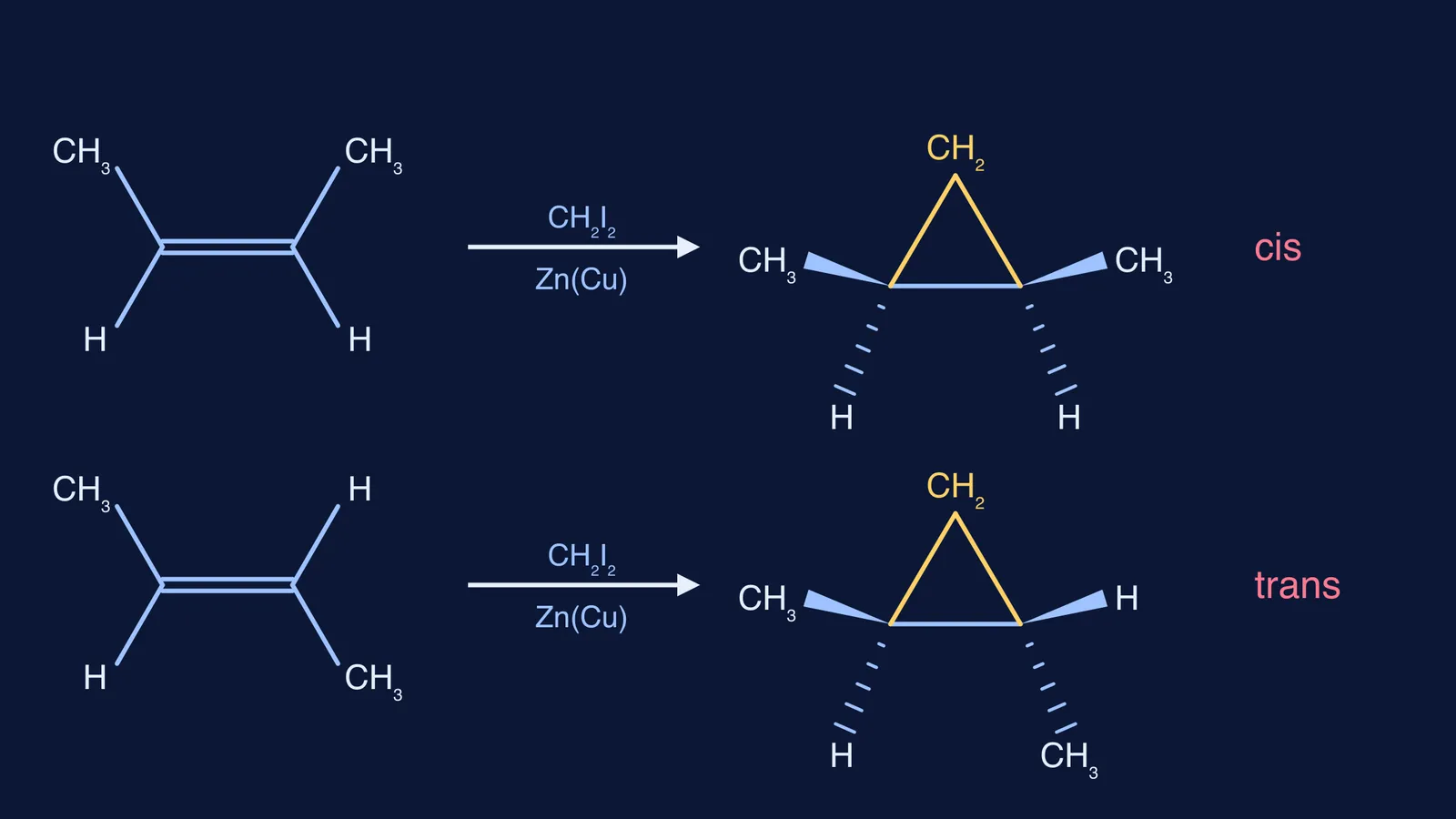
The CH2 is delivered to both alkene carbons at the same time, so the configuration of the double bond is preserved in the product (Wikipedia). There is no intermediate with a single bond that could rotate. Groups that were cis on the alkene stay cis on the ring, and groups that were trans stay trans (Master Organic Chemistry).
The textbook example is cis-2-butene, which becomes cis-1,2-dimethylcyclopropane. The LibreTexts McMurry chapter shows it for the free carbene CH2 and notes that the same method predicts the Simmons-Smith product.
This is the same one-face logic you use for syn dihydroxylation with osmium tetroxide. Compare it with anti addition of bromine through the bromonium ion, where the two new bonds form one after the other, on opposite faces.
How do you predict the Simmons-Smith product?
Use these four steps on any alkene:
Draw the alkene and mark which groups are cis and which are trans across the C=C.
Keep the two alkene carbons. Break only the pi bond.
Join both carbons to one new CH2 to close a three-membered ring.
Copy the geometry: cis groups go on the same face of the ring (both wedges), trans groups on opposite faces (one wedge, one dash).
Worked example 1, the butenes. cis-2-Butene gives cis-1,2-dimethylcyclopropane, with both methyls on wedges. That product has a mirror plane through the CH2 carbon, so it is a meso compound. trans-2-Butene gives trans-1,2-dimethylcyclopropane, with one methyl on a wedge and one on a dash. This product is chiral. The CH2 can add to either face of the flat alkene with equal ease, so both enantiomers form in equal amounts.
Worked example 2, cyclohexene. Adding CH2 across the ring double bond gives a fused bicyclic product, bicyclo[4.1.0]heptane, also called norcarane (Wikipedia). Count the carbons: 6 + 1 = 7, which is where the "heptane" comes from.
Worked example 3, an allylic alcohol. When an OH group sits near the double bond, zinc coordinates to it and delivers the CH2 to the same face as the OH (Wikipedia). The Charette and Beauchemin review highlights this ability of nearby hydroxy or ether groups to control which face reacts.
If your answers keep coming out with the wrong wedge pattern, the Fermi Problem Library has worked problems with a step-by-step solver that explains the reasoning rather than printing an answer.
Where do students lose marks on cyclopropanation?
Adding two carbons. CH2I2 contributes one carbon to the ring, and only one.
Scrambling cis and trans. A cis alkene can never give a trans cyclopropane here.
Drawing a free carbene. The reacting species is the zinc carbenoid ICH2ZnI.
Swapping in other diiodides. An attempt with CH3CHI2 instead of CH2I2 gave a very low yield, 4% (Master Organic Chemistry).
Being thrown by a different zinc source. Furukawa and co-workers replaced the zinc-copper couple with a dialkylzinc in a 1968 Tetrahedron paper; diethylzinc proved the most active (Wikipedia). The ring is formed the same way, so you predict the product the same way.
Once the ring is made, its 60-degree bond angles explain much of its chemistry, covered in why cyclopropane is more reactive than cyclohexane. If carbenes or stereospecific addition still feel shaky, the Fermi Concept Library gives each concept in chemistry its own lesson and its place in the map.
Next step: take the three worked examples above, cover the answers, and draw each product with wedges and dashes from scratch.