On this page
Silk Road, by Nick Middleton, is the travelogue in Hornbill, the Class 11 English Core reader. The English author is crossing Tibet to walk the kora, the pilgrim circuit round Mount Kailash. The extract covers the drive, a frightening night at altitude and the wait for a companion.
What happens in Silk Road?
This summary follows chapter 6 of the current NCERT Hornbill textbook, in six stages.
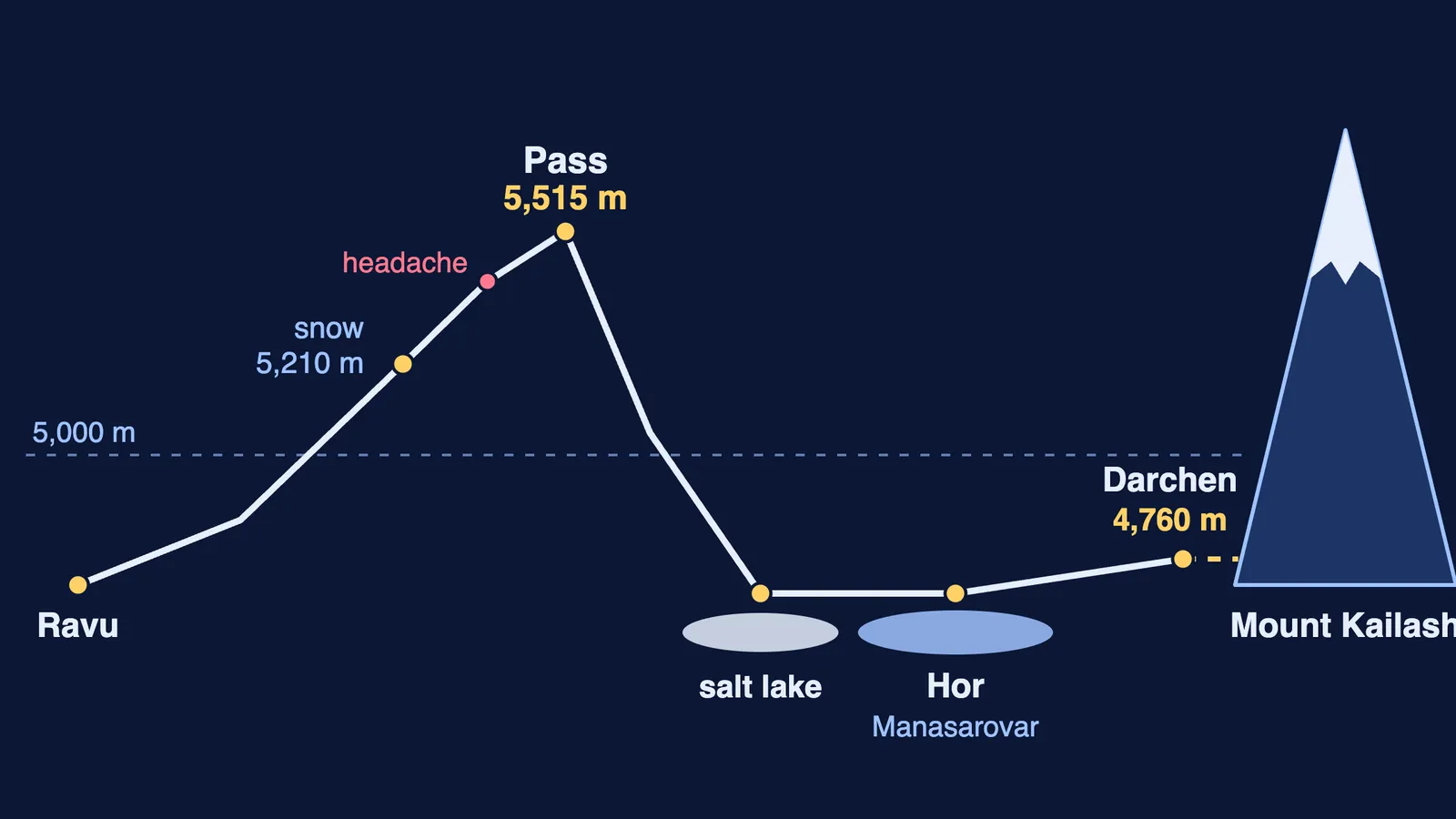
Leaving Ravu. Lhamo, a nomad woman at Ravu, gives the author a sheepskin coat for the cold. His driver Tsetan takes a short cut south-west off the Changtang plateau, past gazelles, wild ass (kyang) and tents guarded by fierce Tibetan mastiffs.
The high pass. Snow blocks the track at 5,210 metres. The three spread soil on the icy surface and Tsetan drives over it, then steers round a second patch. Near 5,400 metres the author's head throbs; the pass tops out at 5,515 metres, marked by a cairn with prayer flags.
The salt lake. Lunch is at a workcamp by a dry salt lake, which the author links to the ancient Tethys Ocean.
Hor. This town on sacred Lake Manasarovar is dusty and full of rubbish, unlike the moving accounts of earlier travellers such as the Japanese monk Ekai Kawaguchi, who reached the lake in 1900. Daniel, the author's companion, leaves for Lhasa.
Darchen. At 4,760 metres, with a cold and a blocked nose, the author cannot breathe easily lying down and stays awake all night. A Tibetan doctor diagnoses a cold plus the effects of altitude, and after the first day of a five-day course of Tibetan medicine he sleeps soundly, "Like a log, not a dead man." Tsetan returns to Lhasa.
Meeting Norbu. It is too early in the season for pilgrims. In a cafe the author meets Norbu, a Tibetan scholar from Beijing who has written about the kora but never walked it. They agree to go together.
The extract ends before the kora begins, so never write that the author completed it.
Who are the main characters in Silk Road?
The author: curious, self-mocking, unwell and honest about his fear.
Tsetan: the calm, skilled, good-humoured driver.
Daniel: the companion who interprets for the author early on.
Lhamo: the Ravu woman whose farewell gift shows nomad warmth.
Norbu: the scholar who knows the kora only from books.
Why is the chapter called Silk Road?
The journey touches the old trade network. The highway at Hor follows the old trade route from Lhasa to Kashmir, and the author recalls that mastiffs were sent from Tibet to China's imperial courts along the Silk Road as tribute. He jokes that striped plastic is today's Chinese export along the same road. For the route's history, see our post on what travelled the Silk Road, from paper to numerals.
What are the main themes of Silk Road?
Legend versus reality: sacred Manasarovar against grim Hor.
Kindness of hill people: Lhamo's coat, Tsetan's care, Norbu's friendliness.
The body at altitude: headaches, broken sleep and a hissing fuel tank.
Why people take hard journeys: faith for pilgrims, curiosity for the author and Norbu.
The altitude details are real science. At the pass, the petrol cap hisses because, as the chapter explains, the lower air pressure lets the fuel expand. The Darchen doctor blames his sleepless night on a cold and the altitude. Our explainer on how soldiers cope with thin air at Siachen walks through why the body struggles high up.
If air pressure is fuzzy from physics, the Fermi Concept Library covers every concept in physics, chemistry, biology, mathematics and computing, each with its own lesson, so you can check the idea behind the hissing tank.
How do you answer Silk Road questions in the Class 11 exam?
The CBSE English Core curriculum for 2026-27 lists Silk Road among the Hornbill prose texts. From Hornbill, the Class 11 paper has a prose extract (one of two) worth 3 marks, two short answers of 40-50 words (one prose, one poetry) worth 3 marks each, and one long answer of 120-150 words on prose or poetry worth 6 marks.
A short-answer model (about 45 words). Question: How did Tsetan help the author? Answer: Tsetan drove skilfully over snow-covered passes, spreading soil on ice and steering round drifts. He got two punctured tyres fixed, joked to keep spirits up and took the author to the Darchen doctor. He left only once he was sure the author would recover.
A long-answer plan (120-150 words). For a question on legend and reality:
Claim: the chapter sets what the author expected against what he found.
Example one: sacred Manasarovar against rubbish-strewn Hor; Kawaguchi wept, Middleton drank tea in a greasy cafe with broken windows.
Example two: he expected bustling pilgrims at Darchen and found none.
Close: this honesty makes the travelogue believable.
The same stage method works for other Hornbill prose, as in our guide to The Portrait of a Lady.