On this page
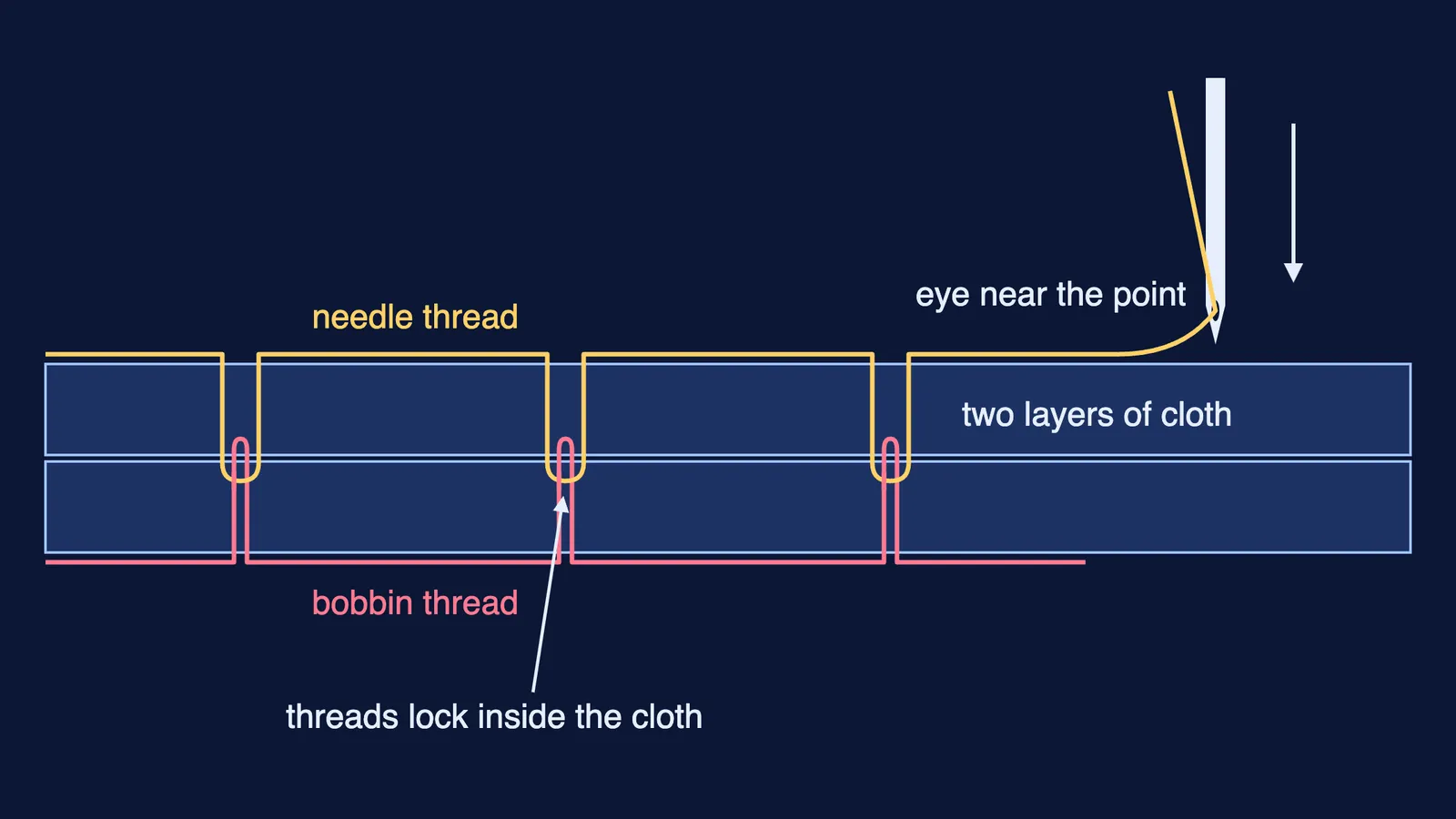
Look closely at a machine-sewn seam on your school uniform and you will see a neat line of thread on top and another underneath. The two threads never tie a knot. Once per stitch they hook through each other inside the cloth.
How does a sewing machine make a stitch?
A home sewing machine makes a lockstitch: one thread from the needle above and one from a bobbin below, interlocking in the middle of the fabric. A 1917 encyclopedia entry reprinted by the International Sewing Machine Collectors' Society describes the two threads “locking together in the centre of the material”.
Every stitch repeats the same four moves:
The needle is threaded through an eye near its point. It pushes the top thread down through the cloth.
The needle starts to rise. The cloth grips the thread, so instead of sliding back up with the needle it bulges into a small loop beside it.
A hook below the cloth catches that loop and carries it right around the bobbin. Now the loop encircles the bobbin thread.
A swinging arm, which the 1917 entry calls “the automatic take-up”, pulls the top thread tight. That drags the crossing point up into the middle of the cloth. The feed moves the fabric forward and the cycle starts again.
What does the rotary hook actually do?
The bobbin thread comes off a spool, so there is no free end to push through the loop. Instead the machine passes the loop over the whole bobbin. In the 1917 entry's words, “the loop is passed over the under spool of thread by a steel circular hook having a rotating movement” (ISMACS).
Modern patents describe the same job. One for a lockstitch sewing machine with a rotary hook says the hook tip “has seized the needle thread loop” and then guides it “around the bobbin housing”.
In many machines the hook also turns faster than the needle moves. A Singer patent for a rotatable loop taker and bobbin case says its drive is “preferably adapted to impart two revolutions to the loop taker for each reciprocation of the needle”.
Howe's machine did this job differently. It used a small shuttle carrying a bobbin, which passed through the loop. Allen B. Wilson's 1851 patent claimed “the rotating hook to extend the loop on one thread”, paired with a bobbin that carried the other thread through that loop, an early step towards the spinning hook.
What was new about Elias Howe's needle?
A hand needle has its eye at the blunt end and passes right through the cloth. A machine cannot let go of its needle, so the trick is to put the eye at the point. The needle pushes its eye just through the cloth, leaves a loop behind and comes back out, holding the thread the whole time.
Howe's US patent 4,750 was granted to Elias Howe Jr of Cambridge, Massachusetts, on 10 September 1846. It describes thread running through an eye situated near the needle point, and a small shuttle carrying a bobbin of silk. According to ASME, the machine had “three essential features common in most modern machines: a needle with the eye at the point; a shuttle operating beneath the cloth to form the lock stitch; and an automatic feed.” Machines that handle thread are full of small fixes like this. Another is Sakichi Toyoda's loom that stopped itself when a thread broke.
Follow one stitch: a worked example
Say you sew a 30 cm hem with the stitch length set to 2.5 mm.
Stitches: 300 mm ÷ 2.5 mm = 120 stitches.
Needle strokes: one down-and-up per stitch, so 120.
Hook turns: with the two-revolutions-per-stroke drive in the Singer loop-taker patent, that is 240.
The same picture helps you read a bad seam:
Loops of top thread hanging underneath: the lock sits below the cloth, so the top thread was not pulled up enough.
Dots of bobbin thread showing on top: the opposite. The top thread was pulled too hard and dragged the lock up to the surface.
The thread itself matters too. Here is why a thread twice as thick holds four times the load.
How can you see the lockstitch for yourself?
Poke three holes in a strip of cardboard and take two strings of different colours. Push a loop of the first string down through a hole, pass the second string through that loop underneath, then pull the first string up until the crossing sits inside the hole. Repeat. You have just been the needle, the hook and the take-up lever.
Moving parts are easier to see than to read about. The Fermi Simulation Lab has interactive simulations for ideas like that. If friction and tension need a refresher, the Fermi Concept Library covers every concept in physics, each with its own lesson. For another everyday object that hides a mechanism in plain sight, read how a safety pin works.