

On this page
You hang a weight on a cotton thread and it snaps. Now you take a thread twice as thick. Before reading on, make a guess: will it hold twice the load, three times, or four times? Write your number down. A 2004 study in the American Journal of Physics found that students who predicted the outcome of a demonstration before seeing it showed significantly greater understanding, while students who only watched understood the concepts no better than students who never saw it.
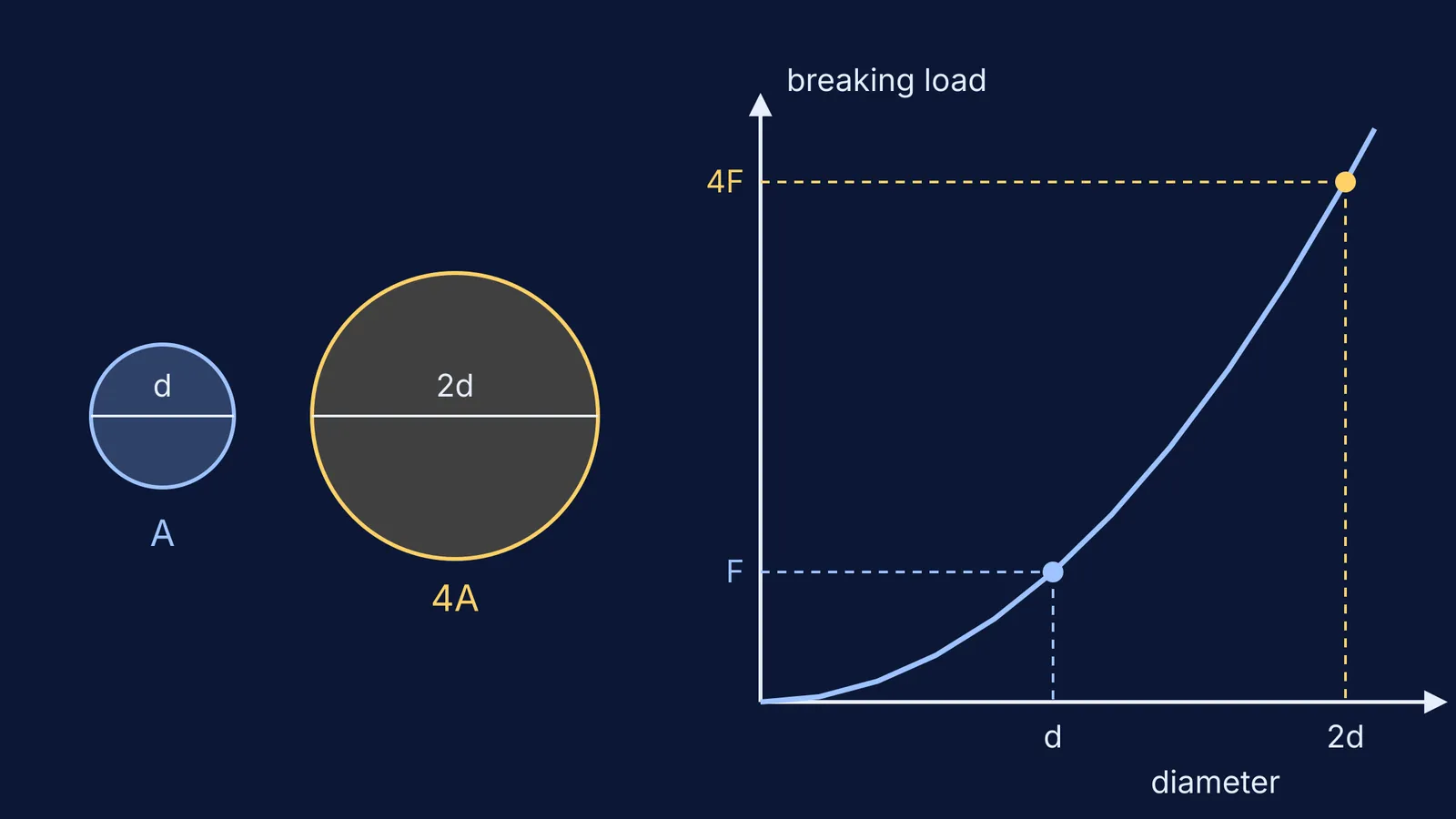
How much more load can a thread twice as thick hold?
About four times as much, if it is made of the same material. A thread breaks when the stress inside it, the force per unit area (OpenStax University Physics, section 12.3), reaches a limit, not when the force alone does.
The stress at which a material fractures is called its breaking stress, or ultimate stress (OpenStax University Physics, section 12.4). Breaking stress belongs to the material. Breaking load belongs to one particular thread or wire.
So breaking load = breaking stress × cross-section area. For a round thread of diameter d, the area is πd²/4. Double d and the area becomes π(2d)²/4, which is 4 × πd²/4. Four times the area means four times the load.
Why does breaking load depend on area, not length?
Picture a thread as many tiny fibres side by side, each carrying a share of the pull. A thicker thread has more fibres sharing the load, so each one carries less. A longer thread adds fibres end to end, not side by side, so the same tension runs through it and, in the ideal picture, it breaks at the same load. We go deeper into this in why a wire's breaking load depends on area, not length.
How much can a 1 mm aluminium wire hold?
OpenStax gives aluminium an ultimate stress of 2.2 × 10⁸ Pa (OpenStax University Physics, section 12.4). Take an aluminium wire 1 mm across:
Area = π × (0.5 × 10⁻³ m)² ≈ 7.85 × 10⁻⁷ m².
Breaking load = 2.2 × 10⁸ Pa × 7.85 × 10⁻⁷ m² ≈ 173 N, roughly the weight of a 17.6 kg mass.
Now a 2 mm wire: area ≈ 3.14 × 10⁻⁶ m², so breaking load ≈ 691 N, roughly the weight of 70 kg.
Divide: 691 ÷ 173 ≈ 4. Twice the diameter, four times the load.
How can you test it at home?
You need a spool of plain cotton sewing thread, a small bucket or cloth bag with a handle, water, a kitchen or bathroom scale and a notebook.
Predict first. Write down how many times more you expect 2 strands and 4 strands to hold compared with 1 strand.
Tie one strand between a fixed hook and the bucket handle. Use the same knot every time.
Pour water in slowly until the thread snaps. Weigh the bucket with its water. That mass is your breaking load expressed in kilograms; multiply by 9.8 to get newtons.
Repeat each setup a few times and keep the middle value, because single threads vary.
Do the same with 2 strands laid side by side, then with 4 strands.
Divide each result by the 1-strand result and compare it with your prediction.
Keep the bucket low over a towel and your feet out of the way. A parent can read the prediction aloud before each pour, so nobody quietly changes their guess.
Why might your thicker thread not reach four times?
Real results usually come in under the ideal. Strands rarely share the load perfectly: if one is slightly tighter, it takes more of the pull and snaps first, and the rest follow. Watch where each thread breaks. If it is always at the knot, the knot is setting the limit, not the thread.
There may be a deeper reason too. A common explanation is that materials fail at their weakest flaw, and a bigger piece has more chances to contain a bad one. A 2017 study of giant bamboo fibres in the Journal of Materials Research and Technology found an inverse dependence between diameter and tensile strength: the thinnest fibres were the strongest. So four times is the textbook answer for an ideal material, and your experiment shows how close real thread gets.
If your ratio came out below four, that is not a failed experiment. Write down why. Naming sources of error is exactly what a practical exam asks for.
What should you try next?
If you cannot do the bucket test, try the idea on screen. The Fermi Simulation Lab has interactive simulations for ideas that are easier to see than to read, so you can change one thing at a time and check your prediction. Our stress-strain curve simulation walkthrough shows where breaking stress sits on the graph, and how to use an AI tutor with a physics simulation gives a predict-then-test routine you can reuse. If the squared area still feels slippery, Fermi's AI tutor can draw the figure and check your understanding as it goes.


