On this page
You are asked to convert m-dinitrobenzene into m-nitroaniline. The ring already carries two nitro groups, and you need to turn exactly one of them into an amino group while leaving the other alone. The whole question comes down to the reducing agent, and the usual wrong answer is Sn/HCl.
Which reagent converts m-dinitrobenzene to m-nitroaniline?
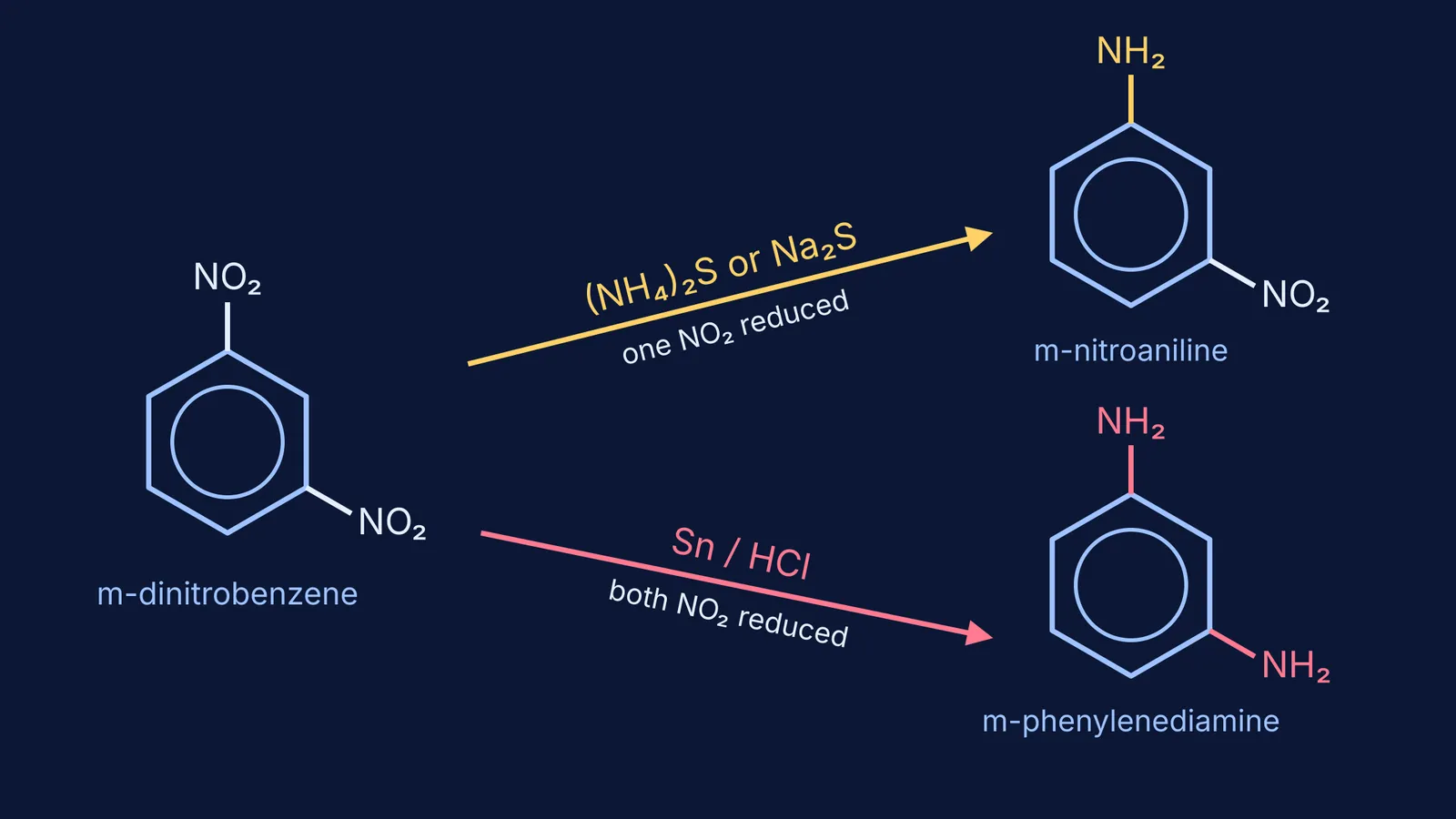
Use ammonium sulphide, (NH4)2S, or sodium sulphide, Na2S. Reducing an aromatic nitro compound with sulphide is called the Zinin reduction, which H. K. Porter's 1973 review in Organic Reactions describes as the reduction of nitroarenes "by negative divalent sulfur" (Porter, Organic Reactions, vol. 20). The same review notes that Zinin first used it to make aniline from nitrobenzene.
With two nitro groups on one ring, the sulphide reduction can stop after the first. Dinitrobenzenes can often be reduced selectively to the nitroaniline, and 3-nitroaniline from 1,3-dinitrobenzene is the standard example (Zinin reaction summary).
In an answer sheet, write it like this: m-C6H4(NO2)2 → m-O2N–C6H4–NH2, with (NH4)2S or Na2S written over the arrow.
Why does Sn/HCl reduce both nitro groups?
The NCERT Class 12 chapter on amines gives two general ways to reduce a nitro compound to an amine: hydrogen gas over finely divided nickel, palladium or platinum, and a metal in acid, such as Sn + HCl or Fe + HCl (NCERT Chemistry Part II, Unit 9 Amines). The same page notes that iron scrap with HCl is preferred, because the FeCl2 formed is hydrolysed to release HCl, so only a small amount of acid is needed to start the reaction.
These methods do not stop to pick one nitro group: every NO2 on the ring becomes NH2. On m-dinitrobenzene, Sn/HCl gives m-phenylenediamine (benzene-1,3-diamine). Industry makes m-phenylenediamine with the other method, by hydrogenating 1,3-dinitrobenzene, as this overview of m-phenylenediamine records from Ullmann's Encyclopedia of Industrial Chemistry.
Why does sulphide stop where tin does not? A helpful picture: two NO2 groups pull electron density out of the ring, so the first one is easy to reduce. Once it becomes NH2, a group that releases electrons into the ring, the remaining nitro group is less ready to accept electrons from a mild reducing agent. Treat this as a memory aid, not a full mechanism; Porter's review says a better understanding of the mechanism would make the method more attractive.
How do you choose a reagent for nitro reductions?
Keep this short chooser in your revision notes:
(NH4)2S or Na2S: reduces one nitro group of a dinitroarene. m-Dinitrobenzene gives m-nitroaniline.
Sn + HCl or Fe + HCl: reduces every nitro group. m-Dinitrobenzene gives m-phenylenediamine.
H2 with Ni, Pd or Pt: reduces every nitro group, the same outcome as metal and acid.
Before you write any reagent, count the nitro groups in the starting material and in the product. If the product still has one, you need sulphide.
How does this fit into a benzene to m-nitroaniline conversion?
Conversion questions can hide this step inside a longer chain. Here is the route from benzene, with the reason for each step.
Nitrate benzene with concentrated HNO3 and H2SO4 to get nitrobenzene. Sulphuric acid's job is to make the nitronium ion; see how mixed acid nitrates benzene.
Nitrate again under harsher conditions. The first NO2 is meta-directing, so the second goes meta and you get m-dinitrobenzene. If directing effects still feel shaky, this guide to ortho, para and meta directors works through them.
Reduce with (NH4)2S or Na2S to get m-nitroaniline.
Why not simply nitrate aniline? NCERT shows that direct nitration of aniline gives tarry oxidation products plus a mixture of 51% p-nitroaniline, 47% m-nitroaniline and 2% o-nitroaniline (NCERT Unit 9 Amines). The meta product forms because aniline is protonated to the meta-directing anilinium ion in strong acid. The dinitro route fixes the meta pattern before any amine exists, so you are not left separating isomers.
The same idea, set the meta pattern first and convert groups afterwards, drives the benzene to m-bromophenol route, where the nitro group also goes on first.
If you keep reaching for the wrong reducing agent in conversion chains, practise on worked problems. The Fermi Problem Library has a step-by-step solver that explains the reasoning rather than printing an answer, so you see why each reagent was chosen.
Where is selective reduction used outside exams?
Nitroarylamines, the family m-nitroaniline belongs to, are widely used as intermediates for medicines, pesticides and dyes, according to the background section of a Chinese patent on making m-nitroaniline from m-dinitrobenzene (CN100494163C). The same patent notes a practical plus of the sulphide route: the sodium thiosulphate it forms dissolves in water and separates easily from the water-insoluble amine.
It also lists the downsides: higher cost, yields generally lower than iron-powder reduction, and large volumes of sulphur-containing waste liquid. The patent itself proposes a modified iron-powder method for the same selective reduction.
To revise the electron-releasing and electron-withdrawing effects behind all of this, the Fermi Concept Library covers every concept in chemistry, each with its own lesson and its place in the map.