

On this page
m-Bromophenol has a bromine atom and an –OH group sitting meta to each other on a benzene ring. That one detail makes it a favourite conversion question. It appears word for word as "Benzene to m-bromophenol" in Exercise 9.8(ii) of the NCERT Class 12 Chemistry unit on amines, and the whole answer depends on doing the steps in the right order.
What are the steps from benzene to m-bromophenol?
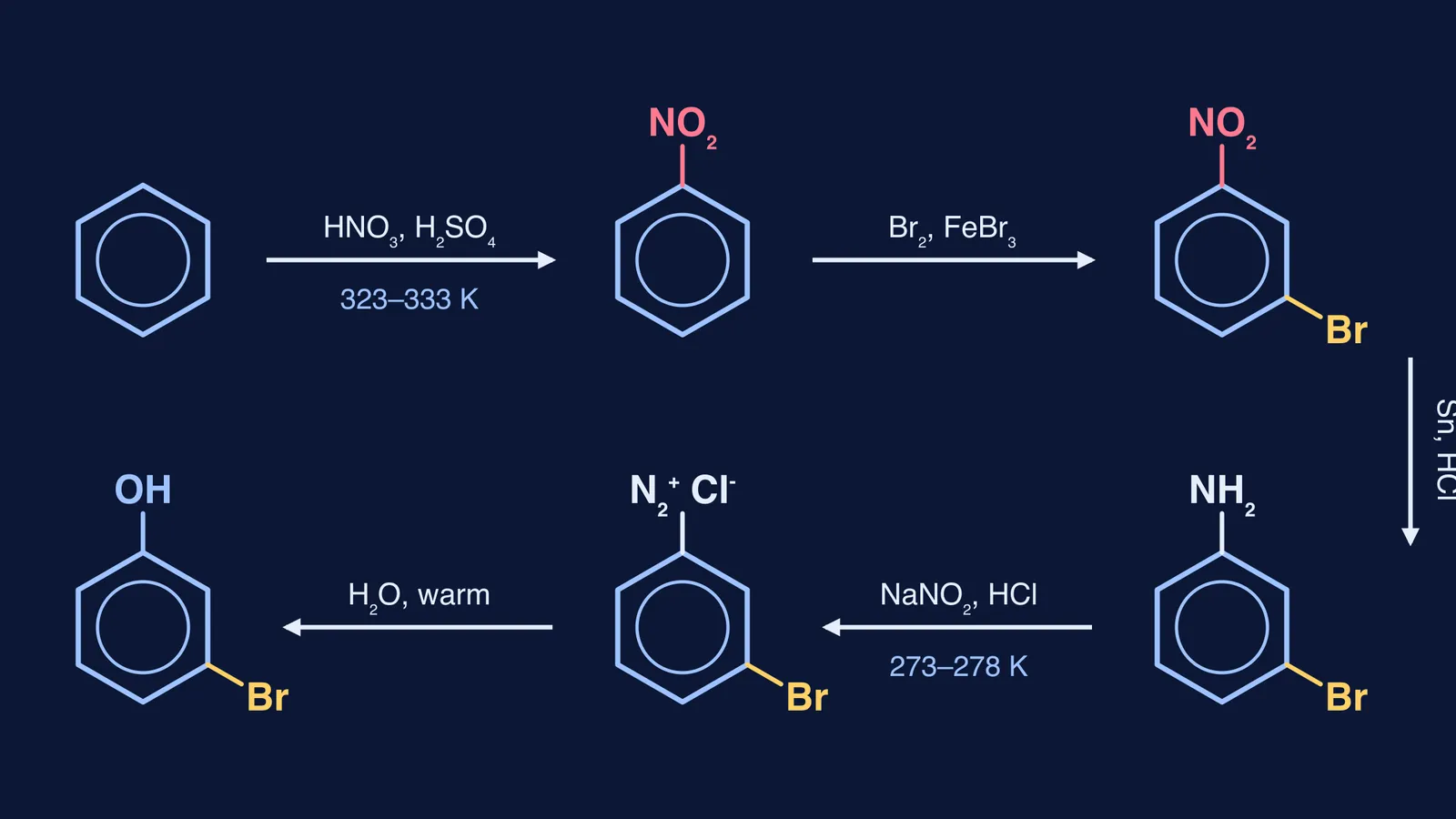
There are five operations, with the reagents and conditions NCERT gives.
Nitration. Heat benzene with concentrated nitric acid and concentrated sulphuric acid at 323–333 K to get nitrobenzene (NCERT Class 11, Hydrocarbons).
Bromination. Treat nitrobenzene with Br₂ and a Lewis acid such as FeBr₃. Arenes react with halogens in the presence of anhydrous FeCl₃, FeBr₃ or AlCl₃, and –NO₂ is a meta-directing group, so you get m-bromonitrobenzene (NCERT Class 11, Hydrocarbons).
Reduction. Reduce the nitro group with Sn/HCl or Fe/HCl to get m-bromoaniline (NCERT Class 12, Amines).
Diazotisation. Treat m-bromoaniline with NaNO₂ and HCl at 273–278 K to get m-bromobenzenediazonium chloride (NCERT Class 12, Amines).
Hydrolysis. Warm the diazonium salt solution with water. N₂ and HCl leave, and the –OH takes the place of the diazonium group, giving m-bromophenol (NCERT Class 12, Alcohols, Phenols and Ethers).
The bromine survives steps 3 to 5. You can see the same thing in NCERT's own Example 9.5, where a ring bromine stays put through Sn/HCl reduction and diazotisation (NCERT Class 12, Amines).
Why must the nitro group go on first?
Because the group already on the ring decides where the next one goes. NCERT calls this the directive influence of substituents, and it depends on the group already present, not on the incoming one (NCERT Class 11, Hydrocarbons).
Try the other two orders and see what goes wrong:
Bromine first. Halogens are deactivating but ortho/para-directing, according to the same NCERT Hydrocarbons unit. Nitrating bromobenzene puts the nitro group ortho or para to the bromine, which is the wrong isomer.
–OH first. The –OH group activates the ring and directs ortho and para. Phenol with bromine water gives 2,4,6-tribromophenol as a white precipitate, and even Br₂ in CS₂ at 273 K gives o- and p-bromophenol (NCERT Class 12, Alcohols, Phenols and Ethers). Neither gives you the meta product.
So both groups you want in the product direct ortho/para. To get them meta, you put on a meta director first and later turn it into one of them. The nitro group reduces electron density at the ortho and para positions more than at meta, so bromine goes meta (NCERT Class 11, Hydrocarbons). Then it changes into –NH₂, then –N₂⁺, then –OH.
The same logic decides the order in most two-substituent problems, which we walk through in how to order the steps when you synthesise disubstituted benzenes.
Why go through the diazonium salt at all?
You cannot swap –NO₂ straight for –OH in one textbook step. The diazonium group, though, is a very good leaving group. NCERT shows diazonium salts can introduce –F, –Cl, –Br, –I, –CN, –OH and –NO₂ into the ring, including groups you cannot add by direct substitution (NCERT Class 12, Amines). The fluorine version is in our post on the Balz-Schiemann route to fluorobenzene.
Temperature is the part students mix up. Arenediazonium salts are stable for only a short time, in solution, at 273–278 K, so they are used immediately. If the solution is allowed to warm to 283 K, the salt is hydrolysed to a phenol (NCERT Class 12, Amines). So step 4 is cold and step 5 is warm: same salt, two temperatures, two outcomes.
How should you write this answer in an exam?
Use this checklist before you move on:
Draw structures, not just names, so the 1,3 (meta) relationship is visible on the ring.
Write reagents above each arrow and conditions (323–333 K, 273–278 K, warm) below it, as given in the NCERT Hydrocarbons and Amines units.
Name every intermediate: nitrobenzene, m-bromonitrobenzene, m-bromoaniline, m-bromobenzenediazonium chloride, m-bromophenol.
Add one line of reasoning: "–NO₂ is meta-directing; Br and –OH are ortho/para-directing, so the nitro group goes on first."
And check you have avoided the four usual slips:
Brominating benzene before nitrating it.
Starting from phenol and adding bromine water.
Leaving out the Lewis acid in the bromination step.
Writing "273 K" over the hydrolysis arrow instead of "warm".
If a third group joins the ring in a later question, the rules for combining two directors are in where a third group goes on a disubstituted benzene.
If you can't see which step comes first in a new conversion, the Fermi Problem Library has worked problems with a step-by-step solver that explains the reasoning rather than printing an answer. If directing effects themselves feel shaky, the Fermi Concept Library gives every chemistry concept its own lesson and shows where it sits in the map.
Try this next: NCERT Exercise 9.8 also asks for benzoic acid to aniline and aniline to 2,4,6-tribromofluorobenzene. Work out the order first, then the reagents.


