On this page
Every Class 11 and NEET-UG biology student meets the same short NCERT passage on how breathing is controlled. It is easy to memorise and easy to mix up. Here is each centre on a simple map, why breathing tracks CO2 rather than oxygen, and a model answer.
Where are the respiratory centres in the brain?
All three structures sit in the brainstem. NCERT Class 11 Biology, Chapter 14, Breathing and Exchange of Gases, places them like this:
Respiratory rhythm centre: in the medulla, and "primarily responsible" for regulating breathing.
Pneumotaxic centre: in the pons, just above the medulla; it can moderate the rhythm centre.
Chemosensitive area: in the medulla, next to the rhythm centre, and highly sensitive to CO2 and hydrogen ions.
Outside the brain, receptors in the aortic arch and carotid artery also recognise changes in CO2 and H+ and signal the rhythm centre. If the medulla and pons are hazy, our guide to the cerebrum, cerebellum and medulla maps the larger brain first.
What is the role of the respiratory rhythm centre and pneumotaxic centre?
Think of the rhythm centre as a metronome and the pneumotaxic centre as the hand that adjusts its tempo.
The OpenStax Anatomy and Physiology textbook describes a group of medullary neurons that stimulate the diaphragm and external intercostal muscles to contract for inspiration; when that activity stops, the muscles relax and you breathe out. A healthy human breathes 12 to 16 times a minute on average, according to NCERT Chapter 14.
The pneumotaxic centre's signal, in NCERT's words, "can reduce the duration of inspiration and thereby alter the respiratory rate." Shorter breaths in can mean more breaths per minute.
Why does CO2, not oxygen, drive breathing?
NCERT states that "the role of oxygen in the regulation of respiratory rhythm is quite insignificant" (NCERT Chapter 14). The textbook does not spell out why, but three facts from the same chapter help.
CO2 becomes acid. Carbonic anhydrase speeds up CO2 + H2O ⇌ H2CO3 ⇌ HCO3- + H+, so a rise in CO2 also raises H+, and the chemosensitive area reads both.
Breathing changes CO2 directly. Blood reaches the lungs at a pCO2 of 45 mm Hg and meets alveolar air at 40 mm Hg (NCERT Table 14.1), so breathing more or less changes how much CO2 leaves.
Oxygen has a cushion. The oxygen dissociation curve (NCERT Figure 14.5) is sigmoid and flattens near the top, so haemoglobin stays nearly saturated when pO2 dips a little.
OpenStax supplies a number that ties this together: if blood oxygen becomes "quite low—about 60 mm Hg or less", peripheral chemoreceptors stimulate an increase in breathing (OpenStax, section 22.3). Oxygenated blood normally carries a pO2 of 95 mm Hg (NCERT Table 14.1). Combining the two books, oxygen must fall roughly 35 mm Hg before it becomes a strong signal.
A 2015 review in Neuron by Patrice Guyenet and Douglas Bayliss describes specific brainstem neurons, such as those of the retrotrapezoid nucleus, that are activated by PCO2 and stimulate breathing; they detect CO2 partly through intrinsic proton receptors (Neuron, 2015).
How does the whole loop work, step by step?
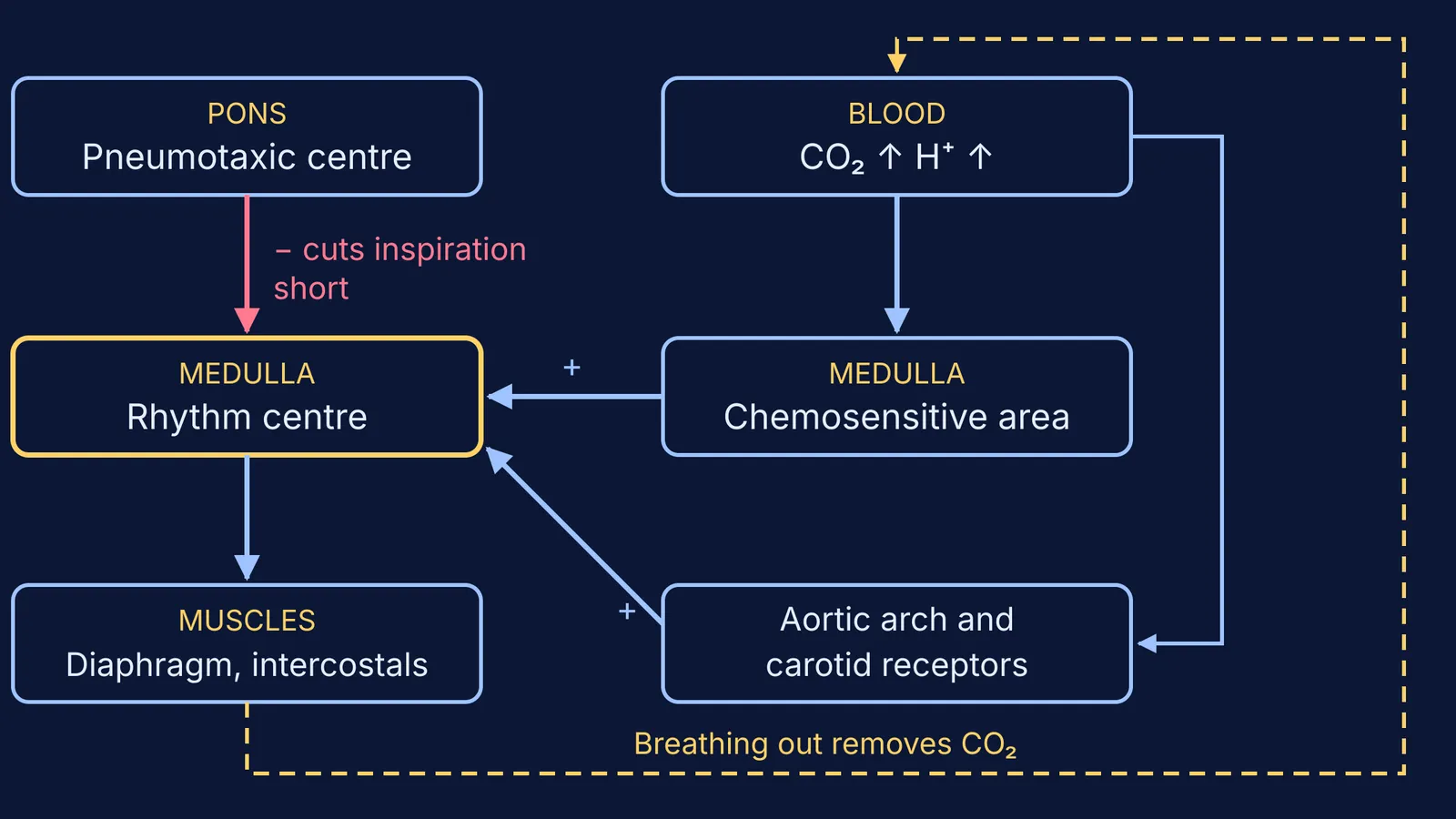
Follow the diagram at the top. Each step follows NCERT Chapter 14, sections 14.2 and 14.5.
Your cells make CO2, so CO2 and H+ in the blood rise.
The chemosensitive area in the medulla, and the receptors in the aortic arch and carotid artery, detect the rise.
They signal the rhythm centre, which makes the necessary adjustments through the diaphragm and intercostal muscles.
The pneumotaxic centre in the pons can shorten each inspiration, which alters the rate.
Breathing out removes CO2, H+ falls, and the signal eases.
This is negative feedback, and you feel it when you hold your breath: see why we cannot hold our breath for long.
How do you write this answer in an exam?
NCERT's own exercise asks, "How is respiration regulated?" A model answer built only from the textbook's points:
"Respiration is regulated by the neural system. The respiratory rhythm centre in the medulla is primarily responsible. The pneumotaxic centre in the pons can reduce the duration of inspiration and so alter the rate. A chemosensitive area next to the rhythm centre is highly sensitive to CO2 and H+ and signals the rhythm centre when they rise, as do receptors in the aortic arch and carotid artery. The role of oxygen is quite insignificant."
Before you submit, check for these slips:
Placing the pneumotaxic centre in the medulla. It is in the pons.
Saying the pneumotaxic centre starts each breath. It shortens inspiration; the rhythm centre sets the rhythm.
Naming low oxygen as the main trigger. NCERT names CO2 and H+.
To see where this fits in the wider chapter, the Fermi Concept Library gives every biology concept its own lesson and its place in the map, so you can step from breathing control to gas transport. Then pair it with the NCERT values for lung volumes and capacities from the same chapter.