On this page
A potato plant and a tomato plant cannot be crossed by pollen. Plant scientists found a way round that barrier: take one cell from each, strip off the walls, and make the two naked cells merge into one. The result, the pomato, is a favourite board-exam example of a somatic hybrid. Here is how it was made, and why you will never find it in a sabzi mandi.
What is protoplast fusion?
A protoplast is a plant cell without its cell wall, bounded only by the plasma membrane, as the Tamil Nadu Class 12 Botany textbook, chapter 5 (Plant Tissue Culture) defines it. Protoplast fusion merges two such cells, often from different species, into one hybrid cell. A plant grown from that cell is a somatic hybrid, because it came from body (somatic) cells, not from pollen and egg.
Why go to this trouble? A 1993 PhD thesis from Wageningen Agricultural University states plainly that "tomato and potato cannot be cross-hybridized". Fusing cells skips the flower altogether.
How is pomato made by protoplast fusion?
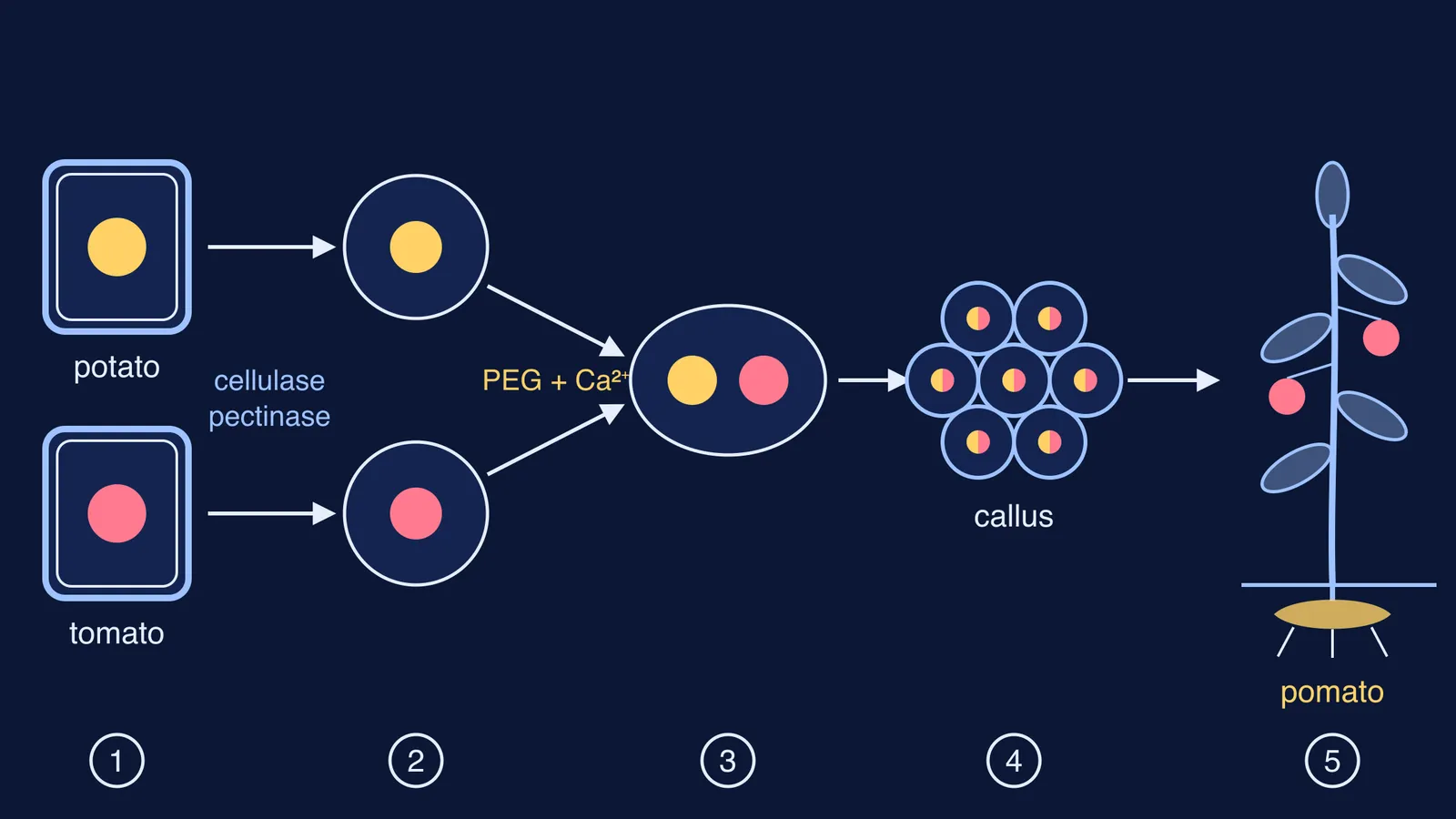
Georg Melchers, Maria Sacristán and Anthony Holder reported somatic hybrid plants of potato and tomato regenerated from fused protoplasts in Carlsberg Research Communications in 1978. The general protoplast method your state-board textbook describes runs like this; it is the textbook recipe, not the exact 1978 lab protocol (Tamil Nadu Botany, chapter 5):
Take leaf tissue. Small bits of leaf from each parent are the starting material.
Digest the walls. The tissue is soaked in 0.5% Macrozyme and 2% Onozuka cellulase in 13% sorbitol or mannitol at pH 5.4, overnight at 25°C. Cellulase breaks down cellulose; Macrozyme, a pectin-digesting mix, frees the cells from each other. The sugar alcohol stops the naked cells from bursting.
Clean up. The protoplasts are moved to 20% sucrose and centrifuged away from wall debris.
Fuse. They are incubated in 25 to 30% polyethylene glycol (PEG) with Ca2+ ions, clump together and fuse.
Culture. Fused cells grow in modified MS liquid medium at 25°C. A new wall forms within 24 to 48 hours; the first division comes in 2 to 7 days.
Select hybrids. Hybrid cells are picked out from unfused cells and same-parent fusions, and the two nuclei fuse; the textbook calls this somatic hybridization.
Regenerate. Hybrid cells form callus, then shoots and roots, and the plantlets are hardened before going to soil.
Steps 5 to 7 are ordinary tissue culture, and they work because plant cells are totipotent. Our posts on plant tissue culture and micropropagation and the 1958 carrot experiment that proved totipotency cover that half of the story.
What does the flow chart look like in a board answer?
For a five-mark answer, draw boxes joined by downward arrows, and write the enzyme and the fusogen beside the arrows:
Potato leaf cells + tomato leaf cells
Cellulase + pectinase (Macrozyme) in mannitol, overnight
Naked protoplasts of each parent
PEG + Ca2+ (fusogen)
Fused hybrid cell; nuclei fuse
Culture on MS medium; new cell wall forms
Selection of hybrid cells
Callus
Shoots and roots (regeneration)
Hardening, then somatic hybrid plant: pomato
Add one line under the chart: "Pomato was produced by Melchers and co-workers in 1978." For more layout tips, read how to write biology long answers with flowcharts and tables.
Why did pomato never become a crop?
The Wageningen thesis sums up the 1978 plants: they "formed flowers, parthenocarpic fruits and slightly thickened rhizomes. However, all hybrids were sterile." In plain words, there were no proper potatoes underground, the fruits had no seed, and the plants could not be bred further.
A crop has to be multiplied and improved. A sterile plant cannot pass its traits on through seed or be crossed with better varieties. The same thesis adds that hybrids carrying both parents' full genomes "are seldom desirable from a plant breeding point of view", since breeders usually want one or two useful traits, not everything at once. Its own attempts to move only part of the potato genome into tomato gave many hybrid calli, but "no viable plants could be regenerated".
Where does pomato fit in the timeline?
Edward Cocking published a method for isolating plant protoplasts in Nature in 1960. Peter Carlson and colleagues fused protoplasts of Nicotiana glauca and N. langsdorffii and regenerated hybrid plants, in a paper published in PNAS in 1972 (your textbook may date it 1971). Pomato followed in 1978.
If these names and steps blur together, the Fermi Concept Library gives every concept in biology its own lesson and its place in the map, so you can see that totipotency comes before somatic hybridisation.
Before the exam, write the ten-step chart from memory once, then check it against your textbook. When you can draw it without looking, you have the answer.