

On this page
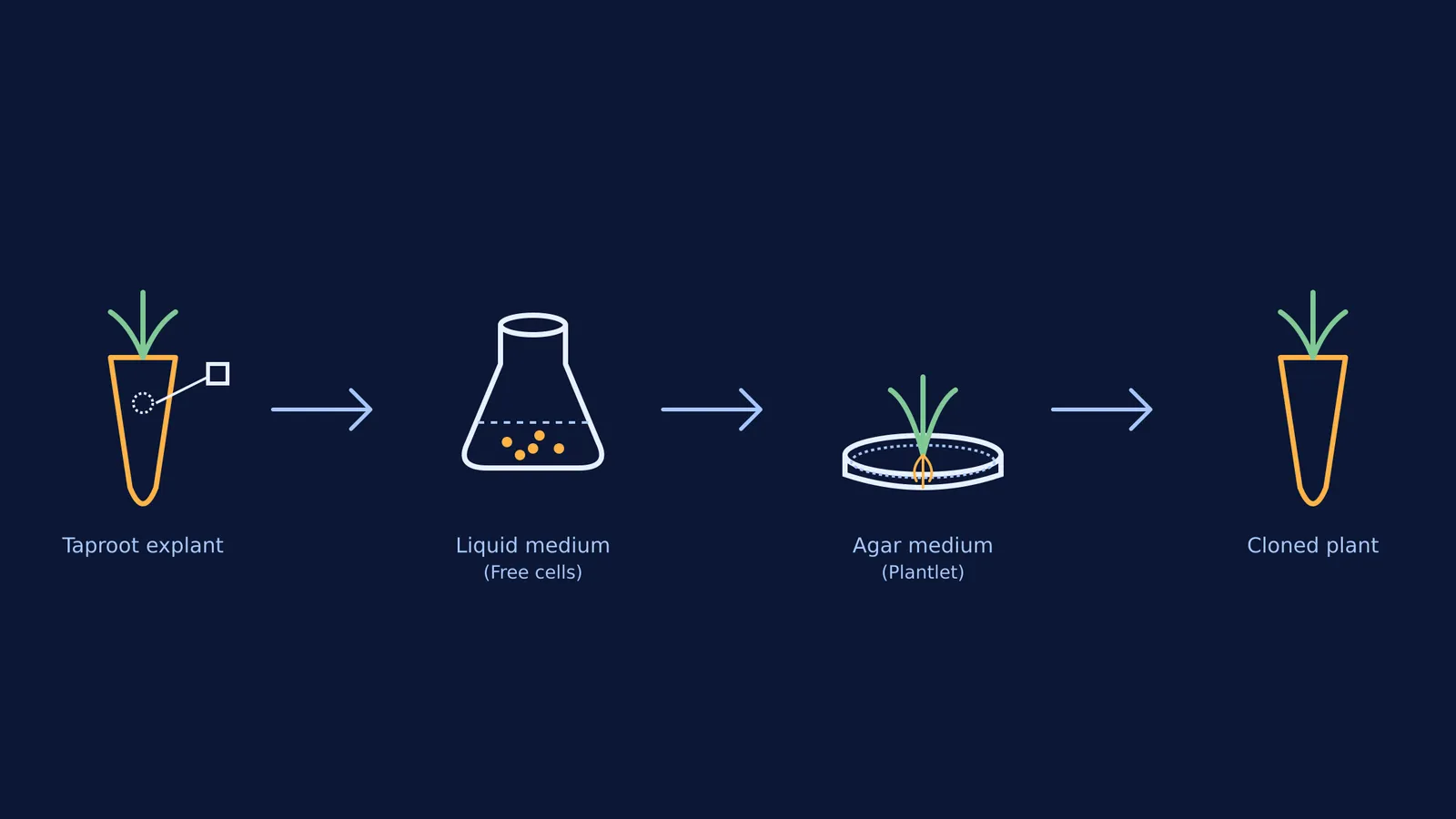
For decades, biologists wondered if a single mature plant cell could grow into a complete organism. In 1958, F.C. Steward and his team at Cornell University proved it was possible. They published their landmark results in the *American Journal of Botany*. In their experiment, Steward took small, 2 mg slices of secondary phloem from the taproot of a carrot (*Daucus carota*) (https://doi.org/10.1002/j.1537-2197.1958.tb12224.x). These cells were already mature and highly specialised for transporting nutrients. He placed them in a liquid nutrient medium that included coconut milk, which is the liquid endosperm of the coconut. We now know this milk is rich in cytokinins, a growth hormone that encourages rapid cell division.
How did the Steward wheel induce dedifferentiation?
Steward placed his flasks on a specially designed rotating wheel. This constant movement aerated the liquid medium, ensuring the cells had enough oxygen to survive. It also caused individual cells and small clusters to mechanically break away from the main tissue segment and float freely in the liquid.
Inside the flasks, a remarkable biological process occurred. The mature phloem cells dedifferentiated. This means they lost their specialised transport functions and reverted to an actively dividing, embryonic state, forming an unorganised mass of cells known as a callus. If you are preparing for exams, understanding these cellular changes is the foundation of plant tissue culture and micropropagation.
In the liquid medium, the free-floating callus cells began to redifferentiate, forming root initials first. When these root-bearing aggregates were transferred to a solid agar medium, they developed shoot systems, eventually growing into mature, flowering carrot plants that were genetically identical to the original taproot.
What does totipotency mean for modern agriculture?
Steward’s findings did more than just settle a biological debate; they revolutionised how we grow crops. Because every cell contains the complete genetic blueprint of the plant, you do not need seeds to propagate a species.
This process, known as micropropagation, allows growers to clone large numbers of identical plants from a single parent. It is widely used today for commercial crops like bananas, orchids, and timber. It also plays a vital role in genetic engineering, because once a single cell is modified with a new trait—such as pest resistance—that cell can be cultured into a full plant carrying the exact same trait in every one of its tissues.
Why does plant cell totipotency matter for NEET?
Steward's experiment proved the concept of cellular totipotency: the inherent capacity of a single living plant cell to regenerate into a complete, mature plant.
This discovery laid the foundation for the entire biotechnology unit in your biology syllabus. By taking an explant (any part of a plant taken out and grown in a test tube), agricultural scientists can bypass the long wait for seeds. They can even use Meristems: apical, intercalary and lateral, and where each lies as explants to grow virus-free plants, because the rapidly dividing apical meristem is typically free of viruses even when the rest of the plant is infected.
If you have concept gaps when tracing the steps from an explant to a fully grown plant, the Fermi Concept Library covers every concept in physics, chemistry, biology, mathematics and computing, each with its own lesson and its place in the map.
How do you answer exam questions on tissue culture?
When revising plant biotechnology and tissue culture for your exams, keep this checklist of definitions ready. Exam questions frequently test your ability to tell these similar-sounding terms apart.
Explant: Any part of a plant (root, stem, leaf, or meristem) taken out and grown in a sterile test tube.
Totipotency: The capacity to generate a whole plant from any cell or explant.
Callus: An unorganised, undifferentiated mass of actively dividing cells produced in tissue culture.
Somaclones: Plants produced through tissue culture that are genetically identical to the original parent plant.
If you struggle with wrong-method mistakes when matching these definitions to applied questions, the Fermi Problem Library has worked problems with a step-by-step solver that explains the reasoning rather than printing an answer. This helps you build a solid understanding of how tissue culture techniques are used in real-world agriculture.


