On this page
A voltmeter draws current, so it reads a cell's terminal voltage, not its emf. A potentiometer gets round this: at the balance point no current flows through the cell, so the length you measure matches its emf. That is the idea behind Experiment 4 in the NCERT Class 12 physics laboratory manual, which compares a Leclanché cell with a Daniell cell.
What is the principle behind comparing emfs with a potentiometer?
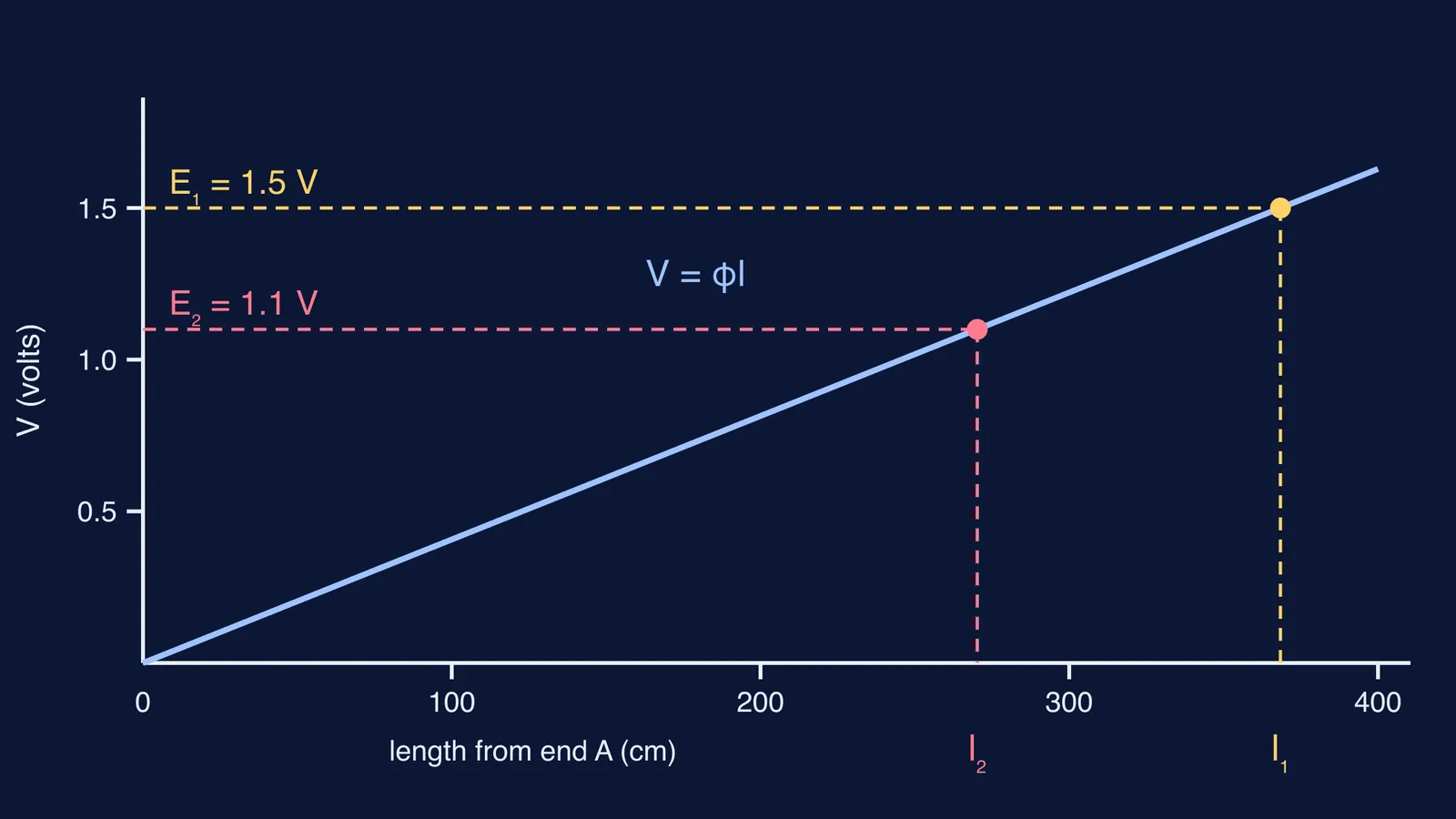
When a steady current flows through a wire of uniform thickness and material, the potential difference between two points on it is directly proportional to the length between them: V = φl, where φ is the potential gradient (NCERT lab manual, Experiment 4).
At balance, E1 = φl1 and E2 = φl2, so E1/E2 = l1/l2. The gradient φ cancels, so you don't need the driver battery's exact voltage, only a steady current through the wire while you take both readings.
How do you set up the circuit?
Besides the two cells and a galvanometer, the manual calls for a resistance box (0 to 1000 Ω), a low-resistance rheostat (about 20 Ω), a battery eliminator or lead accumulator, and one two-way and two one-way keys (NCERT lab manual). Then:
Join the positive terminal of the driver battery E and the positive terminals of both cells to end A, the zero end of the wire.
Connect the negative of E to end B through key K1 and the rheostat.
Connect the negatives of E1 and E2 to terminals a and b of the two-way key. Run the common terminal c through the resistance box (shunted by key K2) to the galvanometer, and from there to the jockey.
With about a thousand ohms out of the box, touch the jockey at A, then at B. Opposite deflections mean the circuit is right.
Slide the jockey gently to the null point, then close K2 and fine-tune. Record l1, approaching from both directions.
Switch to E2 without touching the rheostat and find l2 the same way.
Move the rheostat and repeat the whole set three times.
What do sample readings and the calculation look like?
These readings are illustrative: we made them up to show the arithmetic. They assume NCERT's values of 1.1 V for a Daniell cell and nearly 1.5 V for a dry Leclanché cell (NCERT Class 12 Chemistry, Electrochemistry). That puts the expected ratio near 1.36. The example uses a 400 cm wire read to 0.1 cm.
Set 1: l1 = 368.2 and 368.6 cm (mean 368.4); l2 = 270.0 and 270.4 cm (mean 270.2); l1/l2 = 1.363
Set 2: l1 = 342.0 and 342.6 cm (mean 342.3); l2 = 252.0 and 252.2 cm (mean 252.1); l1/l2 = 1.358
Set 3: l1 = 320.4 and 321.0 cm (mean 320.7); l2 = 234.6 and 235.0 cm (mean 234.8); l1/l2 = 1.366
The mean ratio is 1.362. For the error, the NCERT lab manual uses Δ(E1/E2) = (Δl1/l1 + Δl2/l2) × (E1/E2) for each set and reports the largest. Set 3, with the shortest lengths, gives (0.1/320.7 + 0.1/234.8) × 1.366 ≈ 0.001. Result: E1/E2 = 1.362 ± 0.001.
Two points for your write-up. First, shorter balancing lengths give bigger percentage errors, so you want the null points far along the wire. A related percentage-error argument explains why the meter bridge null point should be near the middle. Second, the sets spread from 1.358 to 1.366, which is wider than ±0.001. The formula only covers scale-reading error, not jockey pressure or drift in the driver current, so note the spread under sources of error.
What precautions and sources of error should you write?
From the NCERT lab manual:
Plugs in the resistance box must make good contact.
Press the jockey gently so the wire doesn't kink.
Don't move the rheostat until you have balance lengths for both cells.
Keep the keys open when the cells aren't in use, so they don't run down.
Don't pass current for long; it heats the wire.
If there is a small range with no visible deflection, take its middle as the balance point.
Sources of error include a wire whose cross-section isn't uniform, a wire that isn't taut along the scale, and a jockey that isn't lined up with the scale. For phrasing these so they earn marks, see how to write precautions and sources of error in practicals.
Where do students usually slip up?
Moving the rheostat between l1 and l2. That changes φ, so the ratio means nothing.
Writing E1/E2 = l2/l1. The bigger emf always gets the longer balancing length.
To watch the balance point move, try our potentiometer simulation for comparing two EMFs. If potential gradient still feels shaky, the Fermi Concept Library gives each concept its own lesson. For numericals, the Fermi Problem Library has a step-by-step solver that explains the reasoning rather than printing an answer.