On this page
If you are revising plant breeding from an older NCERT edition, a previous-year paper or a question bank, section 9.2.3 is short but packed: three kinds of trait, six crops and five Pusa varieties. Here it is in one revision list, with a five-minute self-test.
Is this topic still in the NCERT Class 12 book?
Not in the current edition. The contents page of the NCERT Class 12 Biology reprint for 2026-27 lists 13 chapters, and Unit VIII, Biology in Human Welfare, now holds only Human Health and Disease and Microbes in Human Welfare. The material below comes from Chapter 9, Strategies for Enhancement in Food Production, in the 2020-21 edition of the same textbook. Check that your current board or exam syllabus still lists plant breeding before you spend hours on it.
How does plant breeding make crops resistant to insect pests?
NCERT's 2020-21 textbook says insect resistance in host crop plants may be due to morphological, biochemical or physiological characteristics (NCERT Class 12 Biology, Chapter 9, 2020-21). Sort every example into one of these:
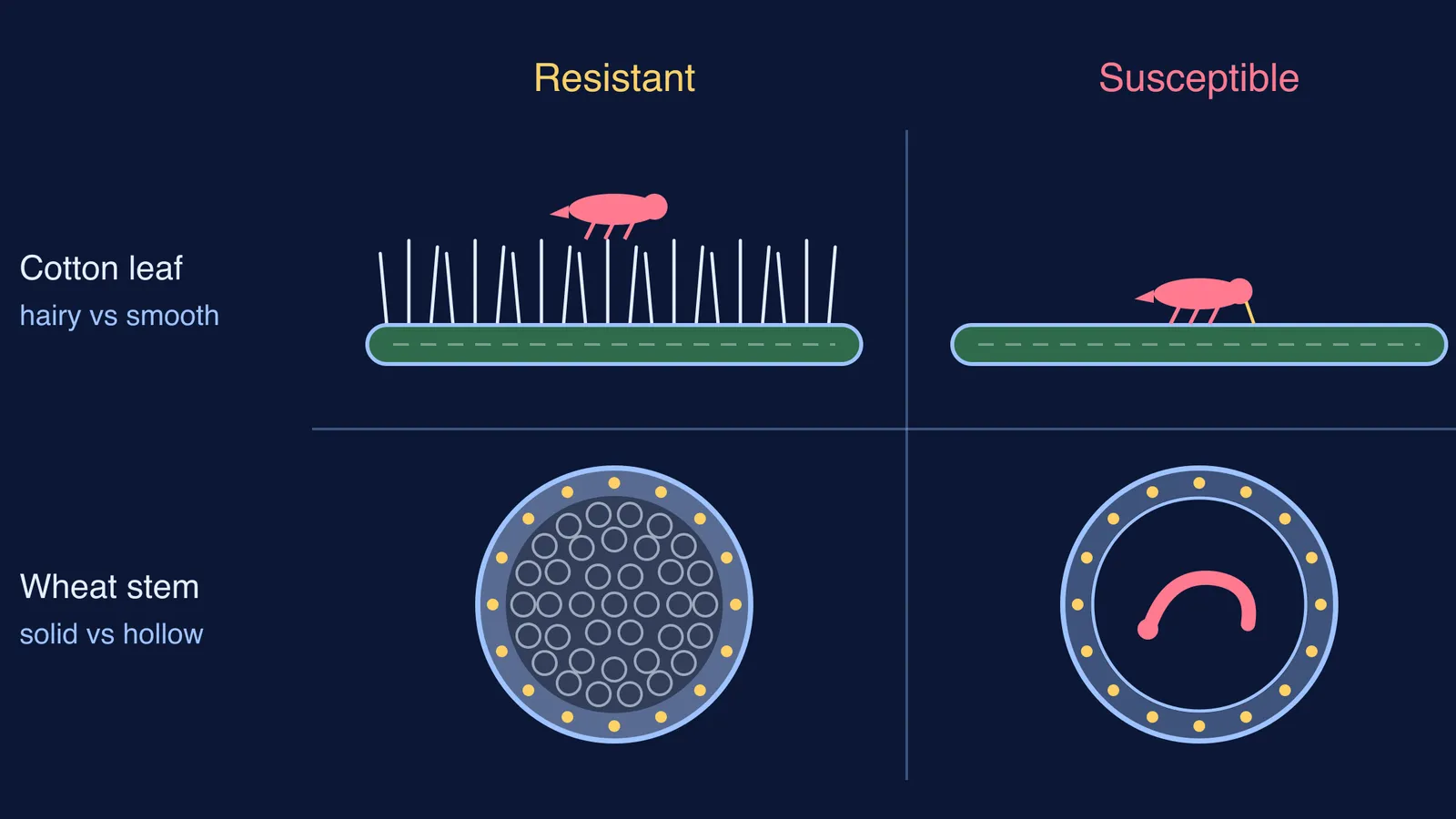
Morphological means the plant's build and surface: hairy leaves, solid stems, smooth leaves without nectar.
Biochemical means what the plant's tissue contains: high aspartic acid, low nitrogen and low sugar in maize.
Physiological means how the plant functions. NCERT gives no example of it here, so don't invent one.
Breeding for insect resistance follows the same steps as breeding for yield or quality, and resistance genes may come from cultivated varieties, germplasm collections or wild relatives. If those steps are hazy, revise the steps of plant breeding and NCERT's disease-resistant varieties.
Why do hairy leaves and solid stems keep pests away?
NCERT links hairy leaves to resistance against jassids on cotton and the cereal leaf beetle on wheat (NCERT, 2020-21). A 2025 study in the Journal of Cotton Research compared nine cotton lines from Tamil Nadu Agricultural University and found that the jassid-resistant lines had significantly denser and longer leaf hairs than the susceptible ones (Subhashini and colleagues, 2025).
For wheat, NCERT says solid stems lead to non-preference by the stem sawfly, meaning the insect avoids the plant. A 2023 review in Crop Science, on a sawfly that has damaged wheat in the US and Canada since the late 19th century, calls solid stems the most effective genetic resistance for cutting the yield losses it causes (Bathini and colleagues, 2023).
NCERT's last two examples are about what the plant offers the pest. Smooth-leaved cotton varieties without nectar do not attract bollworms. In maize, high aspartic acid, low nitrogen and low sugar content lead to resistance to maize stem borers. Bollworms return in biotechnology, where the defence is an inserted gene: see which Cry genes in Bt cotton control bollworms.
Which NCERT examples should you remember?
From the 2020-21 chapter, as trait, crop, pest.
Traits (section 9.2.3):
Hairy leaves: cotton, resists jassids
Hairy leaves: wheat, resists cereal leaf beetle
Solid stems: wheat, not preferred by stem sawfly
Smooth leaves, no nectar: cotton, does not attract bollworms
High aspartic acid, low nitrogen and sugar: maize, resists maize stem borers
Released varieties (Table 9.2, bred by hybridisation and selection):
Pusa Gaurav: Brassica (rapeseed mustard), resists aphids
Pusa Sem 2 and Pusa Sem 3: flat bean, resist jassids, aphids and fruit borer
Pusa Sawani and Pusa A-4: okra (bhindi), resist shoot and fruit borer
A memory hook: sort by where the defence sits. Leaf surface is cotton and wheat, the stem is wheat alone, chemistry is maize alone. Learn the two Brassica varieties as a pair: Gaurav for aphids, Swarnim for white rust. The chapter's third list, nutrient-rich crops, is in our post on biofortification examples like Atlas 66.
How can you test yourself in five minutes?
Cover the lists and answer aloud.
Which wheat trait makes the stem sawfly avoid the plant?
Hairy leaves protect cotton from which pest?
Name the three maize traits linked to stem borer resistance.
Pusa Gaurav belongs to which crop, and which pest does it resist?
Is Pusa Komal on the insect list or the disease list?
Which two okra varieties resist shoot and fruit borer?
Answers: solid stems; jassids; high aspartic acid, low nitrogen and low sugar; Brassica and aphids; the disease list (cowpea, bacterial blight); Pusa Sawani and Pusa A-4.
Missed two or more? Rewrite only those lines, not the chapter, and test again tomorrow.
To see where plant breeding sits next to Bt crops, the Fermi Concept Library gives every biology concept its own lesson and its place in the map. If match-the-column questions keep tripping you, the Fermi Problem Library has worked problems with a step-by-step solver that explains the reasoning rather than just printing an answer.