

On this page
*Bacillus thuringiensis* (Bt) is a soil bacterium that naturally produces protein crystals during a specific phase of its growth. These crystals contain a highly toxic insecticidal protein that protects modern agriculture. By isolating the genes that code for these specific toxins and inserting them into the DNA of crop plants, scientists have successfully created pest-resistant crops, most notably Bt cotton and Bt corn.
According to ISAAA Brief 57 (2024), India plants Bt cotton on more than 95% of its cotton land, covering approximately 12.2 million hectares. However, the Bt toxin is not a single, universal poison that kills all insects. It is highly specific to certain insect groups, meaning that the choice of gene must be carefully matched to the crop and the targeted pest.
Which cry genes control cotton bollworms and corn borers?
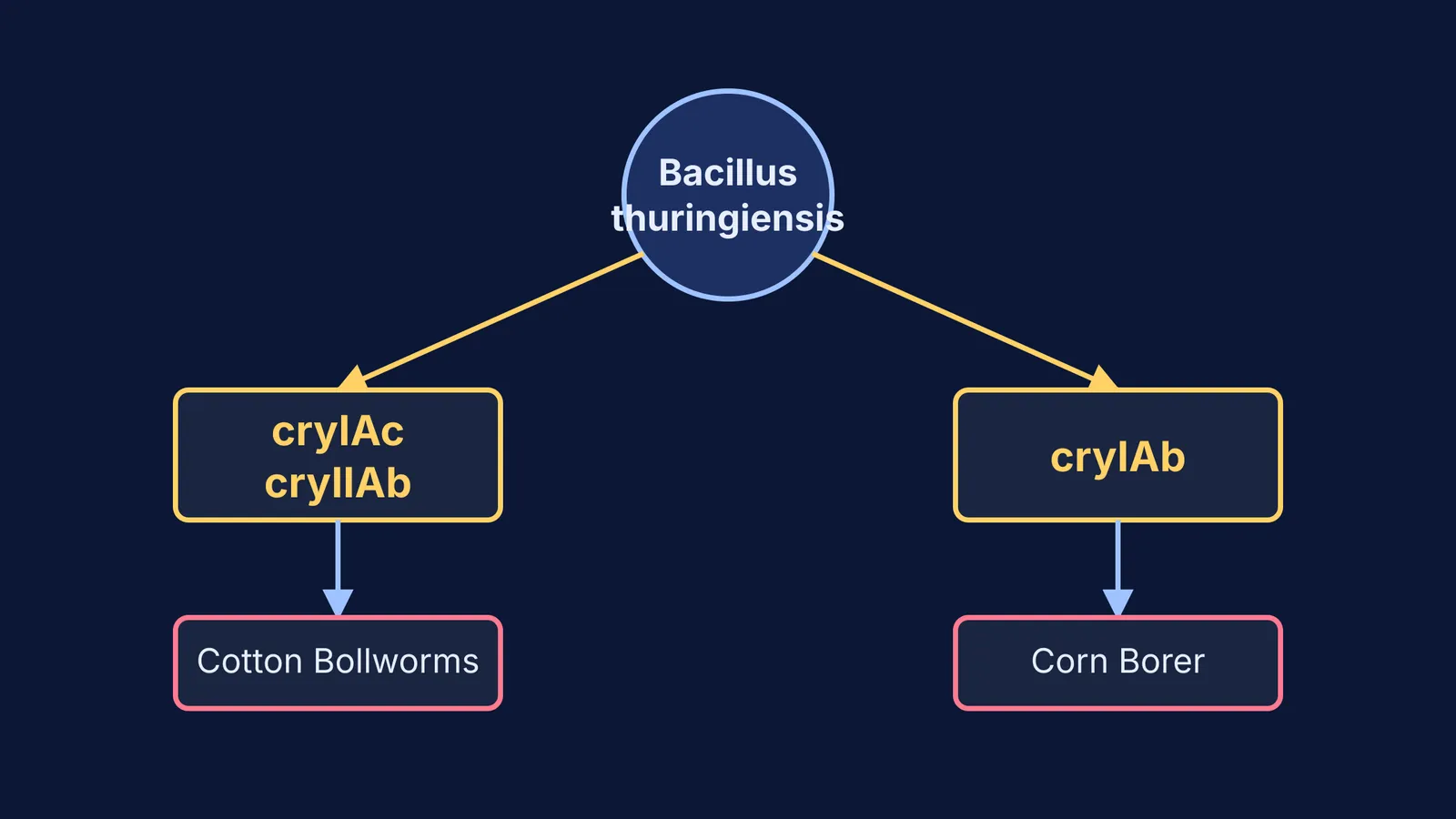
The insecticidal toxins are coded by genes named *cry*. Because there are several distinct Cry proteins, you must match the exact gene to the pest it targets. According to the NCERT Class 12 Biology curriculum, the specific pairings are:
The proteins encoded by the genes cryIAc and cryIIAb control the cotton bollworms.
The protein encoded by the gene cryIAb controls the corn borer.
Agricultural biotechnology often relies on a strategy called "gene stacking." A single crop might express multiple *cry* genes simultaneously. For example, stacking `cryIAc` and `cryIIAb` makes it significantly harder for the cotton bollworm to evolve resistance. Because the two toxins bind to different receptors in the insect's gut, the pest would need to develop multiple simultaneous mutations to survive—a statistical unlikelihood that protects crop yields over the long term.
Why doesn't the Bt toxin kill the bacterium itself?
A common question is why *Bacillus thuringiensis* does not perish from its own toxic proteins. The answer lies in how the protein is formed. The Bt toxin protein exists in the bacterium as an inactive protoxin. It only becomes lethal under very specific environmental conditions.
When an insect, such as a hungry cotton bollworm or a corn borer larva, ingests the inactive toxin from the plant tissues, the crystals travel to the insect's midgut. The midgut of these pests has a highly alkaline pH, which solubilises the crystals and chemically converts the protoxin into its active form.
The newly activated toxin then binds to the surface of midgut epithelial cells. This binding creates pores in the cell membrane, disrupting the osmotic balance. The influx of fluid causes cell swelling and lysis, eventually leading to gut paralysis, starvation, and the death of the insect. Because humans and other mammals have highly acidic stomachs, the protoxin never dissolves or activates in our bodies, making these crops safe for human consumption.
If you struggle to picture how enzymes and pH interact at a cellular level, the Fermi Concept Library holds a lesson for every concept in biology, along with its place in the map.
How do you remember the genes for exams?
Questions distinguishing `cryIAc`, `cryIIAb`, and `cryIAb` are frequent in NEET, board exams, and university entrance tests. Because the letters and Roman numerals look similar, students often mix them up. Here is a practical framework to keep them straight:
Count the words in the pest's name.
"Cotton bollworm" consists of two words. Therefore, remember that it is controlled by a pair of two genes: `cryIAc` and `cryIIAb`. Notice how the pair spans two different Roman numerals (I and II).
"Corn borer" is a different agricultural pest, and for the standard syllabus, it pairs with just one specific gene: `cryIAb`.
Check the suffix letters.
Both genes active against the cotton bollworm end in a combination of A and a lowercase letter (`Ac` and `Ab`), but they use different numerals: IAc and IIAb.
The corn borer gets the remaining IAb.
Understanding the precise mechanism of action for these genes is a cornerstone of modern biotechnology. When revising genetics and applied biology, compare this pest-resistance strategy with other unique mechanisms in nature, such as how plants achieve apomixis and polyembryony or how eukaryotic RNA polymerases divide their transcription work across different cellular products.


