On this page
Ask a student why net ATP is "only theoretical" and you usually get four assumptions recited in order. Here is the list, the reason each item fails, and a recount you can do in two minutes.
What are the assumptions of the respiratory balance sheet in NCERT?
Section 12.5 of the NCERT Class 11 Biology chapter Respiration in Plants says the net ATP calculation "can remain only a theoretical exercise" and can be made only if you assume that:
There is a sequential, orderly pathway: one substrate forms the next, and glycolysis, the TCA cycle and the ETS follow one after another.
The NADH made in glycolysis is transferred into the mitochondria and undergoes oxidative phosphorylation.
None of the intermediates is used to make any other compound.
Only glucose is respired, and no other substrate enters at any intermediate stage.
The same page then says these assumptions "are not really valid in a living system". Earlier in the chapter, NCERT also takes one NADH as giving 3 ATP and one FADH2 as giving 2 ATP. That is an unlisted fifth assumption the 38 depends on.
Why does each assumption fail in a real cell?
1. The pathways do not take turns. In a living cell, NCERT notes, all pathways work at the same time, ATP is used as and when it is needed, and enzyme rates are controlled in several ways.
2. Glycolytic NADH cannot simply walk in. NADH made in the cytoplasm cannot easily cross into mitochondria, so its electrons are picked up inside by NAD+ or FAD instead. OpenStax Biology 2e explains that NAD+ is the carrier in the liver, while FAD acts in the brain. The FAD route skips the first complex of the chain, so it makes fewer ATP. Our guide to the electron transport chain complexes shows where each carrier enters.
3. Intermediates are drawn off. NCERT's own amphibolic pathway section says acetyl CoA is withdrawn from respiration when the cell needs to make fatty acids, and respiratory intermediates link to protein synthesis too. For the full map, read respiration as an amphibolic pathway.
4. Glucose is not the only fuel. Fats enter as acetyl CoA or as glycerol (after conversion to PGAL), and amino acids enter as pyruvate, acetyl CoA or Krebs cycle intermediates, according to the same NCERT chapter. The chapter's section on respiratory quotient adds that respiratory substrates are often more than one.
5. NADH does not give a whole 3 ATP. A review of P/O ratio measurements since 1937 by Peter Hinkle in Biochimica et Biophysica Acta (2005) concludes that values of about 2.5 for NADH-linked substrates and 1.5 for succinate, which feeds in through FADH2, fit most reports. It adds that slightly lower values, 2.3 and 1.4, are also possible. The values are fractions because of the coupling ratios of proton transport.
One more loss sits on top of all five. In resting mammals, about 20% of mitochondrial oxygen use is uncoupled from ATP synthesis by proton leak across the inner membrane, according to an estimate in a 1997 review by Rolfe and Brown in Physiological Reviews.
How many ATP does a cell really make from one glucose?
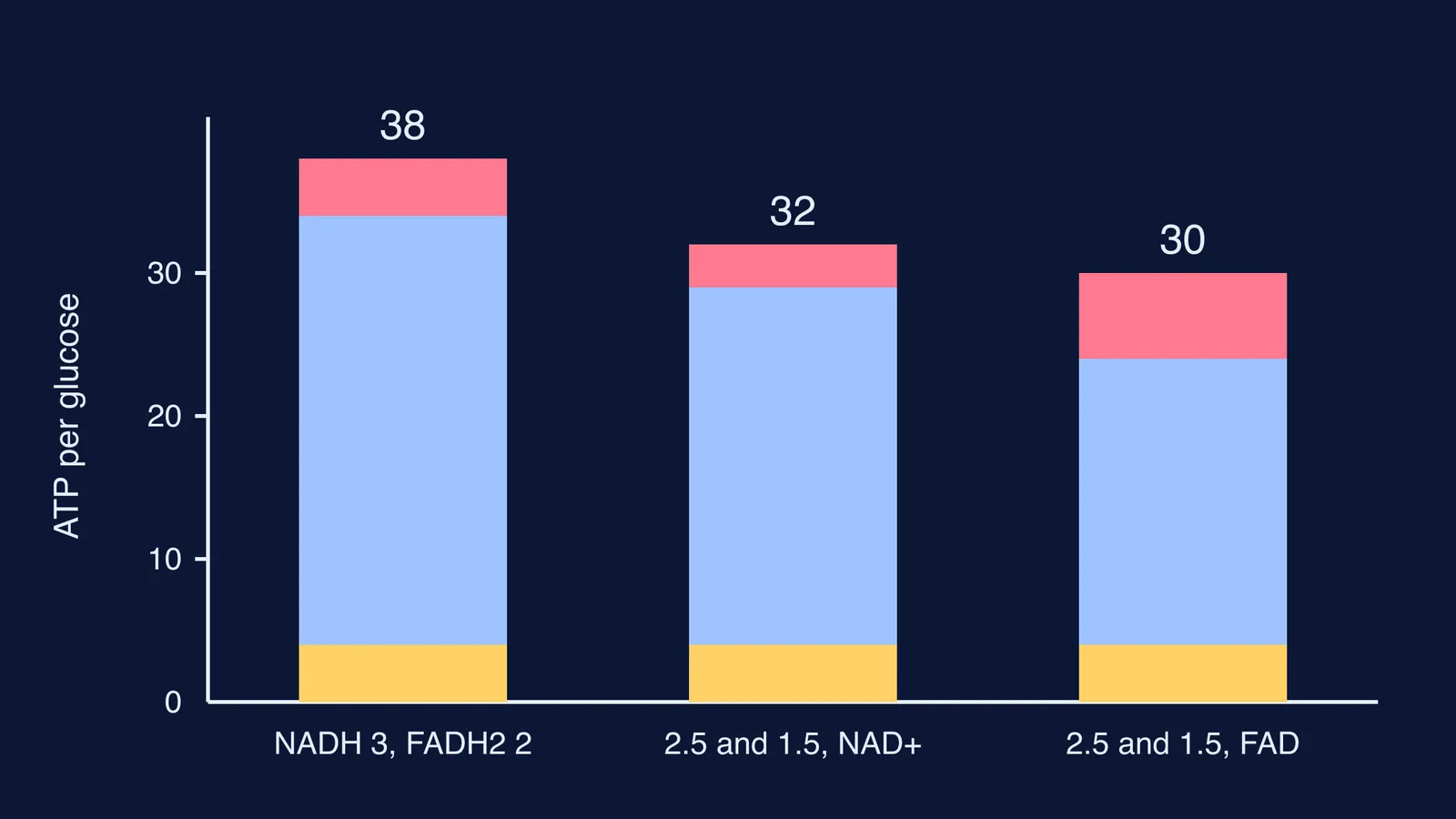
Recount it yourself, using the counts in the NCERT chapter. Per glucose, glycolysis gives 2 net ATP and 2 NADH (why the net is two). The link reaction gives 2 NADH. Two turns of the Krebs cycle give 6 NADH, 2 FADH2 and 2 ATP. That makes 10 NADH, 2 FADH2 and 4 ATP made directly.
NCERT values (3 and 2): 10 × 3 + 2 × 2 + 4 = 38.
Hinkle's values, with glycolytic electrons going to NAD+ (liver-style): 10 × 2.5 + 2 × 1.5 + 4 = 32.
Hinkle's values, with glycolytic electrons going to FAD (brain-style): 8 × 2.5 + 4 × 1.5 + 4 = 30.
Proton leak and withdrawn intermediates lower the yield further, by amounts that vary from cell to cell, so no single "true" number replaces 38.
How should you write this in an exam?
For a 3-mark answer, use this pattern.
Name the assumption: "The calculation assumes only glucose is respired."
Give the real-cell fact: "Fats and proteins also enter the pathway at acetyl CoA, pyruvate or Krebs cycle intermediates."
Say what it does to the count: "So ATP cannot be traced back to one glucose molecule."
End with NCERT's own point: the exercise is still useful to appreciate how efficiently the living system extracts and stores energy. In NCERT-based multiple-choice questions, 38 is the textbook figure; use 30 to 32 only when a question is clearly about measured yields.
If the jump from protons to ATP still feels shaky, the Fermi Concept Library gives every biology concept its own lesson and its place in the map. For counting questions, the Fermi Problem Library has worked problems with a step-by-step solver that explains the reasoning rather than printing an answer.