On this page
Some seeds will not germinate in the dark, even with water and warmth. Some lettuce varieties are the classic example, and the reason is a light-sensing pigment called phytochrome. Once you see that phytochrome is a two-position switch, a whole family of exam questions becomes a matter of reading the last step of a sequence.
What are the Pr and Pfr forms of phytochrome?
Phytochrome is a protein with a light-absorbing pigment attached, and it exists in two forms that can be turned into each other by light. A review in The Arabidopsis Book by Wang and Deng (2004) sets out the basic facts:
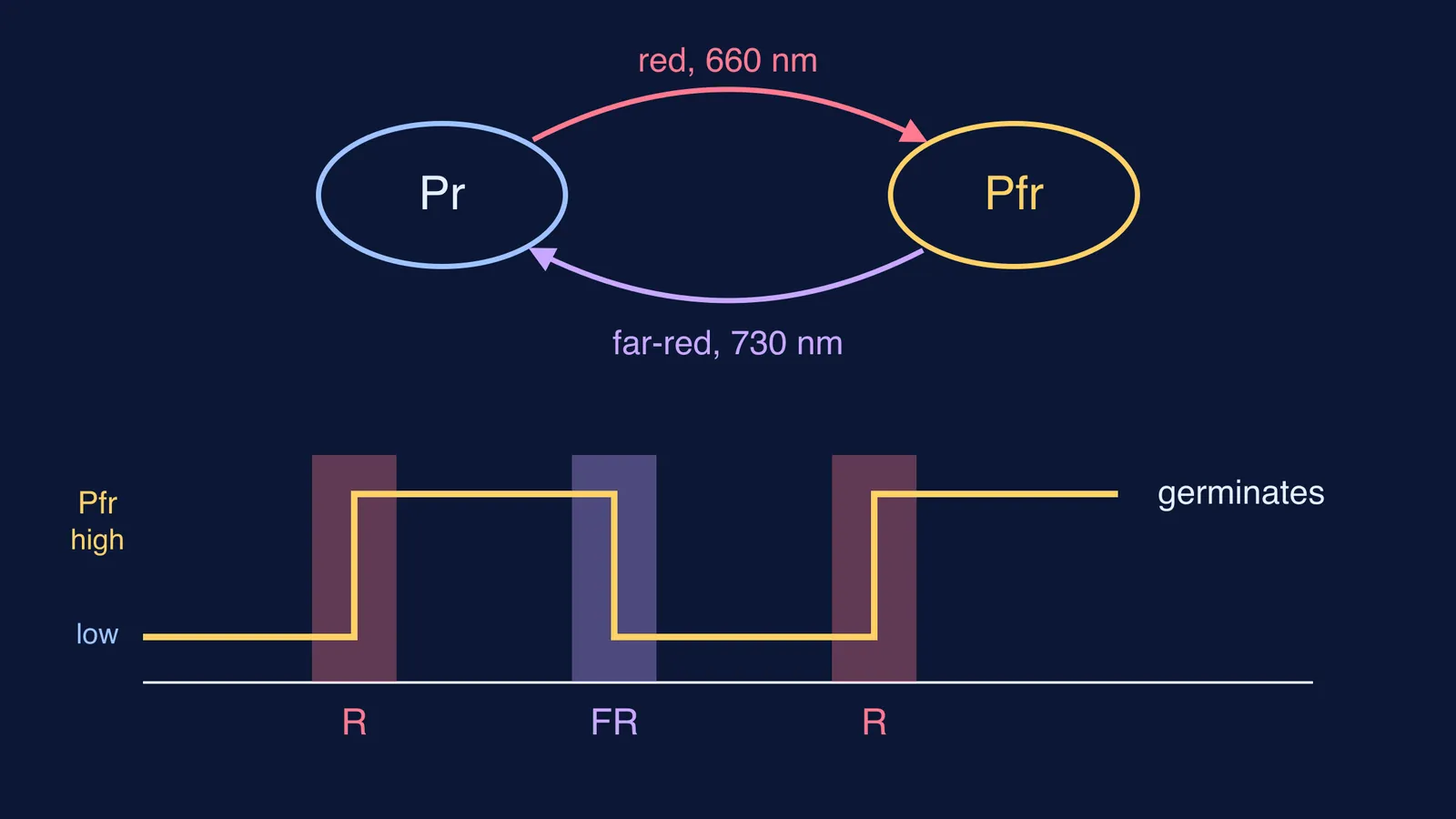
Pr is the red-absorbing form. It absorbs most strongly at 660 nm (Wang and Deng, 2004).
Pfr is the far-red-absorbing form. It absorbs most strongly at 730 nm (Wang and Deng, 2004).
Phytochrome purified from dark-grown plants is in the Pr form, and Pfr is considered the biologically active form.
In the dark, Pfr slowly drifts back to Pr, a process called dark reversion.
The naming trips up many students. Each form is named after the light it absorbs, not the light that made it. Pr absorbs red, and absorbing red turns it into Pfr. Pfr absorbs far-red, and absorbing far-red turns it back into Pr.
What did the lettuce-seed experiment show?
In 1952, Harry Borthwick, Sterling Hendricks and their colleagues at the US Department of Agriculture published A Reversible Photoreaction Controlling Seed Germination in PNAS. They worked with seeds of the lettuce variety Grand Rapids, which need light to germinate.
The USDA Agricultural Research Service history of the work describes the result plainly: seed hit with red light germinated unless it was then hit with far-red, but if red came again, it would germinate. All that mattered was which colour came last, even after 100 alternating cycles of red and far-red.
That reversibility was the clue that a single pigment with two forms was at work. The same USDA account records that in 1959 Hendricks and colleagues, measuring dark-grown turnip seedlings with a spectrophotometer, found the absorption change predicted for the pigment. You can read more about the people behind this in our story on Borthwick, Hendricks and the discovery of phytochrome.
How do you predict whether the seeds germinate?
Use this three-step method on any sequence of flashes given to soaked, light-requiring seeds kept otherwise in the dark.
Start in Pr. Seeds that have been soaked in darkness hold their phytochrome mostly as Pr, so nothing is switched on yet.
Track each flash. Red (R) moves phytochrome to Pfr. Far-red (FR) moves it back to Pr. A far-red flash reverses a red one, and a red flash reverses a far-red one.
Read the last flash. Last flash red means Pfr is present, so the seeds germinate. Last flash far-red means phytochrome is back in Pr, so they stay dormant.
Worked example: six sequences. Try each one before reading the answer.
Dark only: no flash, phytochrome stays Pr. Seeds do not germinate.
R: Pr becomes Pfr. Seeds germinate.
FR: phytochrome is already Pr, so nothing changes. Seeds do not germinate.
R, FR: Pfr is made, then turned back to Pr. Seeds do not germinate.
R, FR, R: last flash is red, so Pfr is present. Seeds germinate.
R, FR, R, FR, R, FR: last flash is far-red. Seeds do not germinate.
Notice that counting the flashes is a trap. Three red flashes and three far-red flashes do not cancel to give a neutral result; only the last colour matters. Examiners also flip the question: "Which flash should be added to make these seeds germinate?" The answer is always a red flash at the end.
Why does this matter beyond one experiment?
The same switch helps plants read light in other settings. Phytochrome is one of the pigments that let plants respond to day length, which is the idea behind short-day and long-day plants in photoperiodism. Light-requiring seeds are also one face of a wider topic, seed dormancy and what breaks it.
The Wang and Deng review notes that the model plant Arabidopsis has five phytochromes, named phyA to phyE. For school and NEET-level biology, the single-switch model above is the level you need.
If the switch still feels abstract, the Fermi Concept Library has a lesson for every concept in biology, each with its place in the map. When you want to test the flash rule on fresh questions, the Fermi Problem Library has worked problems with a step-by-step solver that explains the reasoning rather than printing an answer.
A good next step: write the six sequences above on a card, cover the answers, and check yourself tomorrow.