On this page
This is a common ray optics question in Class 12 physics and JEE Main practice: an object hangs above a tank of water, a plane mirror lies flat on the bottom, and you look straight down. Where is the image? It is three easy problems in order: refraction into the water, reflection at the mirror, refraction back out. Treat each surface separately and use the image from one step as the object for the next.
What happens to the light, step by step?
Three rules do all the work.
Refraction: Snell's law says n1 sin θ1 = n2 sin θ2, with angles measured from the normal (OpenStax University Physics, Vol. 3, section 1.3).
Reflection: the angle of reflection equals the angle of incidence (OpenStax, section 1.2), so a plane mirror forms an image as far behind it as the object is in front.
Water: OpenStax gives water's refractive index as 1.33, and HyperPhysics uses 4/3, the value most textbook problems use.
Looking nearly straight down, the angles are small, so sin θ is close to tan θ. Combine that with Snell's law and you get two results:
An object in air at height h, seen from inside water, appears at height n × h. It looks farther away.
An object in water at depth x, seen from air, appears at depth x / n. This is the familiar apparent depth.
How do you find the image position in the water tank?
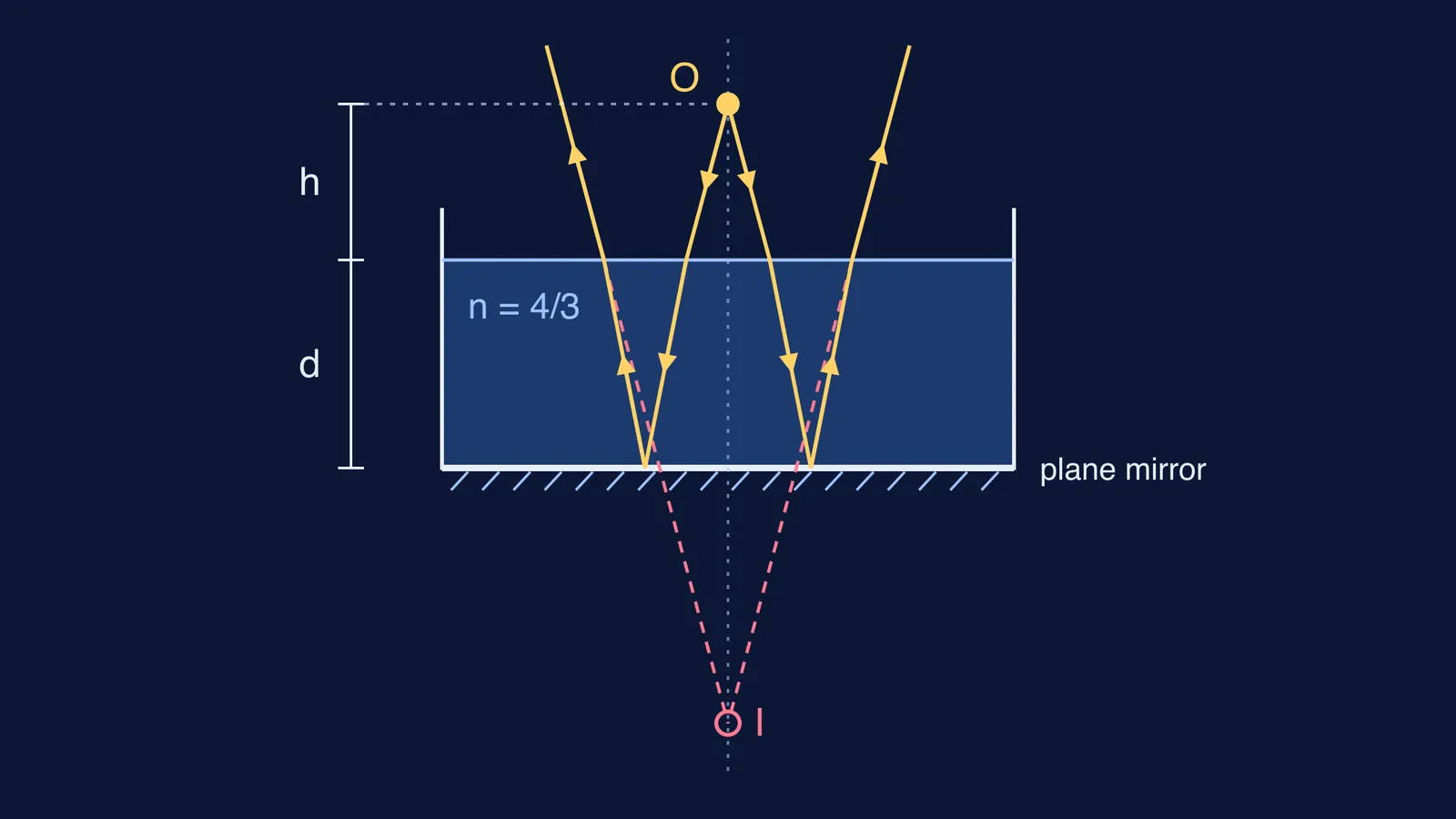
An object O is 30 cm above the surface of water (n = 4/3) that is 40 cm deep. A plane mirror lies on the bottom. Find the image seen by an observer looking down from above.
Refraction at the surface (air to water). To the water, O appears at n × h = (4/3) × 30 = 40 cm above the surface. Call this I1.
Reflection at the mirror. I1 is 40 + 40 = 80 cm above the mirror, so the mirror forms I2 80 cm below it: 80 + 40 = 120 cm below the water surface.
Refraction at the surface (water to air). I2 sits 120 cm deep in water. From air it appears at 120 / (4/3) = 90 cm below the surface. This is the final image I.
So the image is 90 cm below the surface. In general the image depth is (n h + 2d) / n = h + 2d/n. Check: 30 + 2 × 40 × 3/4 = 90 cm. If the question asks for the distance from the observer, add the observer's height above the water.
Is there a faster way to solve it?
Yes. For near-normal viewing, a layer of water d thick behaves like a layer of air d/n thick. Seen from above, the mirror appears to be 40 / (4/3) = 30 cm below the surface.
Now it is a plain mirror problem in air. The object is 30 + 30 = 60 cm in front of the apparent mirror, so the image is 60 cm behind it: 90 cm below the surface.
The same idea handles a glass slab placed in front of a plane mirror. For more practice, see apparent depth and normal shift problems, and for the reverse view, how high a bird appears to a fish under water.
How do you draw the ray diagram?
The diagram at the top was traced with Snell's law at 15 degrees. To sketch it in an exam:
Draw the tank, the water surface and the mirror as a thick line with hatching underneath.
Put O on a vertical dashed line and draw two rays leaving it at a small angle, one either side.
At the surface, bend each ray towards the normal; at the mirror, reflect it at an equal angle.
At the surface again, bend each ray away from the normal. It leaves at the angle it entered with.
Extend the outgoing rays backwards as dashed lines. Where they meet on the vertical line is I.
Rays at larger angles meet slightly less than 90 cm deep (about 89 cm at 15 degrees), because the small-angle result only holds near the normal. That is why problems say "viewed from above".
What mistakes cost marks here?
Dividing by n in step 1 instead of multiplying.
Measuring the mirror image from the water surface instead of from the mirror.
Forgetting step 3 and answering 120 cm.
Using the shortcut but measuring from the real mirror, not the apparent one.
If you keep landing on the wrong number, the Fermi Problem Library has worked problems with a step-by-step solver that explains the reasoning rather than printing an answer, so you can see which step went wrong. To revise apparent depth and plane mirrors, each has its own lesson in the Fermi Concept Library.
Try it yourself: change the depth to 60 cm. You should get 120 cm below the surface.