On this page
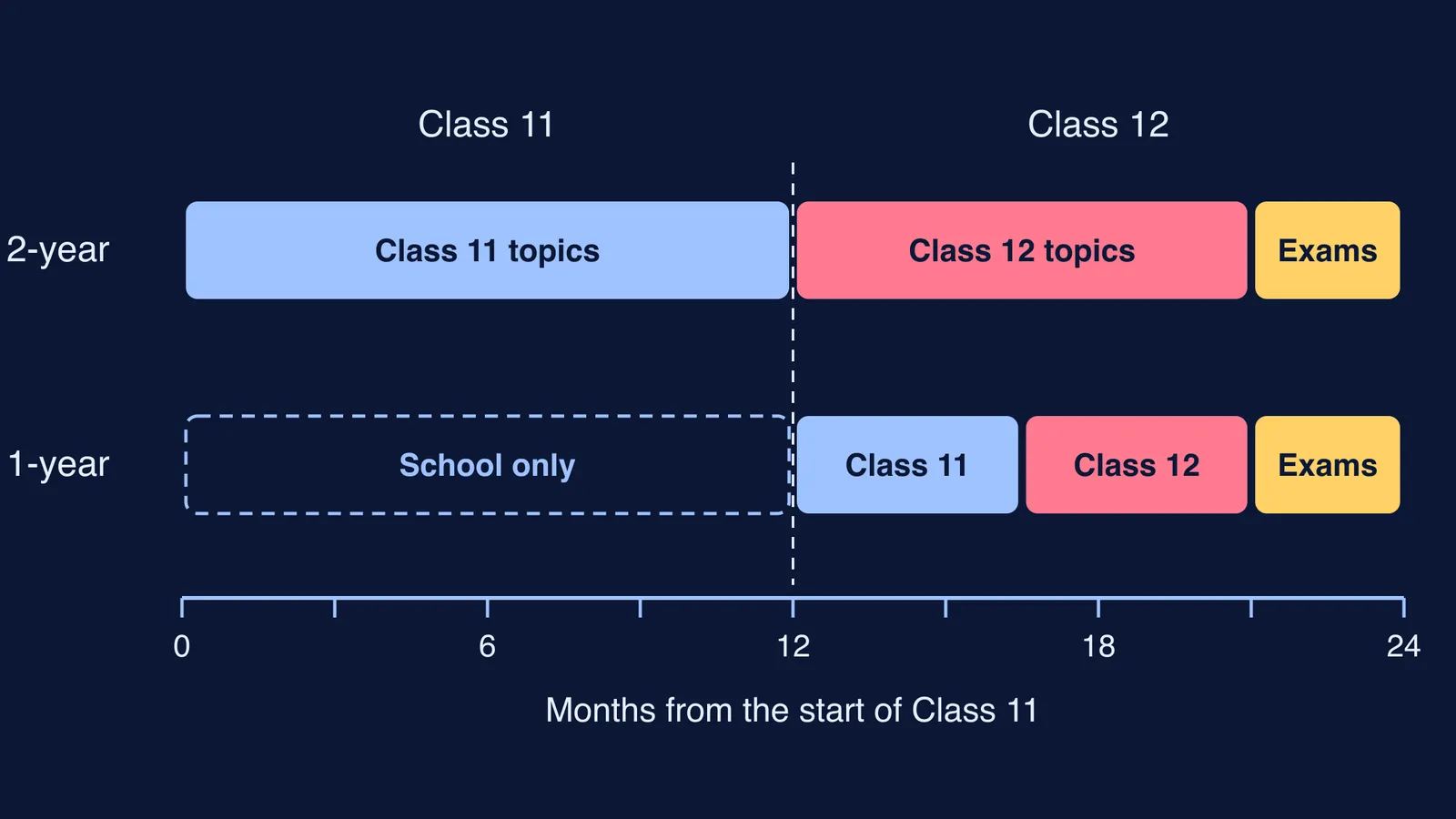
Most JEE and NEET coaching comes in two shapes. A two-year programme starts after Class 10 and runs alongside Classes 11 and 12. A one-year programme packs the same work into about twelve months, during Class 12 or after it as a drop year. The syllabus is the same; the pace, the total cost and the clash with school are not.
What is the difference between one-year and two-year JEE coaching?
Both cover two school years of content. The NEET (UG) 2026 syllabus finalised by the National Medical Commission opens its physics section with kinematics, laws of motion and rotational motion, which schools teach in Class 11, and JEE also draws on both years. A two-year programme teaches Class 11 topics in Class 11. A one-year programme teaches or re-teaches them alongside Class 12 topics.
How the two compare:
Pace. Two-year: about one school year of topics per year, with time to revise. One-year: two years of topics in twelve months, so tests come fast and gaps show early.
Start. Two-year: after Class 10; the Ministry of Education's 2024 coaching guidelines say centres should not enrol a student below 16 years of age or before the secondary school examination. One-year: in Class 12, or after it.
Cost. Two-year: two years of fees, and two years of hostel and mess if your child moves cities. One-year: one year of fees, plus another if a repeat attempt follows.
Board overlap. Two-year: coaching and school run side by side for both years. One-year in Class 12: board preparation and Class 11 revision compete for the same months. After Class 12: no board exam that year, but the marks are already fixed.
How much does each option cost?
Fees vary too much between institutes and cities for a fair average, so get the full figure in writing. For context, the government's Comprehensive Modular Survey: Education, 2025 found that 37.0% of higher secondary students were taking or had taken private coaching in the current academic year. Average spending on private coaching per higher secondary student was ₹9,950 in urban areas and ₹4,548 in rural areas. Those averages include students who took no coaching, so treat them as a floor, not a quote for a full JEE or NEET classroom programme.
The 2024 guidelines are a model for states to adopt in law, so whether they bind a centre depends on your state. They say a centre should publish course duration, fees and its refund policy, and should not raise the fee during the course. A student who paid in full and leaves midway should get a pro-rata refund within 10 days, including hostel and mess fees.
Do board marks still matter if my child is in coaching?
Yes. Under the JoSAA 2026 business rules, IIT admission needs at least 75% aggregate in Class 12 (65% for SC, ST and PwD candidates) or a place in the category-wise top 20 percentile of the candidate's board. NITs, IIITs and other government-funded institutes have separate Class 12 criteria.
The Ministry of Education guidelines also say coaching for school students should not run during school hours, partly to avoid dummy schools, and should not exceed 5 hours a day. Before weighing that route, read our guide to dummy schools for JEE and NEET aspirants.
Which one suits my child?
Talk these through together:
How solid are Class 10 maths and science? Shaky basics favour two years.
How does your child react to a bad weekly test? If one low score knocks them off for days, a faster programme will feel harder; our piece on when a child cannot keep up with the coaching pace lists signs to watch.
Is the board year already crowded with practicals, projects and pre-boards?
What is the total cost to the end, including hostel, travel and test series?
If the first attempt does not go to plan, what next? Our guide to supporting a drop year helps you talk about it calmly now.
A worked example. A student leaving Class 10 with marks in the 70s in maths and science, who gets anxious after tests, may suit the two-year track: the basics need time, and the weekly pressure is lower. A Class 12 student already strong in Class 11 physics and maths could take a one-year programme, as long as the family plans board revision into the same calendar.
One way to open the conversation: “Both options lead to the same exam. Which pace leaves you time to sleep, go to school and still do one thing you enjoy each week?”
Whichever track your child picks, Class 11 gaps tend to surface as wrong methods on Class 12 problems. The Fermi Problem Library has worked problems with a step-by-step solver that explains the reasoning rather than printing an answer, and the Fermi Concept Library gives each concept its own lesson, which helps when an old topic needs a quick revisit.
If worry about results starts to affect sleep, food or mood for weeks, talk to a school counsellor or a doctor, or call Tele MANAS on 14416.