On this page
One phone, two or three children, and classes that all seem to start at once. It can work if the family plans the phone's day the way a school plans a timetable.
How common is sharing one phone for online classes?
Common, especially in rural India. The ASER 2021 survey by Pratham reached 75,234 children aged 5 to 16 in rural India in September and October 2021. It found that 67.6% of enrolled children had a smartphone at home, but 26.1% of those children had no access to it.
The gap is still there for teenagers. ASER 2023 Beyond Basics surveyed 34,745 young people aged 14 to 18 in 28 rural districts. Close to 90% had a smartphone in the household and knew how to use it, yet among those who could use one, only 43.7% of boys and 19.8% of girls had their own. So most of these teenagers rely on a shared phone, and girls are even less likely to have one of their own. Without written rules, the phone can end up with whoever asks loudest.
What does a one-phone timetable look like?
Start with a simple priority order. Every request for the phone falls into one of four types:
Live: a class or test that happens at a fixed time and cannot be replayed.
Deadline: homework to upload or a form to submit today.
Recorded: a lesson, PDF or video that can be watched any time once downloaded.
Free use: calls, games, messages.
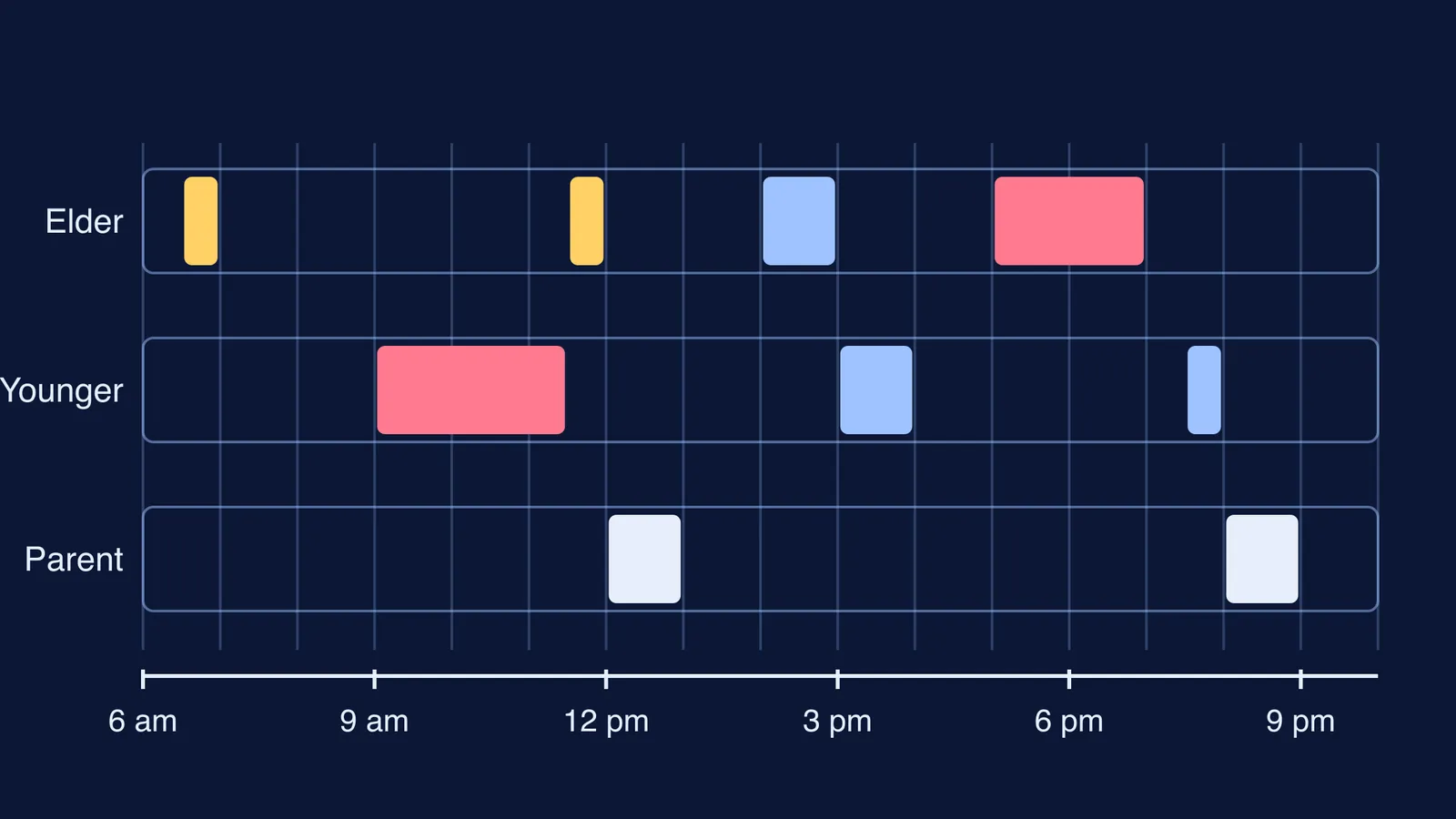
Live beats deadline, deadline beats recorded, and everything beats free use. Here is a worked example for a family with an elder child in Class 11 (coaching live class 5 to 7 pm), a younger child in Class 6 (school online class 9 to 11:30 am), and a parent who needs the phone for work calls.
6:30 to 7:00 am: elder child downloads the day's recorded lessons and PDFs for both children
9:00 to 11:30 am: younger child's live school class
11:30 am to 12:00 pm: elder child downloads any new class recordings and uploads homework photos
12:00 to 1:00 pm: parent's work calls
2:00 to 3:00 pm: elder child watches a downloaded lecture
3:00 to 4:00 pm: younger child does downloaded practice
5:00 to 7:00 pm: elder child's live coaching class
7:30 to 8:00 pm: younger child uploads homework
8:00 to 9:00 pm: parent and family time
9:00 pm: the phone charges overnight in a common room
No two slots overlap, and recorded work fills the gaps between live classes.
How do you download classes to watch offline?
Use the government's DIKSHA app: the PM eVidya page on DIKSHA says it lets you store and share content offline, without an internet connection, and that you can scan the QR codes in NCERT textbooks to find related material.
Check whether your school or coaching app has a download button for class recordings, and use it in the morning download window.
Save PDFs and notes into one folder per child, named by subject, so nobody deletes the other's files.
For more on stretching a small data pack, read our guide on studying online with slow internet or a small data pack.
What if two live classes clash?
It will happen. Decide the rule before the first clash, not during it.
The child with a test or a class that has no recording gets the phone.
If both are equal, the younger child takes the live class and the elder child asks a teacher for the recording.
Whoever gives up a slot gets the next free one, written on the chart.
If the elder child missed part of a lesson and the recording never came, the Fermi Concept Library has a lesson for each concept in physics, chemistry, biology, mathematics and computing, so they can catch up on the idea in a later slot.
What rules should parents set for a shared phone?
The chart decides, not the loudest voice.
Live classes are off-limits for calls; put the phone on silent and tell relatives the class times.
Charge during free-use time, never just before a live class.
Each child logs out of their own accounts after their slot.
Girls and boys get equal slots.
A script you can use at the family meeting: "We have one phone and two of you who need it. Tonight we write down every class time for the week. Live classes come first, then homework, then videos. Whoever gives up a slot gets the next one."
If siblings also share a room for study, our post on how to study when you share a room with siblings has ideas for noise and space. For limits on how long the phone is on overall, see how much screen time is okay for a teenager.
If phone fights at home turn into constant stress or worry for a child, talk to the school counsellor, or call Tele MANAS on 14416.
Tonight, write down the week's class times and fill in the chart together.